Overview
TeamSpy Crew is a long-running cyber-espionage threat group associated with a covert surveillance campaign known as TeamSpy, which has been active for nearly a decade. First uncovered by researchers at Hungary’s CrySyS Lab following a notification from the Hungarian National Security Authority, the operation demonstrated an unusually persistent and targeted approach to espionage.
Evidence suggests the campaign had been operating quietly for up to 10 years before public exposure, targeting a limited set of carefully selected victims rather than conducting broad, indiscriminate attacks.
Who is TeamSpy Crew
The group has been observed targeting heavy industry, government intelligence agencies, and political activists, leveraging a blend of legitimate remote administration software and commodity malware techniques.
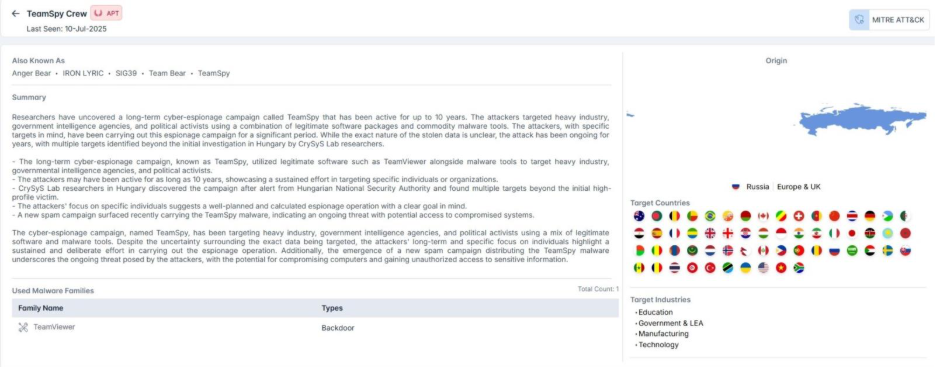
Unlike many espionage operations that rely heavily on bespoke malware, TeamSpy Crew abused trusted tools, most notably TeamViewer, to establish covert access, blending malicious activity into otherwise legitimate network traffic. The group was last observed operating on 10 July 2025, indicating that its infrastructure or tactics may still pose an active risk.
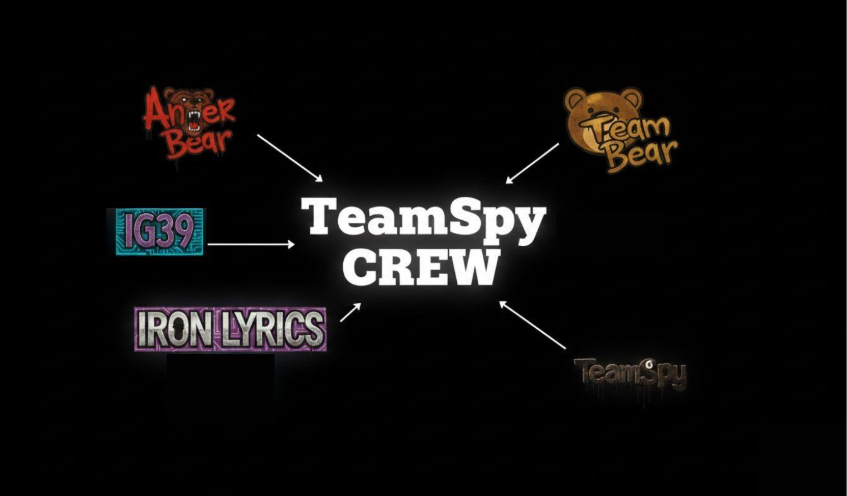
Also tracked under multiple aliases, including Anger Bear, IRON LYRICS, IG39, Team Bear, and TeamSpy, the group’s varied naming reflects fragmented visibility across investigations rather than distinct operational units.
Campaign Characteristics and Discovery
The TeamSpy campaign came to light after CrySyS Lab investigated suspicious activity affecting a high-profile Hungarian victim. Subsequent analysis revealed that the compromise was not an isolated incident. Instead, researchers identified multiple victims across different sectors and countries, indicating a sustained and coordinated espionage effort.
According to CrySyS Lab, the attackers demonstrated a preference for specific individuals, rather than entire organizations. This targeting pattern strongly suggests intelligence collection objectives, potentially aligned with geopolitical or strategic interests. While researchers were unable to conclusively determine the exact nature of the stolen data, the long dwell time and persistence mechanisms point toward long-term surveillance and information harvesting rather than short-term disruption.
More recently, security researchers observed a new spam campaign distributing TeamSpy-related malware, reinforcing the assessment that TeamSpy Crew remains active or that its tooling continues to circulate among related actors. This development raises concerns about lingering access to previously compromised systems and the possible reactivation of dormant infections.
Origin and Geographic Scope
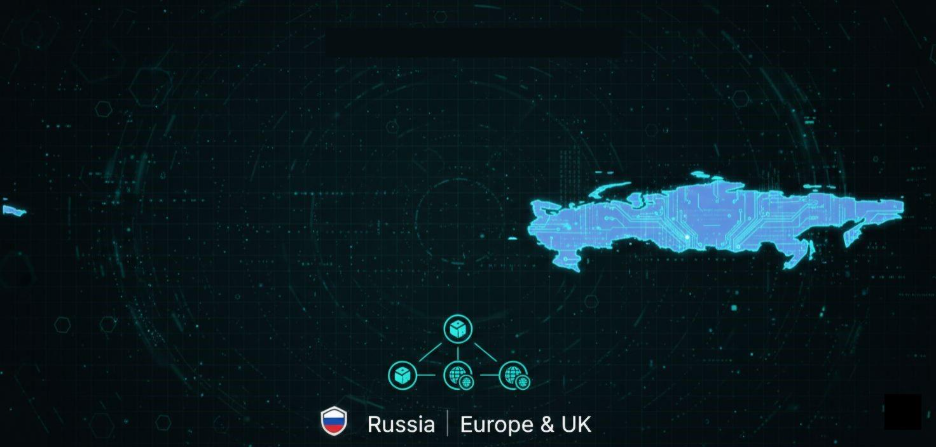
TeamSpy Crew is assessed to have links to Russia, with operational activity spanning Europe and the United Kingdom. However, the group’s targeting footprint is global in scope.
Observed activity linked to TeamSpy Crew spans a wide range of countries, including Australia, Bangladesh, Belgium, Brazil, Canada, China, France, Germany, Hungary, India, Iran, Italy, Japan, the Netherlands, Norway, Romania, Russia, Saudi Arabia, Sweden, Turkey, Ukraine, the United Kingdom, the United States, Vietnam, and South Africa, among others.
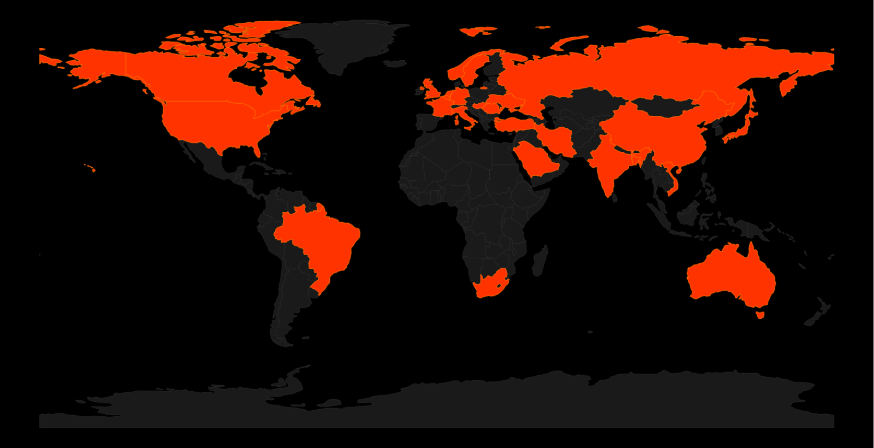
The diversity and geographic spread of affected regions indicate a combination of strategic intelligence collection against high-value targets and opportunistic expansion beyond an initial core set of priority victims.
Targeted Industries
TeamSpy Crew’s operations have affected several high-value sectors, including:
- Government and Law Enforcement Agencies
- Manufacturing and Heavy Industry
- Technology
- Education
The repeated targeting of government entities and industrial organizations aligns with classic espionage objectives, including intelligence collection, political monitoring, and insight into industrial or technological capabilities.
Malware and Tooling
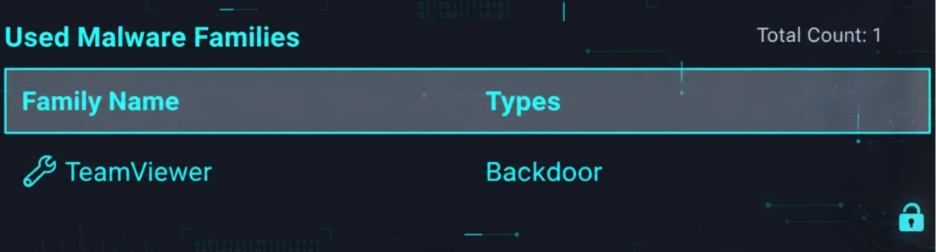
Unlike many advanced persistent threat groups that rely on custom malware families, TeamSpy Crew primarily abused legitimate remote access software, specifically TeamViewer, as its primary backdoor mechanism.
By installing and configuring TeamViewer on victim systems, the attackers were able to:
- Maintain persistent, interactive access
- Blend command-and-control traffic into legitimate application-layer communications
- Evade traditional malware detection mechanisms that focus on known malicious binaries
This “living-off-the-land” approach reduced the operational footprint of the campaign and complicated forensic analysis, particularly in environments where TeamViewer was already in legitimate use.
How TeamSpy Crew Operates
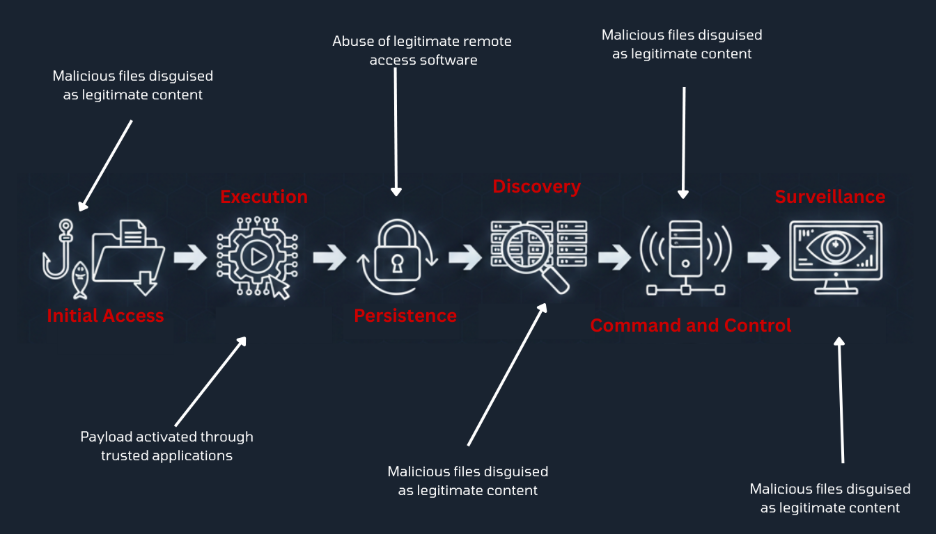
TeamSpy Crew relies on a carefully planned set of methods designed to stay hidden, maintain long-term access, and quietly monitor targeted systems. Rather than using loud or destructive attacks, the group focuses on blending into normal activity and avoiding detection for as long as possible.
One of the group’s core tactics involves disguising malicious files so they appear harmless. By hiding or altering these files, the attackers reduce the chance that security tools or analysts will recognize them as suspicious. In some cases, these files must be manually opened or reconstructed, making them even harder to detect during routine scans.
The group has also been observed manipulating how legitimate programs start and run. By inserting their own malicious components into trusted software, the attackers are able to execute their activities under the cover of applications that are already approved and commonly used within organizations.
Once access is established, TeamSpy Crew gathers detailed information about infected systems, including system configurations and hardware details. This allows the attackers to better understand the environment and adjust their actions to remain unnoticed while continuing surveillance.
For communication with compromised systems, the group hides its activity within normal internet traffic. By using common online communication methods, their commands and data transfers blend in with everyday web activity, making them difficult to distinguish from legitimate use.
A defining feature of the campaign is the abuse of legitimate remote access software. By relying on trusted tools commonly used for technical support, the attackers gain full control over target systems while appearing to conduct routine administrative activity. This approach allows them to maintain persistent access without deploying obviously malicious software.
Conclusion
TeamSpy Crew is a long-running cyber-espionage threat known for its patient, targeted operations and reliance on trusted software to maintain persistent access while avoiding detection. By abusing legitimate remote access tools rather than deploying overt malware, the group has sustained covert surveillance across government, industrial, and political targets for years, making identification and remediation particularly challenging.
To counter stealthy and persistent threats like TeamSpy Crew, organizations need continuous visibility into attacker behavior and emerging campaigns. Cyble delivers AI-powered threat intelligence that enables proactive detection, real-time insights, and faster response, helping security teams stay ahead of long-term espionage operations.
Book a personalized demo today or explore how Cyble’s threat intelligence solutions strengthen your security posture.
Recommendation and Mitigation Strategies
- Restrict Remote Access Tools: Limit the use of legitimate remote administration software such as TeamViewer and enforce strict approval, logging, and access controls.
- Strengthen Email Security: Deploy advanced spam filtering and user awareness training to reduce the risk of malicious email campaigns delivering TeamSpy-related payloads.
- Monitor Legitimate Tool Abuse: Continuously monitor for unusual or unauthorized use of trusted software that could indicate covert access or misuse.
- Enhance Endpoint Visibility: Use endpoint security solutions capable of detecting abnormal behavior, even when activity appears to originate from legitimate applications.
- Apply Least-Privilege Access: Restrict user and system permissions to reduce the impact of long-term unauthorized access.
- Conduct Regular Access Reviews: Periodically audit systems for unauthorized remote access configurations, dormant connections, and legacy credentials.
- Leverage Threat Intelligence: Integrate real-time threat intelligence from platforms like Cyble to stay informed about active campaigns, evolving tactics, and related infrastructure.
MITRE ATT&CK Techniques Associated with TeamSpy Crew
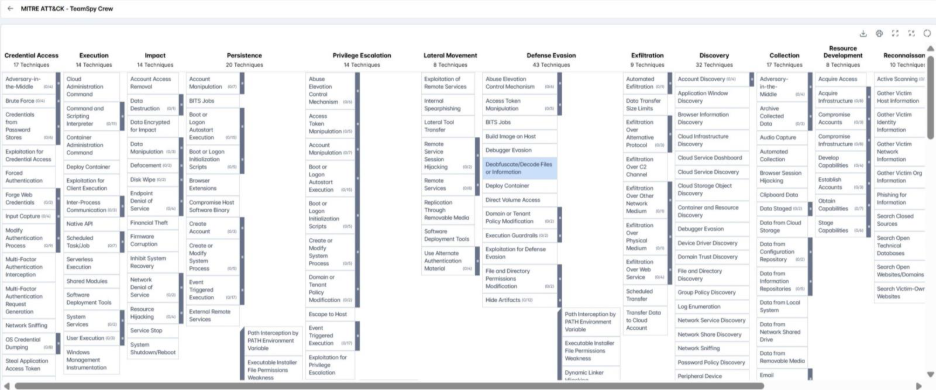
- Obfuscated Files or Information (T1027): Malicious files are encrypted, encoded, compressed, or split into multiple components to make them difficult to detect or analyze and to evade security controls.
- Binary Padding (T1027.001): Junk data is added to malicious files to alter their file size and checksum, allowing them to bypass hash-based detection and static antivirus signatures.
- Deobfuscate/Decode Files or Information (T1140): Hidden payloads are reconstructed or decoded at later stages using system utilities or built-in malware functionality, sometimes requiring user interaction.
- Hijack Execution Flow (T1574): Legitimate program execution is manipulated so that malicious code runs automatically, enabling persistence and evasion of application control mechanisms.
- System Information Discovery (T1082): Detailed system and hardware information is collected to understand the environment and guide follow-on actions.
- Application Layer Protocol (T1071): Common communication protocols are used to exchange commands and data, allowing malicious traffic to blend in with normal network activity.
- Web Protocols (T1071.001): Web-based communication channels, such as HTTP or HTTPS, are abused to conceal command-and-control traffic within routine internet usage.