
Overview
WageMole is a North Korean state-sponsored advanced persistent threat (APT) group that blends social engineering with technical tradecraft to obtain remote employment within Western organizations. Unlike traditional financially motivated cybercriminal operations, WageMole embeds operatives inside companies by posing as legitimate job candidates. Once hired, these individuals operate under fabricated identities to conduct espionage, access sensitive systems, and potentially facilitate follow-on cyber operations.
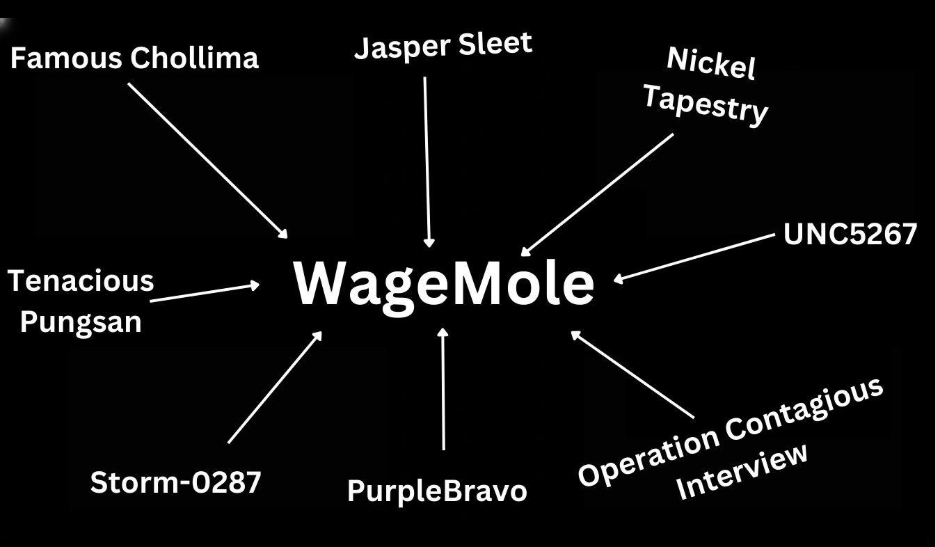
A defining element of WageMole’s activity is its connection to the campaign known as “Operation Contagious Interview.” Through this campaign, the group harvested and reused stolen personal data to construct convincing digital personas. These false identities include forged passports, driver’s licenses, and supporting documentation that allow operatives to pass background checks and identity verification processes. Generative artificial intelligence is reportedly used to create structured interview study guides, helping applicants deliver technically sound and consistent responses during remote hiring interviews.
WageMole primarily targets small to mid-sized businesses, particularly those with limited identity verification controls. Job marketplaces such as Upwork and Indeed have been leveraged to identify and apply for remote technical roles. Automation scripts are used to create and manage multiple job-seeker accounts, increasing application volume and improving placement rates. Once hired, operatives typically request payment through PayPal and similar digital platforms to obscure financial trails and mask their true affiliation.
Target Regions and Industries
WageMole’s operations have affected organizations in the United Arab Emirates, Belgium, Bulgaria, Costa Rica, India, Italy, the Netherlands, Pakistan, Romania, and Vietnam, reflecting an opportunistic targeting pattern centered on countries with active remote hiring markets rather than a tightly defined geographic focus.
The group has primarily targeted the Banking, Financial Services, and Insurance (BFSI) sector as well as Information Technology and IT-Enabled Services (IT & ITES), industries that provide access to financial infrastructure, sensitive customer information, proprietary codebases, and enterprise system administration environments, all of which present high strategic value for intelligence collection and operational leverage.
Malware and Associated Families
Two malware families have been associated with activity linked to WageMole operations:
FriendlyFerret
FriendlyFerret has been described as a threat actor targeting government entities, military organizations, and financial institutions. Believed to originate from China, its motivations have been characterized as espionage and data theft. The group uses spear-phishing emails with malicious attachments to gain initial access. After compromising a network, it conducts lateral movement, escalates privileges, and exfiltrates sensitive information. FriendlyFerret has demonstrated persistence and operational maturity, raising concerns for organizations handling classified or high-value data.
FrostyFerret
FrostyFerret has targeted the aerospace and energy sectors in the United States and South Korea. Its motivations appear financially driven, with a focus on intellectual property theft. Like FriendlyFerret, it relies on spear-phishing emails carrying malicious attachments. After gaining access, it leverages additional tools and techniques to steal data and potentially disrupt critical systems.
While attribution overlaps remain under analysis, both malware families have been referenced in relation to campaigns intersecting with WageMole-linked infrastructure or techniques.
Operational Tradecraft
WageMole blends identity deception with well-established intrusion methods to gain and maintain access to target environments. The group infiltrates organizations by tampering with software supply chains, altering development resources, or distributing modified updates, while also relying heavily on targeted social engineering through social media, personal email accounts, and other third-party communication platforms to build trust before delivering harmful links or attachments.
Once access is achieved, it uses scripting tools and automated programs to run commands, move within systems, and execute additional components, often relying on victims to open disguised files that appear legitimate. To avoid detection, the group hides malicious content through encryption, compression, and other concealment methods, and obscures commands to make activity appear routine.
It extracts stored login details from web browsers, reuses stolen credentials to broaden access, and gathers detailed information about operating systems, hardware, cloud environments, files, and directories to understand the compromised network. Sensitive data is then collected, packaged to reduce visibility, and transmitted out through normal-looking web traffic, allowing communications with remote infrastructure to blend in with legitimate internet activity and reduce the likelihood of discovery.
Conclusion
WageMole remains a persistent state-sponsored threat aligned with North Korean interests, blending remote workforce infiltration with established intrusion methods to secure long-term access to targeted organizations. Active as of March 2026, the group continues to exploit remote hiring ecosystems, stolen identity data, and automation to operate under the guise of legitimate employment, particularly within the BFSI and IT & ITES sectors.
As remote work environments expand, organizations must reinforce identity verification, monitor anomalous user behavior, and enforce strict access controls to reduce exposure to employment-based infiltration schemes. Leveraging threat intelligence platforms such as Cyble can help security teams gain visibility into adversary tactics, detect suspicious activity earlier, and strengthen overall response capabilities.
To proactively defend against threats like WageMole, schedule a Cyble demo to see how real-time threat intelligence, adversary infrastructure monitoring, and actionable insights can help your team detect suspicious activity earlier and respond with greater confidence.
Recommendation and Mitigation Strategies
- Strengthen Identity Verification: Implement rigorous identity and background checks for remote hires, including document authentication and multi-factor verification for job platform accounts.
- Monitor Anomalous Behavior: Continuously track unusual login patterns, access times, or system interactions from new hires or remote accounts.
- Restrict Access Privileges: Apply the principle of least privilege, limiting access to sensitive systems, financial infrastructure, and proprietary code to only what is necessary for each role.
- Secure Communication Channels: Enforce encrypted and monitored email and messaging platforms; be cautious of links or attachments from personal or third-party accounts.
- Control and Audit Software Supply Chains: Validate software updates, dependencies, and development tools to prevent tampering or injection of malicious code.
- Deploy Endpoint and Network Protections: Use anti-malware, intrusion detection, and behavioral monitoring to identify script-based or disguised file execution attempts.
- Leverage Threat Intelligence: Integrate real-time threat intelligence platforms like Cyble to identify emerging adversary tactics, map attacker infrastructure, and proactively hunt for suspicious activity.
MITRE ATT&CK Techniques Associated with WageMole
- Supply Chain Compromise (T1195): Manipulated development tools, source code repositories, software updates, or system images to insert malicious code or distribute counterfeit software, targeting both specific victims and widely used open-source dependencies.
- Spearphishing via Service (T1566.003): Built trust through social media, personal webmail, or third-party platforms using fake recruiter profiles, then delivered malicious links or attachments, often redirecting communications to personal accounts to bypass enterprise email protections.
- Python (T1059.006): Abused Python scripts and built-in libraries for execution, automation, and command operations, distributing scripts directly or as compiled executables.
- JavaScript (T1059.007): Leveraged browser-based JavaScript, JScript on Windows, and JavaScript for Automation on macOS to execute malicious code, host drive-by scripts, or run secondary payloads while obfuscating content.
- Malicious File (T1204.002): Used user interaction to execute malicious documents or executables, employing masquerading, password-protected archives, and familiar naming conventions to increase success.
- Obfuscated Files or Information (T1027): Encrypted, compressed, split, or encoded files and commands to evade detection, sometimes requiring user action to deobfuscate or execute, while hiding functionality across multiple benign-looking components.
- Credentials from Web Browsers (T1555.003): Extracted stored browser credentials from Chrome, Firefox, Edge, Safari, and Internet Explorer, then reused them across accounts and systems to expand access and maintain persistence.
- System Information Discovery (T1082): Collected detailed OS, patch, hardware, and cloud instance information using built-in commands, system tools, and cloud APIs to guide follow-on actions.
- File and Directory Discovery (T1083): Enumerated files and directories locally or on network shares using standard shell commands, custom tools, and network device interfaces to locate sensitive data.
- Data from Local System (T1005): Gathered files, configuration data, and local databases for exfiltration, leveraging command interpreters and automated collection scripts.
- Archive Collected Data (T1560): Compressed and encrypted sensitive data before exfiltration to reduce size and obfuscate content.
- Exfiltration Over C2 Channel (T1041): Transmitted stolen data through existing command-and-control channels, embedding it within normal traffic to avoid detection.
- Web Protocols (T1071.001): Used standard web application protocols for command-and-control communications, blending traffic with legitimate HTTP/HTTPS activity to reduce network monitoring detection.