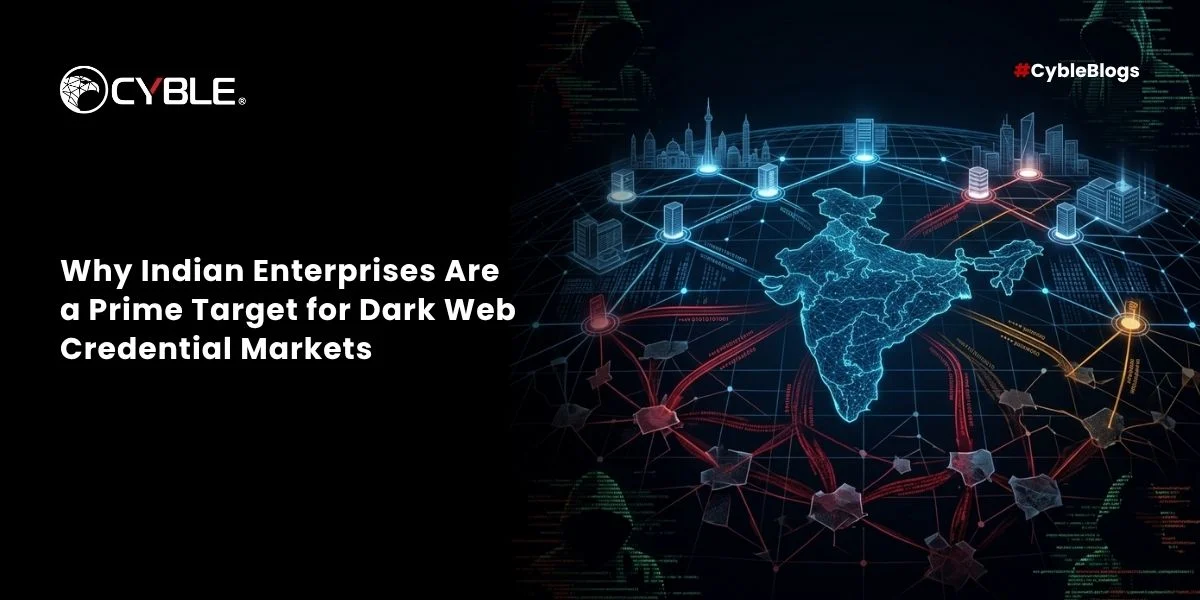
The underground economy of stolen credentials has matured into a structured, high-volume marketplace, and Indian enterprises are at the center. What makes this trend notable is not just the scale of cyber incidents in India, but the type of data being exposed and how efficiently it is monetized on dark web credential markets India forums. This has evolved into a corporate data leak India dark web ecosystem.
Credentials, usernames, passwords, session tokens, have become the currency that powers everything from ransomware intrusions to financial fraud. This is not an abstract risk. It is a measurable, expanding problem backed by government data and visible shifts in attacker behavior.
A Rapidly Expanding Attack Surface
India’s digital growth has been aggressive, but security maturity has not scaled at the same pace. According to the Indian Computer Emergency Response Team (CERT-In), the country recorded 29.44 lakh (2.94 million) cybersecurity incidents in 2025. Just four years earlier, that number stood at 14.02 lakh in 2021, effectively doubling within a short span.
This surge is not just about more attacks; it reflects a widening attack surface and growing enterprise cybersecurity threats India. Every new digital service, cloud migration, or remote access point introduces another potential entry for attackers. More importantly, each successful intrusion increases the likelihood of credential exposure, feeding directly into dark web markets.
Earlier data reinforces this pattern. CERT-In reported handling 13,91,457 incidents in 2022, spanning phishing, malware infections, and unauthorized access attempts. These are not isolated technical events; they are the primary pipelines through which credentials are harvested at scale.
Why Credentials Are the Primary Target
Unlike credit card data, which can be canceled, or systems that can be patched, credentials offer persistent value. A valid login can grant access to corporate networks, financial systems, or sensitive communications without triggering immediate alarms.

Attackers understand this. Phishing campaigns and malware infections, both widely reported by CERT-In as dominant attack vectors, are designed not just to infiltrate systems but to extract authentication data. Once obtained, these credentials, often part of Indian company login credentials stolen sets, are packaged and sold on underground forums, often categorized by industry, privilege level, or geographic origin.
India’s enterprise landscape makes it particularly attractive in this context. Organizations across banking, IT services, manufacturing, and government sectors manage vast amounts of sensitive and operationally critical data. This makes their credentials more valuable and more likely to be traded.
High-Value Targets Across Critical Sectors
Government-backed reporting highlights the concentration of attacks in sectors that naturally generate high-value credentials. CERT-In’s scope of incident response spans banking, energy, telecom, transport, and IT sectors, all of which rely heavily on identity-driven access controls.
In 2023 alone, around 2,04,844 cybersecurity incidents were reported within government organizations. Credentials associated with such entities carry strategic value, not just financial. They can be used for espionage, disruption, or long-term access to sensitive systems.
Similarly, sectors like BFSI and IT services face constant exposure due to their role in handling financial transactions and managing global client data. A single compromised account in these environments can provide entry into broader supply chains or interconnected systems.
The Dark Web as a Distribution Channel
What sets the current landscape apart is how efficiently stolen credentials are distributed. Dark web marketplaces have evolved beyond simple data dumps. They now function like structured platforms where access is categorized, reviewed, and resold.
Credential sets originating from India are often bundled with additional context, such as organization names, roles, or VPN access details, making them more actionable for buyers. In many cases, these credentials are not used immediately. Instead, they are stored, resold, or combined with other datasets to increase their value.
The presence of compromised access listings and credential sales across underground forums reflects a broader shift: attackers no longer need to breach systems themselves. They can simply purchase access, reducing both effort and risk.
Weak Points: Human and Systemic
A portion of credential exposure still traces back to preventable weaknesses. Phishing remains one of the most effective techniques because it exploits human behavior rather than technical flaws. Employees unknowingly provide login details, often bypassing sophisticated security controls.
On the system side, unpatched vulnerabilities and misconfigured services continue to play a role. Government data consistently highlights the exploitation of vulnerable services and outdated systems as a recurring issue. These weaknesses allow attackers to extract credentials directly from compromised environments or escalate privileges once inside.
The combination of human error and systemic gaps creates a steady supply of fresh credentials, exactly what dark web markets depend on.
A Self-Sustaining Ecosystem
The relationship between cyber incidents in India and dark web credential markets is not coincidental, it is cyclical. More attacks lead to more compromised credentials. More credentials increase the availability of access for other attackers. This, in turn, fuels further attacks.
The growth from 14.02 lakh incidents in 2021 to 29.44 lakh in 2025 is not just a statistic; it signals the acceleration of this cycle. As long as credentials remain easy to obtain and difficult to monitor once exposed, Indian enterprises will continue to be a prime target.
Rethinking the Problem
The challenge is no longer limited to preventing breaches; it now includes understanding what happens after data leaves the network and enters underground ecosystems, where exploitation timelines can be extremely short. Indian enterprises are not uniquely vulnerable, but they are highly valuable due to their scale, sector diversity, and rapid digital adoption, making them consistent targets in an environment where access itself is the commodity.
Breaking this cycle requires visibility into how stolen credentials are traded, reused, and weaponized, and this is where platforms like Cyble become critical, delivering AI-native threat intelligence, dark web monitoring, and attack surface visibility to help organizations move from reactive defense to proactive risk anticipation.
With capabilities like Cyble Vision and Cyble Blaze AI, security teams can detect exposure earlier, correlate threats in real time, and respond autonomously before stolen data is exploited. To stay ahead of evolving credential-driven attacks, organizations should evaluate Cyble’s unified threat intelligence platform and request a demo to see how continuous visibility across the dark web and enterprise attack surface can materially reduce risk.