Dark web marketplaces continue to power a portion of the underground cybercrime economy. This enables cybercriminals to do trade of stolen credentials, malware, ransomware services, financial data, and illicit goods. Operating on anonymity-focused networks such as Tor, these dark web markets have evolved into an ecosystems that connect cybercriminals, initial access brokers (IABs), and threat actors worldwide.
The scale of the threat continues to surge. According to Cyble Research and Intelligence Labs (CRIL), 6,046 global data breach and leak incidents were recorded in 2025, while researchers identified thousands of enterprise credentials circulating across dark web marketplaces and cybercrime forums. Many of these credentials were harvested through infostealer malware and later sold to threat actors for fraud, ransomware attacks, and unauthorized network access.
In this article, we learn about the top dark web marketplaces of 2026, how they operate, what gets sold on them, and why security teams actively monitor these underground platforms for early indicators of cyber threats.

Key Takeaways
- Dark web marketplaces remain central hubs for cybercrime, facilitating the sale of stolen credentials, malware, ransomware services, financial data, and illicit goods.
- Cyble Research and Intelligence Labs (CRIL) tracked 6,046 global data breach and leak incidents in 2025, highlighting the scale of underground criminal activity.
- Thousands of enterprise credentials continue to circulate across dark web marketplaces and cybercrime forums, often harvested through infostealer malware.
- Modern dark web markets increasingly rely on cryptocurrencies, escrow systems, invite-only access models, and encrypted communication channels to evade disruption.
- Despite frequent law enforcement takedowns, new marketplaces consistently emerge, making continuous monitoring critical for cybersecurity teams.
What Are Dark Web Marketplaces?
Dark web marketplaces are anonymous online platforms that facilitate the buying and selling of illicit goods, stolen data, cybercrime services, and other prohibited products through privacy-focused networks such as Tor.
The internet is generally divided into three layers:
Surface Web- The surface web consists of publicly accessible websites indexed by search engines and accessible through standard browsers.

Deep Web- The deep web contains content not indexed by search engines, including email accounts, corporate databases, online banking portals, subscription services, and other password-protected resources.
Dark Web- The dark web represents a small portion of the deep web that exists on specialized anonymity networks such as Tor, I2P, Freenet, and Riffle. These networks are designed to provide privacy, censorship resistance, and anonymous communication.
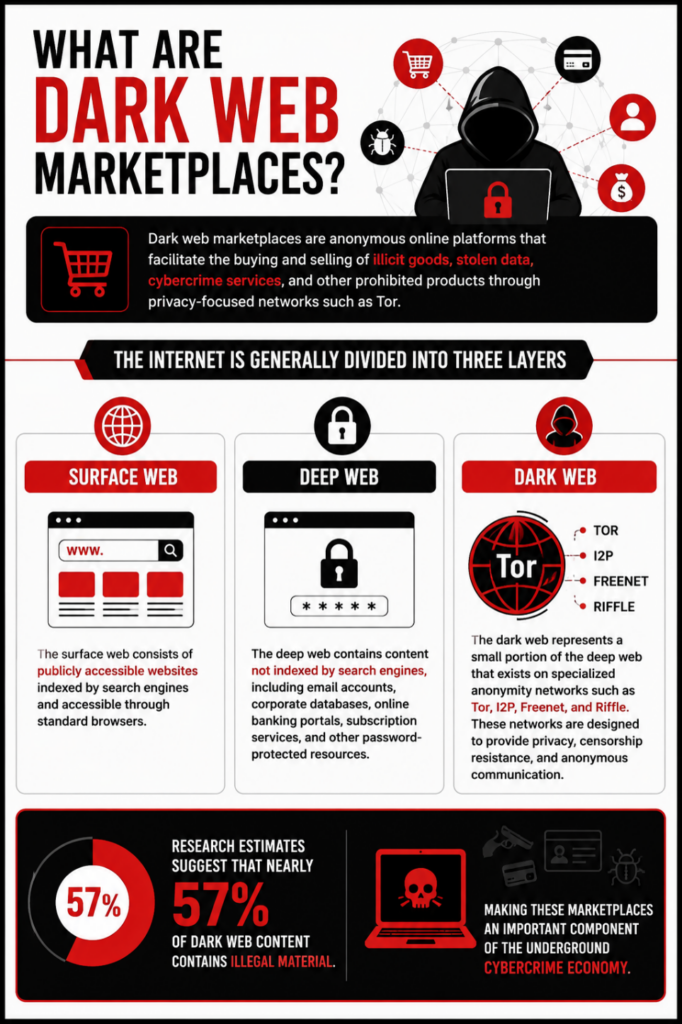
Research estimates suggest that nearly 57% of dark web content contains illegal material, making these marketplaces an important component of the underground cybercrime economy.
How Do Dark Web Marketplaces Work?
Dark web marketplaces operate similarly to mainstream e-commerce platforms but use anonymity technologies, cryptocurrencies, and trust mechanisms to facilitate illegal transactions.
Most marketplaces follow a familiar online shopping model:
- Vendors create product listings.
- Buyers browse available offerings.
- Transactions are conducted using cryptocurrencies.
- Escrow systems hold funds until transactions are completed.
- Review and reputation systems help establish trust.
Tor and Anonymous Access
The primary technology enabling these marketplaces is The Onion Router (Tor).
Originally developed in 2002, Tor routes internet traffic through multiple encrypted relay nodes, making it difficult to identify users or track online activities. Unlike traditional internet browsing, Tor encrypts traffic at every stage of the routing process.
The Tor Browser, introduced in 2008, remains the most widely used tool for accessing dark web services.
Escrow Systems and Trust Mechanisms
Most dark web marketplaces implement escrow services to reduce fraud. Buyers deposit cryptocurrency into marketplace-controlled wallets, and funds are released only after successful transaction completion.
Additional trust mechanisms include:
- Vendor reputation scores
- Verified seller programs
- PGP-encrypted communications
- Buyer feedback systems
- Security deposits for vendors
- Invite-only membership structures
These mechanisms attempt to create trust within an inherently untrustworthy environment.
Cryptocurrency Payments
Cryptocurrencies remain the preferred payment method across dark web marketplaces.
Common payment options include:
- Bitcoin (BTC)
- Monero (XMR)
- Litecoin (LTC)
While Bitcoin remains widely used, privacy-focused cryptocurrencies such as Monero have gained popularity because they provide enhanced transaction anonymity.
Top Dark Web Marketplaces of 2026
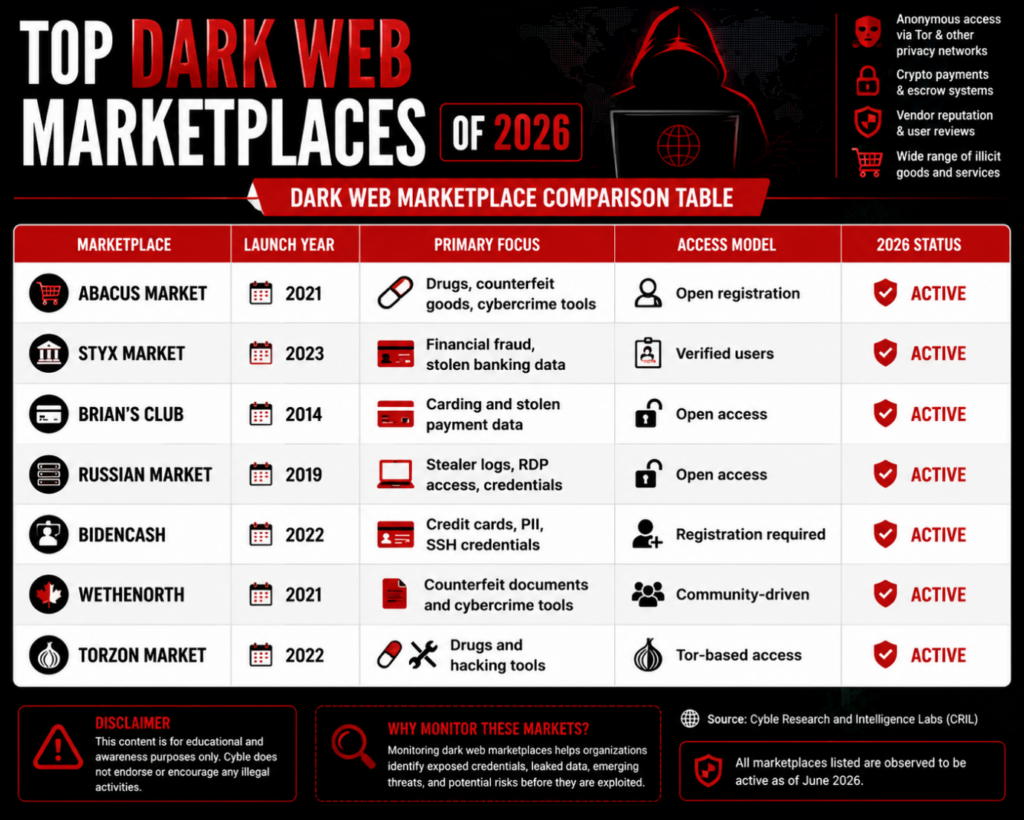
The leading dark web marketplaces in 2026 continue to specialize in stolen credentials, financial fraud, malware distribution, illicit goods, and cybercrime services.
Dark Web Marketplace Comparison Table
| Marketplace | Launch Year | Primary Focus | Access Model | 2026 Status |
| Abacus Market | 2021 | Drugs, counterfeit goods, cybercrime tools | Open registration | Active |
| STYX Market | 2023 | Financial fraud, stolen banking data | Verified users | Active |
| Brian’s Club | 2014 | Carding and stolen payment data | Open access | Active |
| Russian Market | 2019 | Stealer logs, RDP access, credentials | Open access | Active |
| BidenCash | 2022 | Credit cards, PII, SSH credentials | Registration required | Active |
| WeTheNorth | 2021 | Counterfeit documents and cybercrime tools | Community-driven | Active |
| Torzon Market | 2022 | Drugs and hacking tools | Tor-based access | Active |
1. Abacus Market
Abacus Market has emerged as one of the largest dark web marketplaces operating in 2026.
The platform reportedly hosts more than 40,000 listings and has become a major destination for illicit goods ranging from narcotics and counterfeit products to cybercrime tools.
Why Security Teams Monitor It
Security researchers monitor Abacus due to its increasing overlap between traditional illicit goods and cybercrime-related offerings.
2026 Status: Active
2. STYX Market
Launched in 2023, STYX Market focuses heavily on financial fraud operations.
The marketplace offers:
- Stolen credit card information
- Compromised bank accounts
- Cryptocurrency laundering services
- Financial fraud resources
The platform incorporates strict user verification procedures and uses official Telegram channels for communications.
Why Security Teams Monitor It
The concentration of financial crime services makes STYX particularly relevant for fraud prevention teams and financial institutions.
2026 Status: Active
3. Brian’s Club
Brian’s Club remains one of the most recognizable carding marketplaces operating within the cybercriminal ecosystem.
Established in 2014, the platform specializes in:
- Credit card dumps
- CVV records
- Wholesale card databases
- Financial fraud data
New batches of stolen payment card information are regularly added to the marketplace.
Why Security Teams Monitor It
Financial institutions closely monitor Brian’s Club because compromised payment card data frequently appears on the platform.
2026 Status: Active
4. Russian Market
Despite its name, Russian Market serves an international audience and operates primarily in English.
The marketplace specializes in:
- Stealer logs
- RDP access
- Stolen credentials
- Personally identifiable information (PII)
- Cybercrime tools
The platform has become particularly significant due to its role in distributing data harvested by infostealer malware families such as RedLine, Vidar, and Raccoon Stealer.
Why Security Teams Monitor It
Organizations frequently discover exposed employee credentials and corporate access information being traded through Russian Market.
2026 Status: Active
5. BidenCash
Launched in 2022, BidenCash quickly gained notoriety within cybercriminal communities due to its aggressive marketing tactics and focus on stolen financial data.
The marketplace specializes in:
- Stolen credit card data
- Personally identifiable information (PII)
- SSH credentials
- Financial fraud resources
Unlike many competitors, BidenCash has repeatedly released large datasets for free to attract new users and increase platform visibility. These promotional data dumps have included millions of compromised records, making the marketplace a recurring concern for cybersecurity professionals.
Why Security Teams Monitor It
Security teams monitor BidenCash because leaked customer records and financial information frequently appear on the platform. Organizations can often identify exposed assets before they are weaponized by threat actors.
2026 Status: Active
6. WeTheNorth
WeTheNorth is a Canadian-based marketplace established in 2021 that serves both domestic and international users.
The marketplace offers:
- Counterfeit documents
- Financial fraud tools
- Malware services
- Hacking resources
- Cybercrime-related products
One of its distinguishing features is an active community forum that allows users to discuss products, exchange information, and establish trust within the marketplace ecosystem.
Why Security Teams Monitor It
The combination of cybercrime services and active community engagement makes WeTheNorth a useful source of threat intelligence regarding emerging criminal tactics and tools.
2026 Status: Active
7. Torzon Market
Launched in September 2022, Torzon Market has become one of the more established dark web marketplaces operating on the Tor network.
The platform reportedly hosts over 11,000 listings spanning multiple illicit categories, including drugs, cybercrime tools, and digital services.
Torzon differentiates itself through:
- Vendor reputation imports
- PGP-verified reviews
- Premium membership options
- Bitcoin and Monero support
The platform places significant emphasis on transparency between buyers and sellers through imported vendor histories and cryptographic verification.
Why Security Teams Monitor It
Cybersecurity researchers monitor Torzon due to the presence of hacking tools, malware-related offerings, and cybercrime services frequently advertised on the platform.
2026 Status: Active
Why Security Teams Monitor Dark Web Marketplaces
Dark web marketplaces often serve as the earliest indicators of data exposure, credential theft, ransomware operations, and emerging cyber threats. Monitoring these underground ecosystems enables organizations to:
- Identify exposed credentials
- Detect ransomware activity earlier
- Track threat actor behavior
- Monitor leaked corporate assets
- Strengthen incident response efforts
Organizations that proactively monitor dark web activity gain valuable threat intelligence before attacks escalate into larger security incidents.
How We Compiled This List
This analysis combines Cyble threat intelligence research, dark web monitoring, open-source intelligence, and publicly reported law enforcement actions.
Our evaluation criteria included:
- Marketplace activity levels
- Operational longevity
- Cybercrime relevance
- Community engagement
- Product diversity
- Access requirements
- Resilience against takedowns
- Security researcher observations
Marketplace status assessments were reviewed using threat intelligence monitoring, cybercrime community observations, and publicly available reporting.
What Gets Sold on Dark Web Marketplaces?
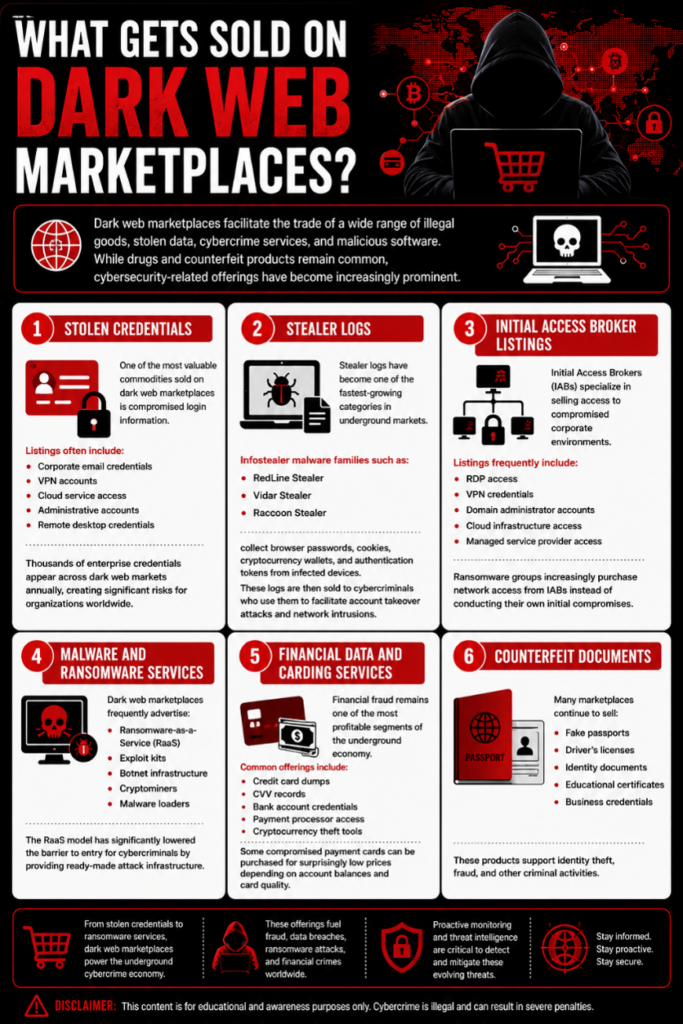
Dark web marketplaces facilitate the trade of a wide range of illegal goods, stolen data, cybercrime services, and malicious software.
While drugs and counterfeit products remain common, cybersecurity-related offerings have become increasingly prominent.
Stolen Credentials
One of the most valuable commodities sold on dark web marketplaces is compromised login information.
Listings often include:
- Corporate email credentials
- VPN accounts
- Cloud service access
- Administrative accounts
- Remote desktop credentials
Thousands of enterprise credentials appear across dark web markets annually, creating significant risks for organizations worldwide.
Stealer Logs
Stealer logs have become one of the fastest-growing categories in underground markets.
Infostealer malware families such as:
- RedLine Stealer
- Vidar Stealer
- Raccoon Stealer
collect browser passwords, cookies, cryptocurrency wallets, and authentication tokens from infected devices.
These logs are then sold to cybercriminals who use them to facilitate account takeover attacks and network intrusions.
Initial Access Broker Listings
Initial Access Brokers (IABs) specialize in selling access to compromised corporate environments.
Listings frequently include:
- RDP access
- VPN credentials
- Domain administrator accounts
- Cloud infrastructure access
- Managed service provider access
Ransomware groups increasingly purchase network access from IABs instead of conducting their own initial compromises.
Malware and Ransomware Services
Dark web marketplaces frequently advertise:
- Ransomware-as-a-Service (RaaS)
- Exploit kits
- Botnet infrastructure
- Cryptominers
- Malware loaders
The RaaS model has significantly lowered the barrier to entry for cybercriminals by providing ready-made attack infrastructure.
Financial Data and Carding Services
Financial fraud remains one of the most profitable segments of the underground economy.
Common offerings include:
- Credit card dumps
- CVV records
- Bank account credentials
- Payment processor access
- Cryptocurrency theft tools
Some compromised payment cards can be purchased for surprisingly low prices depending on account balances and card quality.
Counterfeit Documents
Many marketplaces continue to sell:
- Fake passports
- Driver’s licenses
- Identity documents
- Educational certificates
- Business credentials
These products support identity theft, fraud, and other criminal activities.
What Are the Risks of Using Dark Web Marketplaces?
Dark web marketplaces present significant legal, financial, cybersecurity, and personal risks to users.
Legal Consequences
Many products and services available on these marketplaces are illegal in most jurisdictions.
Purchasing, selling, or facilitating criminal transactions can result in:
- Criminal prosecution
- Financial penalties
- Asset forfeiture
- Imprisonment
Financial Risks
Dark web marketplaces are notorious for fraud.
Common scams include:
- Exit scams
- Fake vendor accounts
- Fraudulent listings
- Payment theft
- Non-delivery schemes
Unlike legitimate e-commerce platforms, users have little legal recourse when transactions fail.
Malware Infection
Users frequently encounter malicious content designed to compromise devices.
Threats include:
- Trojans
- Ransomware
- Keyloggers
- Credential stealers
Downloading files from unknown vendors can quickly lead to compromise.
Identity Theft
Many marketplaces trade stolen personal information.
Users who expose their identities may become targets for:
- Fraud
- Account takeovers
- Social engineering attacks
- Financial theft
Law Enforcement Monitoring
Despite the anonymity provided by Tor, dark web users are not immune to investigation.
Law enforcement agencies increasingly leverage:
- Blockchain analysis
- Undercover operations
- Infrastructure seizures
- Intelligence gathering
to identify criminal actors.
Why Do Dark Web Marketplaces Shut Down So Often?
Dark web marketplaces frequently disappear due to law enforcement actions, exit scams, operational failures, and internal conflicts.
The lifecycle of most marketplaces is relatively short compared to legitimate online businesses.
Law Enforcement Takedowns
International operations regularly target major marketplaces.
Notable examples include:
- Silk Road
- AlphaBay
- Hydra Market
- Hansa Market
These operations often involve cooperation between multiple governments and cybersecurity agencies.
Exit Scams
Exit scams occur when marketplace operators abruptly disappear with user funds.
This remains one of the most common causes of marketplace closures.
Operational Security Failures
Administrators frequently make mistakes that expose:
- Server infrastructure
- Real-world identities
- Cryptocurrency transactions
These errors often lead to arrests and platform seizures.
Internal Disputes
Competition among criminal groups can result in:
- Platform compromises
- Data leaks
- Administrative conflicts
- User migration
The underground economy remains highly unstable.
How Law Enforcement Disrupts Dark Web Marketplaces
Global law enforcement agencies have developed increasingly sophisticated methods to identify, infiltrate, and dismantle dark web marketplaces.
Key disruption techniques include:
Undercover Operations: Investigators frequently pose as vendors or buyers to collect intelligence and identify operators.
Infrastructure Seizures: Backend servers may be exposed through configuration errors or hosting weaknesses.Once identified, authorities can seize infrastructure and collect evidence.
Blockchain Analysis: Cryptocurrency transactions often leave traces that can be analyzed using forensic tools.Bitcoin transactions, in particular, remain vulnerable to tracking.Escrow Wallet Confiscation: When marketplaces are seized, escrow funds are often confiscated, resulting in significant financial losses for operators and users.
Operational Security Mistakes: Many administrators have been identified due to:
- Reused usernames
- IP address leaks
- Personal information exposure
- Activity outside anonymity networks
Shuttered and Defunct Dark Web Marketplaces: Numerous dark web marketplaces have disappeared over the years due to law enforcement actions, hacks, operational failures, or exit scams.
Some notable examples include:
| Marketplace | Closure Reason |
| Mellow | Voluntary exit (2023) |
| Omicron | Hacked (2022) |
| World Market | Exit scam (2022) |
| Kingdom Market | Law enforcement action (2023) |
| Tor2Door Market | Exit scam (2023) |
| Vice City | Exit scam (2023) |
| Aurora Market | Exit scam (2021) |
| ToRReZ Market | Voluntary exit (2021) |
| Genesis Market | Seized by law enforcement |
The closure of one marketplace rarely eliminates criminal activity. Instead, users and vendors typically migrate to alternative platforms.
Economic Impact of Dark Web Marketplaces
Dark web marketplaces represent a substantial underground economy that continues to evolve.
Key observations include:
- Darknet markets and fraud shops generated approximately $1.5 billion in revenue during 2022.
- Illicit cryptocurrency transactions accounted for approximately 0.24% of global cryptocurrency transaction volume.
- Data marketplaces continue to grow as demand for stolen credentials and corporate access increases.
- Ransomware groups increasingly leverage marketplace ecosystems to recruit affiliates and sell stolen data.
The underground economy has become highly specialized, creating interconnected criminal supply chains that support cybercrime operations worldwide.
Trends Shaping Dark Web Marketplaces in 2026
Several trends continue to influence the evolution of dark web marketplaces.
- Growth of Initial Access Brokers: IABs have become critical suppliers for ransomware groups seeking enterprise access.
- Expansion of Infostealer Malware: Stealer malware continues to generate massive volumes of credentials, cookies, and session tokens that are sold through underground marketplaces.
- Increased Demand for Enterprise Access: Threat actors increasingly prioritize corporate credentials due to their value in ransomware operations.
- Cryptocurrency Evolution: Privacy-focused cryptocurrencies such as Monero continue to gain adoption across criminal marketplaces.
- Cross-Platform Criminal Ecosystems: Telegram, encrypted messaging applications, and forums increasingly complement traditional marketplace infrastructure.
Conclusion
Dark web marketplaces remain a constant part of the cybercrime ecosystem, continuously adapting to law enforcement actions, technological changes, and shifting criminal demands. While platforms may disappear through takedowns, exit scams, or operational failures, the broader underground economy continues to evolve through new marketplaces, services, and criminal networks.
Understanding how these marketplaces operate, and the role they play in facilitating cybercrime, provides valuable insight into the threats organizations face today.
Disclaimer: Cyble does not endorse, promote, or facilitate access to dark web marketplaces. The information provided in this article is for educational, research, and cybersecurity awareness purposes only. Users should comply with all applicable laws and avoid engaging in illegal activities
Frequently Asked Questions (FAQs) about dark web marketplaces
How do cryptocurrencies sustain anonymity in illicit trade?
They use pseudonymous wallets, privacy coins (like Monero), mixers, chain-hopping, and non-KYC platforms to obscure transaction trails.
What’s the difference between classic marketplaces and data stores?
Classic darknet markets sell diverse illegal goods; data stores focus on leaked or stolen data like credentials, databases, and ID records.
Is any black market website legit?
No, black market websites operate illegally and pose high risks of scams, fraud, and law enforcement action. They should be avoided entirely.
What are some dark web websites in 2026?
In 2026, dark web websites frequently change domains and are often short-lived. Accessing them may require .onion links and the Tor browser, but caution is advised due to legality and cybersecurity risks.
What is the most popular browser for accessing the dark web?
The Tor Browser remains the most widely used browser for accessing dark web services.
Are dark web marketplaces illegal?
Many activities conducted on dark web marketplaces involve illegal goods or services. While accessing the dark web itself is not necessarily illegal, participating in criminal transactions is against the law.
What are stealer logs?
Stealer logs are datasets collected by infostealer malware containing credentials, cookies, browser data, cryptocurrency wallets, and other sensitive information.
What is an Initial Access Broker (IAB)?
An Initial Access Broker is a threat actor who specializes in selling access to compromised corporate networks.
Why do ransomware groups use dark web marketplaces?
Marketplaces allow ransomware operators to recruit affiliates, purchase access, acquire malware tools, and publish stolen data.
Are cryptocurrencies completely anonymous?
No. While cryptocurrencies offer varying levels of privacy, many transactions can still be analyzed using blockchain forensic techniques.
What is an exit scam?
An exit scam occurs when marketplace operators abruptly disappear with user funds and shut down the platform.
Can law enforcement track dark web users?
Yes. Through undercover operations, blockchain analysis, infrastructure seizures, and operational security investigations, law enforcement agencies can identify criminal actors.
Why do organizations monitor dark web marketplaces?
Organizations monitor these platforms to identify exposed credentials, leaked data, ransomware threats, and emerging cybercriminal activity.
What is the biggest cybersecurity risk associated with dark web marketplaces?
The sale of stolen credentials and enterprise access remains one of the most significant threats because it can lead directly to data breaches, ransomware attacks, and financial fraud.
Source: