
The dark web has sort of turned into this big center for cybercrime, like, a sort of marketplace where you can get ransomware, stolen logins, credit card data, and a bunch of other unlawful services. Research from King’s College London said that more than 60% of surveyed darknet sites hosted content tied to illegal activity, and there’s also this estimate of around 23 million stolen credit cards being listed for sale across dark web marketplaces. Plus, with 80% of people reusing passwords on more than one account, one compromised credential can spill over and endanger both individuals and organizations, quickly.
But the dark web isn’t just a criminal ecosystem, not entirely. It’s built on technologies meant for anonymity, so it can also be used by journalists, researchers, activists, and privacy advocates, who want more secure communciation channels. Still, for orgs it matters a lot to understand how the dark web works, and also how cybercriminals use it to their advantage. That kind of understanding helps teams spot new threats, detect exposed data, and prevent cyber incidents before they get worse.
In this guide, we will loosely break down what the dark web is, how it operates, how it differs from the deep web, who actually uses it, what risks show up, and why dark web monitoring has become a key part of modern cybersecurity.

Key Takeaways
- The dark web is a hidden section of the internet accessible through specialized software such as Tor.
- It is a subset of the deep web, which includes all content not indexed by search engines.
- The dark web supports both legitimate privacy-focused activities and illegal cybercriminal operations.
- Tor uses onion routing to anonymize internet traffic through multiple encrypted relays.
- Cybercriminals use dark web marketplaces to trade stolen credentials, malware, and hacking services.
- Organizations monitor the dark web to identify exposed credentials, leaked data, and emerging threats.
- Accessing the dark web is legal in most countries, but participating in illegal activities is not.
What Is the Dark Web?
The dark web is a hidden part of the internet that isn’t accessible through traditional browsers or search engines. It requires specialized software, such as Tor, to access websites and services designed for anonymity.
While the dark web is often associated with cybercrime, it also has legitimate uses. Journalists, activists, researchers, and privacy-conscious individuals rely on it for secure communication and access to information in restricted environments. Despite representing only a small portion of the internet, the dark web remains an important part of the cybersecurity landscape due to its role in data leaks, cybercrime, and threat intelligence.
History of the Dark Web
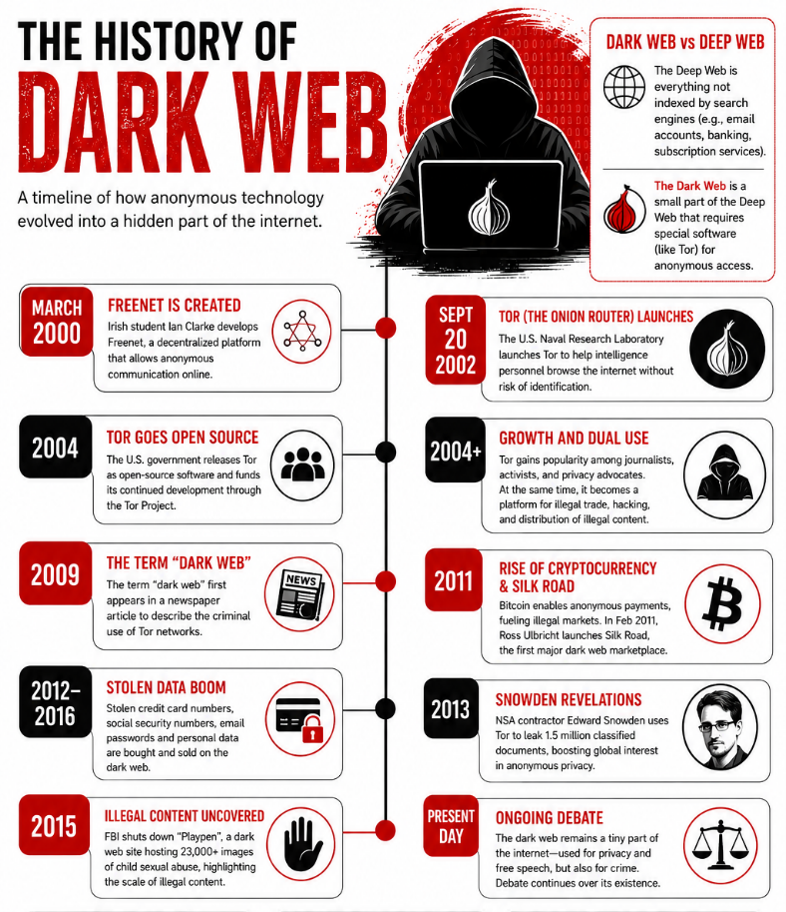
The history of the Dark Web dates back to March 2000, when Irish computer scientist Ian Clarke developed Freenet, a decentralized platform designed to enable anonymous online communication and information sharing. However, the Dark Web gained widespread recognition with the launch of The Onion Router (Tor) on September 20, 2002.
Originally developed by the U.S. Naval Research Laboratory to protect the identities of intelligence personnel online, Tor was later released as open-source software in 2004 and maintained by the Tor Project. By routing internet traffic through multiple encrypted layers and volunteer-operated servers, Tor allowed users to browse anonymously and access websites ending in the .onion domain.
While the technology attracted journalists, privacy advocates, activists, and individuals living under restrictive governments, it also became a platform for illegal activities, including the trade of drugs, weapons, stolen data, and illicit content.
The emergence of cryptocurrencies such as Bitcoin further accelerated Dark Web marketplaces, most notably Silk Road, launched by Ross Ulbricht in 2011. Events such as Edward Snowden’s 2013 revelations about government surveillance also increased public interest in anonymous browsing.
Deep Web vs. Dark Web vs. Surface Web
Many people use the terms deep web and dark web interchangeably, but they refer to different parts of the internet. The surface web is the publicly accessible portion of the internet that search engines can index, including websites such as news portals, blogs, social media platforms, and online stores.
Beneath it lies the deep web, which consists of content that is not indexed by search engines, such as email accounts, online banking systems, medical records, cloud storage, and subscription-based services. In fact, the deep web is estimated to account for more than 90% of all online content.
The dark web is an even smaller segment within the deep web that is intentionally hidden and accessible only through anonymity networks like Tor and I2P.
While it supports legitimate uses such as secure communication and whistleblowing, it is also known for hosting underground forums, darknet marketplaces, and other anonymous services.
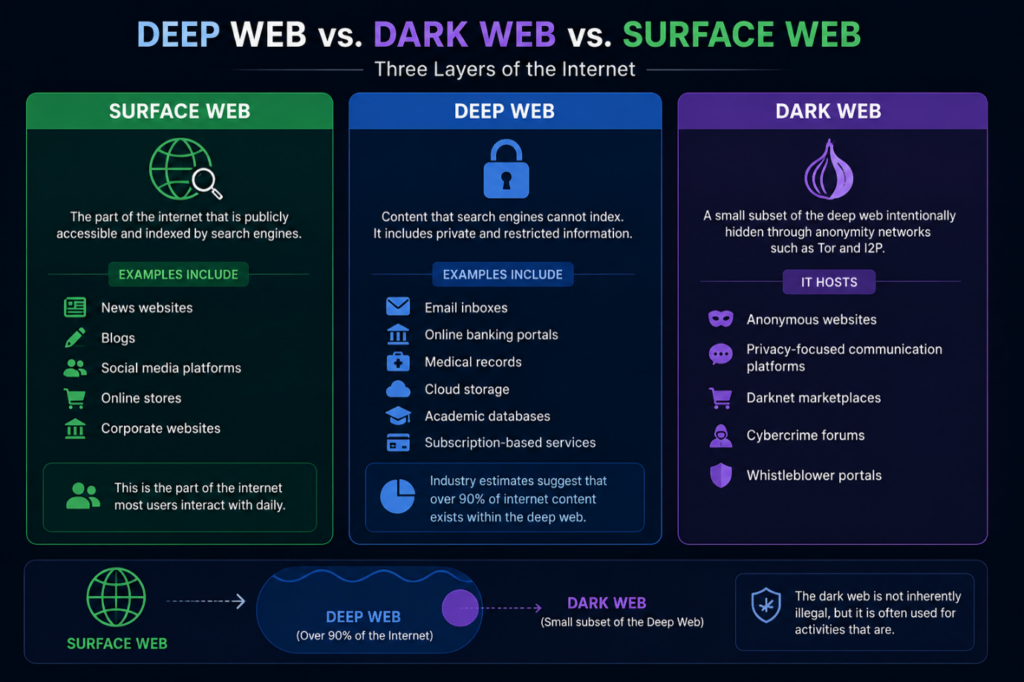
Surface Web vs Deep Web vs Dark Web
| Feature | Surface Web | Deep Web | Dark Web |
| Indexed by Search Engines | Yes | No | No |
| Accessible Through Chrome/Firefox | Yes | Usually | No |
| Requires Special Software | No | No | Yes |
| Publicly Accessible | Yes | No | No |
| Primary Purpose | Public Content | Private Content | Anonymous Communication |
| Typical Examples | News Sites | Email, Banking | Tor Hidden Services |
How Does the Dark Web Work?
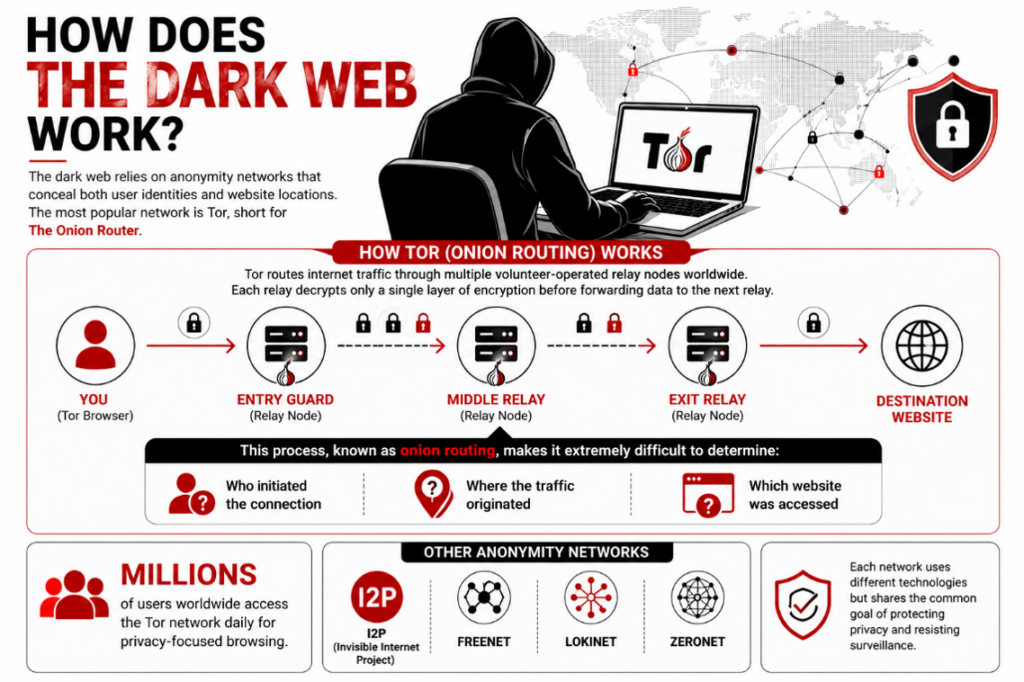
The dark web relies on anonymity networks that conceal both user identities and website locations.
The most popular network is Tor, short for The Onion Router.
Tor routes internet traffic through multiple volunteer-operated relay nodes worldwide. Each relay decrypts only a single layer of encryption before forwarding data to the next relay.
This process, known as onion routing, makes it extremely difficult to determine:
- Who initiated the connection
- Where the traffic originated
- Which website was accessed
As of recent years, millions of users worldwide access the Tor network daily for privacy-focused browsing.
Other anonymity networks include:
- I2P (Invisible Internet Project)
- Freenet
- Lokinet
- ZeroNet
Each network uses different technologies but shares the common goal of protecting privacy and resisting surveillance.
How Does the Dark Web Work?
Is the Dark Web Safe?
The dark web is not inherently dangerous, but it carries significantly higher risks than the surface web. Users may encounter malicious websites, scams, ransomware operators, phishing campaigns, fraudulent marketplaces, and illegal content. Simply visiting the dark web does not automatically compromise a device, but downloading files, clicking unknown links, or engaging with untrusted services can expose users to malware and cyber threats.
Organizations and individuals should use strong security practices, including updated software, multi-factor authentication, endpoint protection, and secure browsing habits when researching dark web environments.
Who Uses the Dark Web?
The dark web itself is neither inherently good nor bad. The same anonymity that helps journalists, activists, and whistleblowers protect their identities can also be exploited by cybercriminals to conceal illegal activities.
| User Group | How They Use the Dark Web |
| Journalists | Protect confidential sources and communicate securely in sensitive investigations. |
| Whistleblowers | Share information about corruption, misconduct, or wrongdoing while preserving anonymity. |
| Human Rights Activists | Avoid surveillance and communicate safely in regions with restrictive governments. |
| Researchers & Security Professionals | Study cybercrime trends, investigate threats, and monitor underground forums. |
| Citizens in Censored Regions | Access information and bypass internet restrictions imposed by governments. |
| Cybercriminals | Buy and sell stolen credentials, personal data, and financial information. |
| Malware Operators | Distribute malware, exploit kits, and malicious tools through underground marketplaces. |
| Ransomware Groups | Sell ransomware-as-a-service (RaaS) offerings and coordinate attacks. |
| Fraudsters | Trade counterfeit documents, stolen credit cards, and compromised accounts. |
| Hackers-for-Hire | Offer cyberattack services, account takeovers, and other illegal activities for payment. |
Examples of Dark Web Websites
Dark web websites, often referred to as hidden services, are accessible through anonymity networks such as Tor and typically use the .onion domain extension. While many people associate these sites with criminal activity, they serve a wide range of purposes.
Examples include:
- Anonymous whistleblower platforms
- Privacy-focused communication services
- Secure journalism portals
- Research communities
- Cryptocurrency discussion forums
- Cybersecurity intelligence forums
Law enforcement agencies continuously monitor and disrupt illegal marketplaces that facilitate cybercrime, fraud, and the sale of stolen data.
Note: Avoid linking to actual .onion websites. Google doesn’t like it and it creates unnecessary compliance concerns.
How Big Is the Dark Web?
Despite its reputation, the dark web represents only a tiny fraction of the internet. While the deep web accounts for the vast majority of online content that is not indexed by search engines, the dark web consists of a relatively small number of hidden services accessible through anonymity networks such as Tor and I2P.
Millions of users access the Tor network each year for privacy-focused communication, research, and secure browsing. However, the number of active dark web websites is significantly smaller than the billions of
How to Check If Your Information Is on the Dark Web
Data breaches frequently result in stolen information being sold or shared on dark web forums and marketplaces.
Signs your information may be exposed include:
- Password reset notifications
- Unauthorized account access
- Suspicious financial transactions
- Login attempts from unknown locations
- Data breach alerts
Organizations should:
- Monitor leaked credentials.
- Conduct regular password audits.
- Implement multi-factor authentication.
- Monitor ransomware leak sites.
- Use dark web monitoring solutions.
This is where dark web monitoring becomes essential. Solutions such as Cyble Dark Web Monitoring continuously monitor dark web forums, marketplaces, ransomware leak sites, encrypted channels, and underground communities for exposed credentials, leaked corporate data, compromised customer information, and emerging cyber threats. By identifying indicators of compromise early, organizations can investigate risks, remediate affected accounts, and prevent minor exposures from escalating into major security incidents.
How Cyble Dark Web Monitoring Helps
Cyble’s Dark Web Monitoring solution continuously scans the hidden corners of the internet, including TOR, I2P, ZeroNet, underground forums, marketplaces, paste sites, and encrypted communication channels. Powered by advanced AI, machine learning, natural language processing (NLP), and a team of threat intelligence experts, the platform transforms raw underground intelligence into actionable alerts.
Cyble helps organizations identify exposed credentials, leaked corporate data, breached records, emerging ransomware threats, and malicious discussions targeting their business. Instead of discovering a breach after damage has occurred, security teams gain real-time visibility into potential risks and receive actionable dark web threat intelligence that enables faster investigation, remediation, and response.
With continuous monitoring and early threat detection, organizations can move from a reactive security posture to a proactive one, staying ahead of cybercriminals and mitigating threats before they impact the business.
Dark Web Myths vs Reality
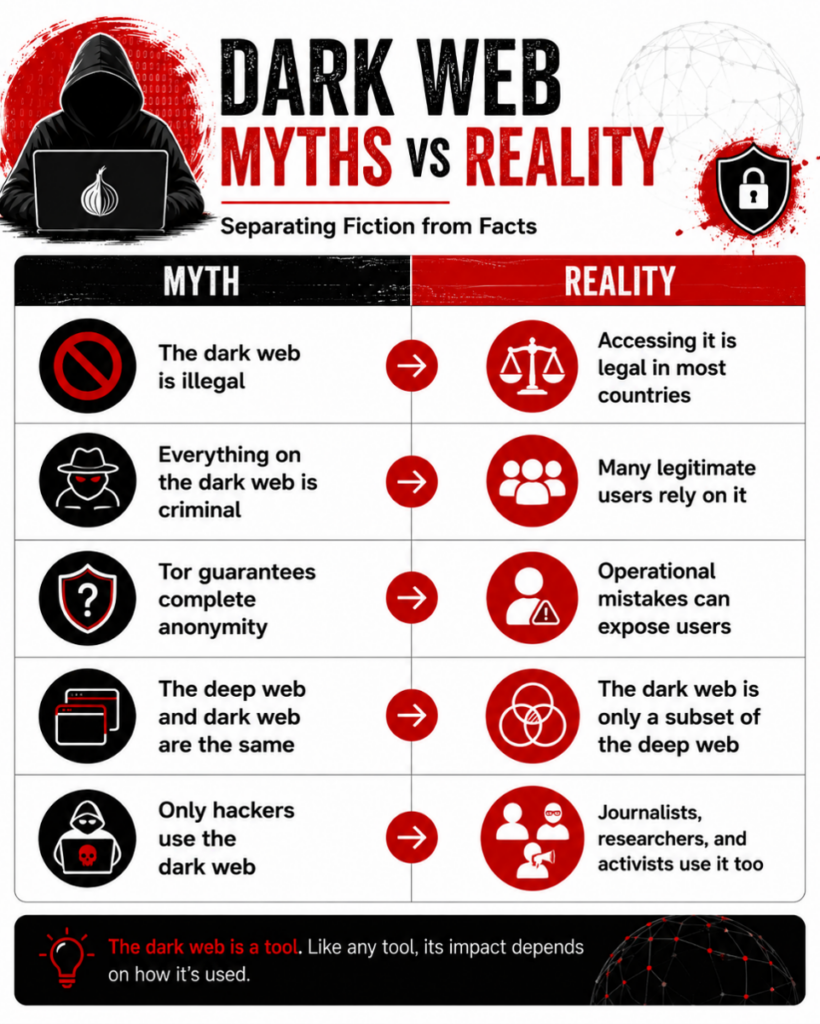
There are many misconceptions surrounding the dark web. Understanding these distinctions helps separate facts from sensationalized media coverage.
| Myth | Reality |
| The dark web is illegal | Accessing it is legal in most countries |
| Everything on the dark web is criminal | Many legitimate users rely on it |
| Tor guarantees complete anonymity | Operational mistakes can expose users |
| The deep web and dark web are the same | The dark web is only a subset of the deep web |
| Only hackers use the dark web | Journalists, researchers, and activists use it too |
Is the Dark Web Illegal?
No. Simply accessing the dark web is legal in most countries, including the United States. However, illegal activities remain illegal regardless of where they occur.
Examples include:
- Purchasing stolen data
- Selling illegal drugs
- Operating ransomware campaigns
- Distributing malware
- Conducting fraud
Law enforcement agencies worldwide actively investigate and prosecute cybercriminal activity conducted through dark web platforms.
Can You Access the Dark Web on Mobile?
Yes. Mobile users can access dark web content through specialized privacy-focused browsers designed to connect to anonymity networks such as Tor. However, security risks remain the same regardless of device type.
Mobile users should exercise caution when accessing dark web resources, avoid downloading files from untrusted sources, and ensure their devices are protected with up-to-date security software. Organizations generally discourage employees from accessing dark web environments without a legitimate business purpose and appropriate security controls.
Common Dark Web Dangers
The dark web exposes users and organizations to a variety of cyber risks, including:
| Threat | Potential Impact |
| Stolen Credentials | Account takeover and unauthorized access |
| Ransomware Services | Business disruption and financial losses |
| Phishing Kits | Credential theft and fraud |
| Malware Distribution | System compromise and data theft |
| Data Breaches | Exposure of customer and corporate information |
| Brand Impersonation | Reputational damage and customer fraud |
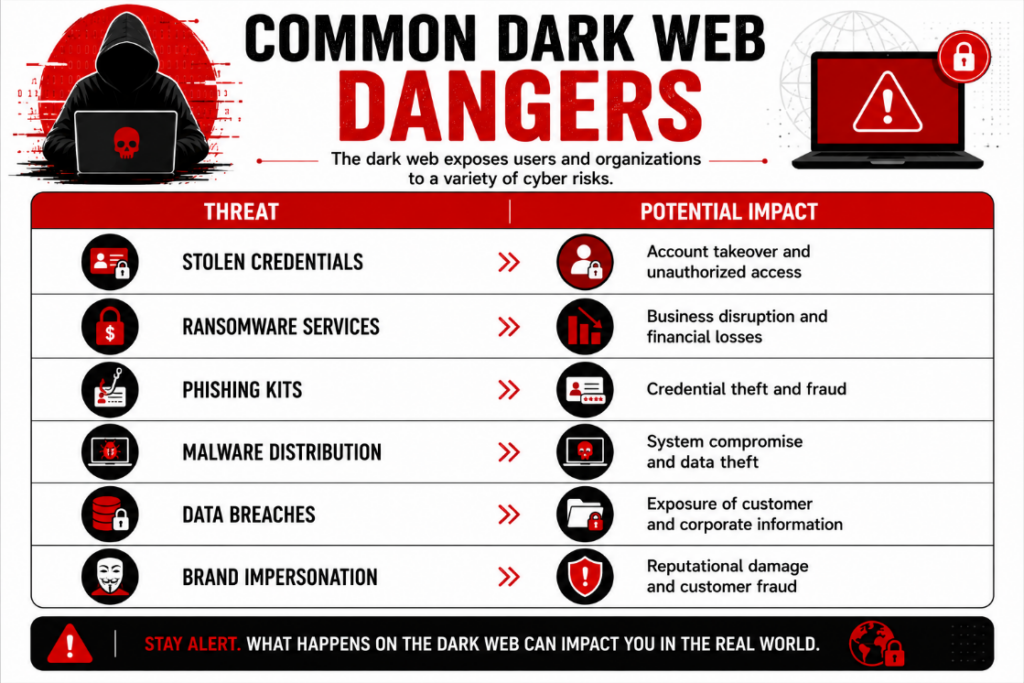
These threats are often traded, discussed, and monetized across underground forums and marketplaces, making continuous monitoring essential for modern cybersecurity programs.
What Happens If Your Data Is Found on the Dark Web?
When personal or corporate information appears on the dark web, it often indicates that a data breach, credential theft, phishing attack, or malware infection has occurred. Exposed information may include usernames, passwords, email addresses, financial records, customer data, or sensitive business documents.
If compromised information is discovered, organizations should immediately:
- Reset affected passwords.
- Enable multi-factor authentication.
- Investigate the source of the exposure.
- Monitor affected accounts for suspicious activity.
- Conduct a broader security assessment.
The faster organizations identify exposed data, the lower the risk of account compromise, fraud, ransomware attacks, and reputational damage.
Why Businesses Monitor the Dark Web
The dark web has evolved into a thriving underground economy where cybercriminals buy, sell, and exchange stolen data, ransomware tools, phishing kits, and access to compromised systems. For organizations, these hidden marketplaces and forums often provide the earliest warning signs of a potential cyberattack. Monitoring dark web activity enables security teams to identify threats before they escalate into data breaches, financial losses, or reputational damage.
Organizations use dark web monitoring to detect leaked employee credentials, exposed customer information, ransomware threats, phishing campaigns, brand impersonation attempts, and supply chain risks. By uncovering compromised data and threat actor discussions at an early stage, businesses can take proactive measures to strengthen defenses and reduce their attack surface.
Conclusion
For organizations, the dark web is like two things at once, a real threat landscape and also a rather useful intelligence source. If you keep an eye on underground communities, you might spot leaked credentials, signs of ransomware activity, and new or rising threats, before they start messing with day to day operations.
It really helps to understand how it works, who tends to use it, and what dangers come with it. For individuals and businesses dealing with today’s cybersecurity world, that knowledge matters. And since threats keep changing, doing proactive monitoring of dark web activity is now a key piece of modern security plans.
Tools like Cyble Dark Web Monitoring let organizations see exposed credentials, leaked datasets, and fresh threats across underground forums and marketplaces, so teams can detect things quicker and respond sooner, before incidents turn into expensive breaches.
FAQs About What is the Dark Web
What is the dark web?
The dark web is a hidden section of the internet accessible through specialized software such as Tor and I2P.
Is the Dark web illegal?
No. Accessing the dark web is legal in most countries. Illegal activities conducted there remain criminal offenses.
Is the Dark Web Dangerous?
Yes. Users may encounter scams, malware, fraud, and illegal content. Proper security precautions are essential.
How to secure oneself from the Dark Web?
Protecting oneself from the potential dangers of the Dark Web involves several measures. Secure tools like the Tor browser are essential for accessing the Dark Web while maintaining anonymity. Additionally, exercising caution when sharing personal information, avoiding illegal transactions, and keeping security software up to date are crucial steps to mitigate risks associated with the Dark Web.
When Was the Dark Web Created?
The concept of the Dark Web began taking shape in the 1990s as part of efforts to enhance online privacy and security. The Tor (The Onion Router) project, a key technology for accessing the Dark Web, was developed during this period.
Who Created the Dark Web?
The creation of the Dark Web is a collaborative effort that evolved over time. The Tor Project, crucial for accessing the Dark Web, was developed by researchers at the U.S. Naval Research Laboratory in the 1990s. However, the exact individuals or entities responsible for creating the entire Dark Web ecosystem remain unclear, as it involved contributions from various sources.
What is the difference between the Deep Web and the Dark Web?
The deep web includes all content not indexed by search engines. The dark web is a small subset of the deep web that requires specialized software to access.
Can you access the Dark Web from a regular browser?
No, you cannot access the Dark Web using a regular browser. It requires special software like Tor to maintain anonymity and navigate encrypted websites.
What are the dangers of browsing the Dark Web?
Risks of browsing the Dark Web include exposure to illegal content, scams, and malware infections.
How to access dark web safely?
Access the Dark Web safely by using a secure browser like Tor, enabling a VPN, and avoiding downloading files or sharing personal information. Tor acts as a dark web gateway, enabling users to connect to the hidden parts of the internet securely.
What is Tor and how is it related to the Dark Web?
Tor is a browser that provides anonymity by routing traffic through a global network; it’s commonly used to access the Dark Web.
Is the Dark Web used for illegal activities?
Yes, while it hosts legitimate content, it is often associated with illegal activities like selling stolen data.
where is dark web created?
The dark web is created on the deep web, specifically on networks like Tor or I2P, which provide encrypted and anonymous browsing.
is browsing the dark web illegal?
Browsing the Dark Web is not illegal, but engaging in illegal activities on it, like buying or selling illicit goods, is.
Can we do dark web access 2026?
Accessing the dark web in 2026 is possible through specialized tools like Tor or I2P, but it requires caution due to security risks and illegal activities.
how to get on the dark web?
To access the dark web, use a secure browser like Tor, which anonymizes your internet traffic. Make sure to follow safety practices, such as using a VPN and avoiding illegal activities.
What is a dark network?
A dark network refers to a private, often anonymous network that is not indexed by traditional search engines. It is typically accessed using specialized software like Tor or I2P, providing users with greater privacy and anonymity. These networks can host both legal and illegal content.
Which is the best online dark web browser?
The best online dark web browser is Tor Browser. It provides strong anonymity by routing traffic through multiple layers of encryption, making it the most popular choice for accessing the dark web safely. It’s open-source, free, and helps protect your privacy.
What is a dark web proxy?
A dark web proxy is a server that allows users to access dark web sites indirectly, masking their IP address and providing an extra layer of anonymity. It routes your traffic through a remote server, helping to hide your identity. However, it may not offer the same level of security as more robust tools like Tor.
How to get tor browser dark web access?
To access the dark web using Tor Browser, download and install it from the official Tor Project website. Once installed, open the browser, connect to the Tor network, and you can start browsing .onion sites securely.
Are dark web site browser Legal?
Using a dark web browser, like Tor, is legal. However, accessing illegal content or engaging in illegal activities on dark web sites is not. Always ensure you’re following the law while browsing.
Is the dark web legal in the United States?
Yes, accessing the dark web is legal in the U.S. However, using it for illegal activities—like buying drugs or stolen data—is against the law.
How does the FBI monitor dark web activity?
The FBI uses undercover operations, surveillance tools, and digital forensics to track criminal activity on the dark web. They also collaborate with international agencies and analyze cryptocurrency transactions to identify users.
Who owns Darkweb?No one owns the dark web—it’s a network of encrypted, decentralized sites without a central authority.
How do you access the dark web?
Users typically access the dark web using the Tor Browser, which routes traffic through encrypted relay networks.
Is Tor illegal?
No. Tor is a legal privacy-focused browser used worldwide for anonymous communication.
What can be found on the dark web?
The dark web hosts forums, marketplaces, whistleblower platforms, privacy tools, research communities, and cybercrime services.
Can law enforcement track dark web users?
While anonymity networks provide privacy, law enforcement agencies use advanced investigative techniques to identify criminal activity.
Why do businesses monitor the dark web?
Organizations monitor the dark web to detect leaked credentials, exposed data, ransomware threats, and emerging cyber risks.
How can I protect myself from dark web threats?
Use strong passwords, enable multi-factor authentication, monitor breach notifications, and avoid sharing sensitive information online.