Managed security services are growing fast because organizations feel a bit more unsure about cyber threats, every quarter. In fact, if you look at recent industry reports the global Managed Security Services Market is expected to climb from USD 38.85 billion in 2025 to USD 69.20 billion by 2030, roughly a 12.24% CAGR. And yes, cloud adoption keeps accelerating, IoT rollouts are everywhere, plus hybrid work patterns and bigger digital infrastructures they all expand the attack surface, so the need for proactive cybersecurity just keeps rising.
The figures behind todays threat landscape pretty much explain why threat intelligence services for MSSPs became such a must have. Cyble’s Annual Threat Landscape Report 2025 said there was a 30% jump in ransomware attacks since the last quarter of 2025, and ransomware groups were averaging close to 700 victims each month.
Since cybercriminals are constantly adjusting their methods, Managed Security Service Providers (MSSPs) can’t just sit with reactive monitoring anymore. They need to shift toward intelligence driven security offerings, so clients can spot risks early, rank what matters most, and reduce exposure before it turns into a real incident.
This is also where threat intelligence services for MSSPs start showing clear, measurable value. Rather than leaning only on alerts produced by security tools, MSSPs can add richer threat context to what they detect, they can interpret adversary behavior in a more practical way, and they can give customers recommendations that actually lead to better security outcomes.
Key Takeaways
| Threat intelligence services for MSSPs enable security teams to detect, prioritize, and respond to cyber threats faster with actionable intelligence.Managed threat intelligence reduces alert fatigue by enriching security alerts with threat context and risk scoring.A modern MSSP threat intelligence platform should support AI-driven analytics, multi-tenancy, SIEM/SOAR integrations, and automated threat enrichment.Threat intelligence feeds for MSSPs are valuable for automation, but finished intelligence provides the context needed for faster investigations and better decision-making.AI and automation are transforming threat intelligence by improving threat prioritization, reducing manual analysis, and accelerating incident response.MSSPs can create new recurring revenue streams by packaging threat intelligence into tiered security services tailored to different customer needs.Platforms like Cyble help MSSPs strengthen security operations with AI-powered intelligence, dark web monitoring, attack surface management, and visibility into more than 350 billion threat data points. |
What Are Threat Intelligence Services for MSSPs?
Threat intelligence services for MSSPs refer to the collection, analysis, enrichment, and delivery of cyber threat intelligence that enables managed security providers to detect threats faster and deliver proactive security services across multiple customer environments.
Unlike standalone threat feeds, modern intelligence services combine information from multiple sources, including:

- Surface web
- Deep web
- Dark web
- Malware repositories
- Vulnerability databases
- Threat actor forums
- Open-source intelligence
- Commercial intelligence sources
The collected data is then analyzed, correlated, and prioritized to provide analysts with intelligence that supports investigations, incident response, vulnerability management, and executive reporting.
Rather than overwhelming SOC teams with thousands of indicators, managed threat intelligence transforms raw data into actionable insights aligned with each client’s industry, technology stack, and risk profile.
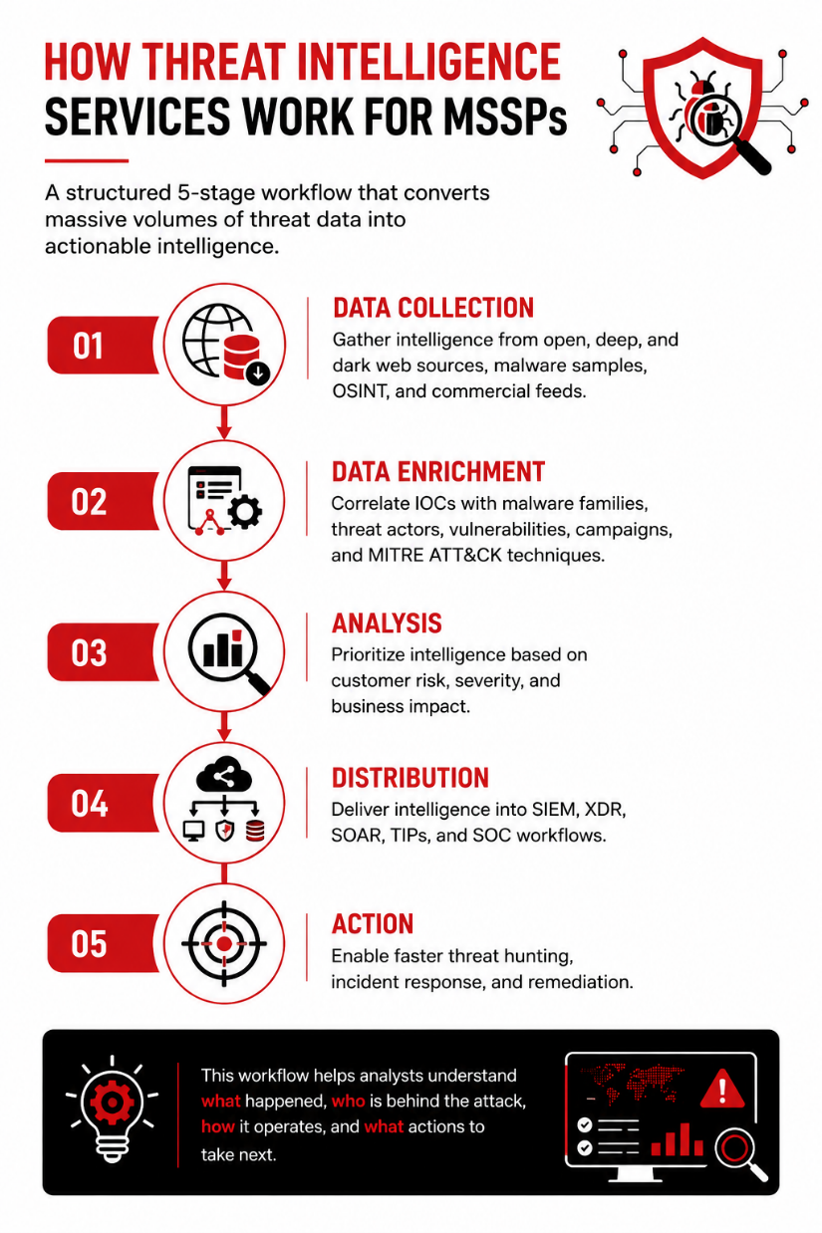
How Threat Intelligence Services Work for MSSPs
The effectiveness of threat intelligence services for MSSPs depends on a structured workflow that converts massive volumes of threat data into actionable intelligence.
Most modern platforms follow five stages.
| Stage | Purpose |
| Data Collection | Gather intelligence from open, deep, and dark web sources, malware samples, OSINT, and commercial feeds. |
| Data Enrichment | Correlate IOCs with malware families, threat actors, vulnerabilities, campaigns, and MITRE ATT&CK techniques. |
| Analysis | Prioritize intelligence based on customer risk, severity, and business impact. |
| Distribution | Deliver intelligence into SIEM, XDR, SOAR, TIPs, and SOC workflows. |
| Action | Enable faster threat hunting, incident response, and remediation. |
This is why threat intelligence for managed security providers has become a critical capability rather than an optional service.
Why MSSPs Need Threat Intelligence Today
Traditional security monitoring generates alerts. Threat intelligence generates context. Without intelligence, analysts spend valuable time determining whether an alert represents malicious activity or a false positive.
With intelligence, analysts immediately understand:
- Which threat actor is involved
- Whether an IOC has been associated with ransomware
- Whether similar attacks are targeting the client’s industry
- Which vulnerabilities are actively being exploited
- Which assets require immediate attention
For MSSPs managing dozens or even hundreds of customer environments, these insights significantly reduce investigation time while improving service quality.
Types of Threat Intelligence MSSPs Should Offer Clients
Different customers require different types of intelligence. The most mature threat intelligence services for MSSPs combine several intelligence disciplines into a single offering.
Strategic Threat Intelligence
Designed for CISOs and executives, strategic intelligence explains emerging cyber risks, industry trends, geopolitical developments, and business impacts that influence long-term security planning.
Tactical Threat Intelligence
Tactical intelligence focuses on attacker tactics, techniques, and procedures (TTPs), enabling security teams to strengthen defenses based on real adversary behavior.
Operational Threat Intelligence
Operational intelligence supports SOC analysts during active investigations by providing malware analysis, infrastructure details, phishing campaigns, and attacker activity.
Technical Threat Intelligence
Technical intelligence consists of:
- Indicators of Compromise (IOCs)
- IP addresses
- Domains
- URLs
- File hashes
- Malware signatures
- YARA rules
These indicators integrate directly into SIEM and SOAR platforms for automated detection.
Key Features to Look for in a Threat Intelligence Platform for MSSPs
Selecting the right MSSP threat intelligence platform requires more than comparing the number of data sources. The platform should improve analyst productivity while supporting multi-client operations.
The following capabilities are particularly important.
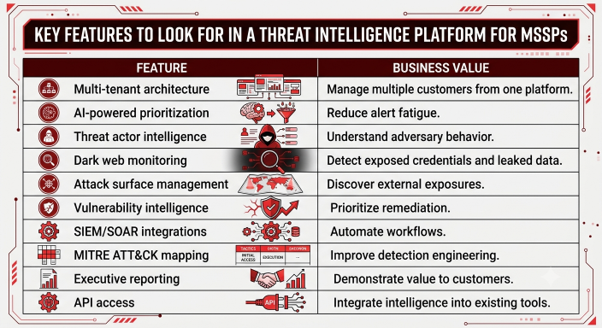
A modern MSSP threat intelligence platform should also support STIX/TAXII standards to simplify intelligence sharing across security technologies.
Threat Intelligence Feeds vs. Finished Intelligence: What MSSPs Actually Need
One of the biggest misconceptions is that subscribing to threat intelligence feeds for MSSPs automatically improves security.
It doesn’t.
Threat feeds deliver raw indicators such as IP addresses, domains, URLs, and malware hashes. While valuable, these indicators lack context.
Finished intelligence answers questions such as:
- Is this threat actor targeting financial institutions?
- Has this malware family been linked to ransomware?
- Which vulnerabilities are currently being exploited?
- What is the recommended response?
| Threat Intelligence Feeds | Finished Intelligence |
| Raw IOCs | Context-rich analysis |
| Large data volume | Prioritized intelligence |
| Requires analyst interpretation | Ready for decision-making |
| Machine-readable | Human and machine-readable |
| Best for automation | Best for investigations |
The most effective threat intelligence feeds for MSSPs are those that combine automation with expert analysis, enabling SOC teams to move from detection to response more efficiently.
How Cyble Helps MSSPs Deliver Intelligence-Driven Security
As cyber threats become more sophisticated, MSSPs need intelligence platforms that go beyond basic IOC collection.
Cyble’s AI-powered Cyber Threat Intelligence solutions provide end-to-end visibility into emerging threats by collecting intelligence from the surface web, deep web, and dark web. The platform combines advanced analytics, automation, and AI to help security teams identify, prioritize, and respond to evolving threats before they impact customers.
Today, Cyble supports security teams with:
- 16+ threat intelligence capabilities
- 500+ enterprise customers
- 67+ alert parameters
- 350 billion+ threat data points
The platform delivers intelligence on threat actors, vulnerabilities, leaked credentials, ransomware campaigns, phishing infrastructure, and attack surface exposure through a unified interface. This enables MSSPs to strengthen customer protection while improving analyst productivity and operational efficiency.
For providers looking to scale threat intelligence services for MSSPs, platforms that combine automation, multi-source intelligence, and AI-driven analysis can significantly reduce investigation time while enhancing the value delivered to clients.
Multi-Tenant Threat Intelligence: Managing Intelligence Across Client Environments
One of the biggest operational challenges for Managed Security Service Providers is managing security across multiple customer environments without compromising visibility or efficiency. As MSSPs scale, manually maintaining separate threat intelligence workflows for every client becomes impractical.
This is where threat intelligence services for MSSPs should support multi-tenant operations by enabling analysts to manage multiple organizations from a single platform while keeping each tenant’s data logically isolated.
An effective MSSP threat intelligence platform should allow providers to:
- Separate customer environments with role-based access controls.
- Customize intelligence based on industry, geography, or risk profile.
- Apply customer-specific watchlists and alerting rules.
- Deliver branded reports for each client.
- Centralize analyst workflows without exposing customer data.
For example, a healthcare organization may require intelligence related to ransomware targeting hospitals, while a financial institution may prioritize banking trojans and credential theft campaigns. A multi-tenant platform allows both customers to receive intelligence tailored to their environments while being managed from the same console.
This approach reduces operational complexity while helping MSSPs deliver more personalized security services.
How AI and Automation Are Changing Threat Intelligence for MSSPs
The volume of cyber threat data has grown beyond what human analysts can process manually. Millions of indicators are generated every day, making artificial intelligence and automation essential components of modern threat intelligence services for MSSPs.
AI helps security teams analyze large volumes of threat data by correlating indicators from multiple intelligence sources, identifying relationships between threat actors, malware, and vulnerabilities, and prioritizing threats based on severity and customer exposure. This enables analysts to focus on high-risk incidents instead of manually reviewing thousands of alerts.
Automation further strengthens security operations by enriching alerts before they reach the SOC. When a suspicious domain, IP address, or file hash is detected, an automated workflow can immediately provide additional context such as associated malware families, phishing campaigns, known threat actors, reputation history, and relevant MITRE ATT&CK techniques. This reduces the time analysts spend gathering information and allows them to move directly to investigation and response.
As AI capabilities continue to evolve, managed threat intelligence is becoming increasingly predictive rather than reactive. Instead of simply providing context after an alert is generated, modern intelligence platforms can identify emerging attack patterns, highlight likely targets, and help MSSPs anticipate threats before they impact client environments. The result is faster investigations, improved analyst productivity, and more proactive security operations.
Choosing the Right Threat Intelligence Platform for MSSPs
The effectiveness of threat intelligence services for MSSPs depends not only on the quality of intelligence but also on how easily it fits into daily security operations. A platform should help analysts investigate incidents faster, support multiple customer environments, and provide intelligence that can be acted upon immediately.
When evaluating a solution, MSSPs should consider whether it can enrich alerts with relevant context, integrate with existing security tools, and present intelligence in a way that supports both technical teams and customer reporting. As client environments grow more complex, scalability and operational efficiency become just as important as the volume of threat data a platform collects.
The table below highlights the capabilities that matter most when selecting an MSSP threat intelligence platform.
| Capability | Why It Matters |
| Multi-tenant management | Enables secure monitoring of multiple customer environments from one platform. |
| Threat intelligence enrichment | Adds context to alerts, reducing investigation time. |
| Dark web visibility | Identifies exposed credentials, leaked data, and emerging threats. |
| Threat actor tracking | Helps analysts understand attacker behavior and campaigns. |
| Native integrations | Connects intelligence with SIEM, SOAR, XDR, and ticketing platforms. |
| Custom reporting | Supports client communication with actionable intelligence and executive summaries. |
One platform designed with these requirements in mind is Cyble Vision. It combines cyber threat intelligence, attack surface visibility, dark web monitoring, and AI-driven analytics into a unified platform that helps MSSPs manage multiple customer environments more efficiently. By providing contextual intelligence instead of raw indicators alone, Cyble Vision enables analysts
How to Price and Package Threat Intelligence as an MSSP Service
Threat intelligence has evolved from a value-added feature into a standalone revenue opportunity.
Rather than including intelligence within standard monitoring packages, many providers now offer tiered intelligence services that align with customer maturity.
Example MSSP Service Packages
| Package | Typical Services |
| Essential | IOC enrichment, weekly reports, vulnerability alerts |
| Professional | Dark web monitoring, threat actor tracking, phishing intelligence, monthly briefings |
| Premium | Dedicated intelligence analyst, attack surface management, executive reporting, custom intelligence requests |
Additional premium services may include:
- Brand monitoring
- Executive protection
- Supply chain intelligence
- Third-party risk intelligence
- Fraud monitoring
- VIP credential monitoring
Packaging intelligence separately helps customers clearly understand its value while creating recurring revenue for MSSPs.
Measuring the ROI of Threat Intelligence Services for MSSP Clients
Organizations increasingly expect security investments to demonstrate measurable business value.
The ROI of threat intelligence services for MSSPs can be evaluated using operational and business metrics rather than simply counting alerts.
Common performance indicators include:
| KPI | Business Outcome |
| Reduced Mean Time to Detect (MTTD) | Faster threat identification |
| Reduced Mean Time to Respond (MTTR) | Shorter incident response cycles |
| Lower false positive rate | Higher analyst efficiency |
| Increased threat hunting success | Improved proactive defense |
| Faster vulnerability prioritization | Better remediation outcomes |
| Executive reporting adoption | Greater customer engagement |
| Higher service renewals | Increased recurring revenue |
Customers are often less interested in the number of indicators processed and more interested in understanding how intelligence reduced business risk.
Best Practices for Delivering Threat Intelligence Services for MSSPs
Successful MSSPs treat intelligence as a continuous service rather than a one-time deliverable.
Key best practices include:
- Align intelligence with each customer’s business risks.
- Prioritize intelligence quality over data volume.
- Map detections to the MITRE ATT&CK framework.
- Integrate intelligence with SIEM, SOAR, XDR, and EDR platforms.
- Continuously validate intelligence sources.
- Provide executive-friendly reporting alongside technical findings.
- Automate repetitive enrichment wherever possible.
- Regularly update customer watchlists and intelligence priorities.
Most importantly, intelligence should always lead to actionable decisions.
Conclusion
The most successful MSSPs combine high-quality intelligence with automation, AI, and efficient SOC workflows to reduce investigation time and improve customer outcomes. They also package intelligence as a premium service, creating new opportunities for recurring revenue while strengthening client trust.
Platforms that deliver multi-source visibility, AI-driven analytics, and multi-tenant management help providers scale operations without increasing analyst workload. Cyble’s Cyber Threat Intelligence Solutions are designed to support this approach by combining intelligence from the surface, deep, and dark web with automation and advanced analytics. With more than 350 billion threat data points, 16+ intelligence capabilities, 67+ alert parameters, and 500+ customers, the platform enables MSSPs to proactively identify emerging threats, prioritize risks, and deliver intelligence-driven security services across diverse customer environments.
For MSSPs looking to differentiate themselves in an increasingly competitive market, investing in threat intelligence services for MSSPs is no longer optional. It is a strategic capability that improves operational efficiency, strengthens customer security, and creates long-term business value.
Frequently Asked Questions (FAQs) about Threat Intelligence Services for MSSPs
What is threat intelligence for MSSPs?
Threat intelligence for MSSPs is the process of collecting, analyzing, and delivering actionable cyber threat information that helps managed security providers detect, investigate, and respond to threats across multiple customer environments.
How do MSSPs use threat intelligence in their operations
MSSPs integrate threat intelligence into SIEM, SOAR, XDR, and SOC workflows to enrich alerts, prioritize incidents, identify threat actors, support threat hunting, and improve incident response.
What’s the difference between threat intelligence feeds and finished intelligence?
Threat intelligence feeds provide raw indicators such as IP addresses, domains, and file hashes. Finished intelligence adds context, analysis, threat actor attribution, and recommended actions, making it more useful for security analysts and decision-makers.
What threat intelligence platforms are best suited for MSSPs?
The best MSSP threat intelligence platforms combine AI-powered threat intelligence, multi-tenant management, dark web monitoring, attack surface management, and seamless SIEM and SOAR integrations. Cyble Vision is one such platform, helping MSSPs identify emerging threats, enrich investigations, and deliver actionable intelligence across multiple client environments.
How should MSSPs package threat intelligence as a service offering?
Many providers offer tiered service packages ranging from basic IOC enrichment and vulnerability alerts to premium offerings that include dark web monitoring, executive reporting, threat hunting support, and dedicated intelligence analysts.
What is multi-tenant threat intelligence and why does it matter for MSSPs?
Multi-tenant threat intelligence enables MSSPs to manage multiple customer environments from a single platform while maintaining strict separation of customer data. This improves operational efficiency and simplifies service delivery at scale.
Can threat intelligence reduce alert fatigue for MSSP analysts?
Yes. By enriching alerts with threat context, prioritizing high-risk events, and automating repetitive analysis, threat intelligence helps analysts focus on incidents that require immediate attention, reducing false positives and improving overall SOC efficiency.