

The vulnerability landscape in 2025 reached unprecedented levels, with over 45,000 vulnerabilities disclosed—averaging 127 new flaws every single day.
As threat actors became increasingly sophisticated in their exploitation techniques, certain vulnerability classes emerged as preferred attack vectors across ransomware campaigns, nation-state operations, and cybercriminal activities.
Cyble’s Annual Threat Landscape Report reveals which vulnerability types threat actors weaponized most aggressively, transforming theoretical security flaws into real-world breaches affecting critical infrastructure, healthcare systems, and industrial control environments.
Here are the top 10 vulnerability types that dominated the 2025 threat landscape.
Vulnerability Trends and Key Statistics in 2025
The vulnerability landscape in 2025 was defined not just by volume, but by the speed and precision of exploitation. While over 45,000 vulnerabilities were disclosed globally, threat actors focused on a smaller subset of high-impact flaws.
Several key trends shaped the year:
- Rapid weaponization: Exploits were often developed within hours or days of public disclosure
- Targeted exploitation: Attackers prioritized vulnerabilities in internet-facing systems such as VPNs, firewalls, and cloud services
- Rise in critical severity flaws: Vulnerabilities with high CVSS scores (9.0+) saw significantly higher exploitation rates
- Increased focus on ICS and critical infrastructure: Industrial environments became prime targets due to weaker security controls and high operational impact
- Chaining of vulnerabilities: Threat actors combine multiple weaknesses (e.g., authentication bypass + RCE) to maximize attack success
Threat intelligence insights from organizations like Recorded Future show that attackers are no longer opportunistic—they are highly selective, focusing on vulnerabilities that deliver immediate access and scalability.
Category-Specific Insights: Cloud, Mobile, and IoT Vulnerabilities
2025 marked a significant shift in threat focus toward cloud-native applications, mobile platforms, and IoT devices. Misconfigured cloud storage buckets, insecure APIs, and weak authentication in SaaS platforms were heavily exploited, enabling attackers to bypass perimeter defenses and exfiltrate sensitive data.
Mobile operating systems and applications saw exploitation of insecure local storage, improper certificate validation, and weak session management. Attackers increasingly leveraged these weaknesses to gain persistent access to enterprise networks via BYOD devices.
IoT and operational technology systems, including smart meters, EV charging infrastructure, and industrial sensors, were targeted for protocol misconfigurations and unencrypted communications. The convergence of IoT and ICS environments amplified the potential operational impact of attacks, making these categories high-value targets for both ransomware and nation-state actors.
How Threat Actors Exploit Vulnerabilities
To effectively defend against modern cyber threats, it is essential to understand how vulnerabilities are turned into real-world attacks.
- Discovery and Monitoring: Threat actors continuously monitor CVE disclosures, vendor advisories, and patch releases to identify new vulnerabilities.
- Exploit Development: Attackers analyze patches or reverse-engineer affected systems to develop working exploits. Increasingly, automation and AI tools are accelerating this phase.
- Initial Access: Exploiting vulnerabilities in internet-facing systems—such as web applications, VPNs, or remote management tools—provides attackers with their entry point.
- Privilege Escalation and Lateral Movement: Once inside, attackers chain vulnerabilities to expand access across systems and networks.
- Payload Execution: Ransomware, backdoors, or data exfiltration tools are deployed to achieve the attacker’s objectives.
1. Improper Input Validation (CWE-20): The Gateway Vulnerability
Improper Input Validation dominated the 2025 vulnerability landscape with 435 disclosed instances, making it the most prevalent weakness exploited by threat actors.
This fundamental flaw occurs when applications fail to properly validate, sanitize, or verify user-supplied data before processing it, enabling attackers to inject malicious payloads, bypass security controls, and manipulate application logic.
Threat actors particularly targeted this vulnerability class in Industrial Control Systems, where 435 ICS-specific instances were documented. The widespread nature of input validation flaws stems from their presence across diverse technologies—from web applications and APIs to embedded systems and industrial protocols.
Ransomware groups like Akira and Qilin leveraged input validation weaknesses in internet-facing enterprise applications to gain initial access, while APT groups exploited these flaws in VPN gateways and network appliances.
The persistent exploitation of input validation vulnerabilities shows that despite decades of secure coding guidance, this fundamental weakness remains a critical entry point for attackers.
2. Remote Code Execution Vulnerabilities: The Crown Jewel of Exploitation
Remote Code Execution (RCE) vulnerabilities represented the most severe and actively weaponized flaw class in 2025, enabling attackers to execute arbitrary commands on target systems without requiring physical access or user interaction.
CVE-2025-61882 in Oracle E-Business Suite exemplified the devastating impact of RCE exploitation—CL0P ransomware group weaponized this flaw to achieve supply-chain compromise affecting over 118 entities globally.
The vulnerability allowed unauthenticated attackers to remotely execute arbitrary code through a server-side request-forgery (SSRF) that forces the application to fetch and execute malicious XSL payloads.
Medusa ransomware similarly exploited CVE-2025-10035, an unauthenticated deserialization RCE in GoAnywhere MFT, chaining it with RMM tooling abuse to establish persistent control.
Multiple Fortinet vulnerabilities (CVE-2025-59718, CVE-2025-32756) and Cisco flaws (CVE-2025-20281, CVE-2025-20337) with CVSS scores of 9.8-10.0 were rapidly weaponized, showing how RCE flaws in network security appliances provide immediate, high-privilege access to corporate environments.
3. Authentication Bypass and Weak Authentication: Breaking the Front Door
Authentication vulnerabilities emerged as a critical enabler for initial access throughout 2025, with threat actors systematically targeting weak authentication mechanisms to compromise high-value systems.
CVE-2025-49201 in Fortinet’s FortiPAM and FortiSwitchManager allowed attackers to execute unauthorized code through specially crafted HTTP requests, bypassing authentication entirely.
The widespread exploitation of Ivanti Connect Secure vulnerabilities (CVE-2025-0282, CVE-2025-22457) by multiple ransomware groups including Qilin demonstrated how authentication bypass in VPN gateways provides direct access to internal networks.
China-backed Salt Typhoon APT extensively abused password-spray attacks combined with authentication weaknesses to compromise at least 200 US companies and entities in 80 countries.
Nation-state actors particularly focused on authentication flaws in secure remote access solutions, recognizing these as high-value chokepoints. The Missing Authentication for Critical Function weakness appeared 59 times in ICS environments, where authentication bypass could grant unauthorized control over SCADA systems, water utilities, and industrial processes.
4. Out-of-Bounds Write (CWE-787): Memory Corruption at Scale
Out-of-Bounds Write vulnerabilities, with 156 documented instances in ICS systems alone, remained a primary target for sophisticated exploitation throughout 2025.
These memory corruption flaws occur when software writes data beyond the intended buffer boundaries, enabling attackers to overwrite adjacent memory locations with malicious code, corrupt program execution flow, or escalate privileges. The severity of out-of-bounds write flaws stems from their potential to achieve arbitrary code execution without requiring user interaction.
Threat actors targeting Industrial Control Systems particularly focused on these vulnerabilities in embedded firmware and industrial protocols where memory safety protections are often absent or minimal.
APT groups leveraged out-of-bounds write flaws in network devices from vendors like Fortinet, Cisco, and Juniper to establish persistent footholds in enterprise environments.
The prevalence of these vulnerabilities across multiple vendor product lines—from Microsoft and Apple to specialized ICS manufacturers like Mitsubishi Electric and Schneider Electric—demonstrates that memory safety remains a fundamental challenge in software development, creating exploitable conditions that threat actors reliably weaponize.
5. Path Traversal (CWE-22): Navigating Beyond Intended Boundaries
Path Traversal vulnerabilities, documented in 55 instances across critical systems, enabled threat actors to access files and directories outside intended application boundaries by manipulating file path parameters.
This vulnerability class proved particularly dangerous in web-facing applications, administrative interfaces, and file transfer systems where successful exploitation grants unauthorized access to sensitive configuration files, credentials, and system resources.
Threat actors on underground forums were observed actively discussing and weaponizing path traversal exploits, with actors like psych1c and NetworkBroker collaborating to weaponize path traversal vulnerabilities they discovered.
The technique’s effectiveness stems from its relative simplicity—attackers manipulate “../” sequences or absolute paths in input parameters to traverse directory structures and access protected files.
In ICS environments, path traversal flaws exposed critical configuration files, engineering workstation credentials, and industrial protocol authentication data.
Multiple ransomware groups exploited path traversal vulnerabilities during lateral movement phases, accessing credential stores, backup directories, and sensitive documents that informed subsequent extortion demands.
6. Cross-Site Scripting (XSS): The Persistent Web Application Threat
Cross-Site Scripting vulnerabilities remained a top exploitation target with 46 documented instances in ICS environments, enabling threat actors to inject malicious scripts into web applications viewed by other users.
XSS exploitation evolved significantly in 2025, with Russian-aligned groups like Sednit exploiting webmail XSS vulnerabilities to compromise diplomatic and government targets.
The versatility of XSS attacks—from credential harvesting and session hijacking to malware distribution and phishing—made them attractive to both cybercriminals and nation-state actors.
Modern XSS exploitation chains often served as initial access vectors for more sophisticated attacks, with threat actors using injected scripts to steal authentication tokens, bypass Content Security Policy restrictions, and establish persistent footholds in enterprise web applications.
The industrial sector faced particular risk as web-based HMI and SCADA interfaces containing XSS vulnerabilities allowed attackers to manipulate control system interfaces, inject malicious commands, and compromise operator workstations.
The continued prevalence of XSS vulnerabilities despite decades of awareness showcases the challenge of securing complex web applications against injection-based attacks.
7. Use After Free (CWE-416): Advanced Memory Exploitation
Use After Free vulnerabilities, with 78 documented instances in critical systems, represented one of the most sophisticated exploitation targets for advanced threat actors in 2025.
This memory corruption flaw occurs when software continues to use a pointer after the associated memory has been freed, creating exploitable conditions that enable arbitrary code execution, privilege escalation, and security control bypass.
Nation-state actors particularly favored Use After Free vulnerabilities due to their reliability in achieving code execution with precise control over program behavior.
Multiple zero-day exploits leveraged by APT groups targeted Use After Free flaws in browser engines, kernel components, and system libraries—CVE-2022-48503 in JavaScriptCore/WebKit exemplified high-severity Use After Free vulnerabilities affecting multiple Apple operating systems and enabling arbitrary code execution.
The technical sophistication required to weaponize these flaws means they’re primarily exploited by well-resourced threat actors including state-sponsored groups, commercial exploit developers, and advanced ransomware operations.
Use After Free exploitation in ICS environments proved particularly dangerous, as successful exploitation of industrial protocol implementations or embedded system components could grant attackers direct control over physical processes.
8. SQL Injection and Command Injection: Direct System Compromise
Injection vulnerabilities—particularly SQL Injection and Command Injection—remained among the most actively weaponized flaw classes throughout 2025, enabling threat actors to execute unauthorized database queries and system commands.
Trigona ransomware operators demonstrated sophisticated SQL-based intrusion chains by brute-forcing exposed MS-SQL servers, embedding malware inside database tables, and exporting it to disk via bcp.exe to install payloads including AnyDesk and Teramind.
The technique weaponizes legitimate database tooling, creating automated SQL-centric intrusion chains that bypass traditional security controls. Command injection vulnerabilities in web applications, APIs, and management interfaces allowed threat actors to execute arbitrary operating system commands with application privileges, often leading to full system compromise.
Multiple threat actors on underground forums, including prominent actors like pianoxltd and skart7, actively shared and discussed command injection exploits, with these vulnerabilities featuring prominently in forum discussions throughout the year.
The ClickFix social engineering technique that surged 517% in 2025 often culminated in command injection, tricking victims into manually executing malicious PowerShell commands that delivered ransomware payloads from groups like Interlock and Latrodectus.
9. NULL Pointer Dereference (CWE-476): Denial of Service and Beyond
NULL Pointer Dereference vulnerabilities, documented in 81 instances across ICS systems, emerged as a significant threat in 2025 particularly for Denial of Service attacks against critical infrastructure and operational technology environments.
This flaw occurs when software attempts to access memory through a null pointer, typically causing application crashes that disrupt service availability.
While traditionally considered less severe than remote code execution, sophisticated threat actors demonstrated that NULL pointer vulnerabilities in specific contexts could be leveraged for privilege escalation and arbitrary code execution.
Hacktivists targeting Industrial Control Systems particularly exploited these flaws to disrupt operations—groups like Z-Pentest, NoName057(16), and Sector 16 weaponized NULL pointer vulnerabilities in exposed HMI and SCADA interfaces to cause operational disruptions across European critical infrastructure.
The impact extended beyond simple crashes, as coordinated exploitation of these flaws in industrial environments could trigger safety system failures, process shutdowns, and physical equipment damage.
ICS vendors including Siemens, Rockwell Automation, and Schneider Electric issued numerous patches addressing NULL pointer dereference flaws in their industrial control products, highlighting the persistent challenge of ensuring robust error handling in safety-critical systems.
10. Missing Encryption of Sensitive Data (CWE-311): The Silent Data Exposer
Missing Encryption of Sensitive Data vulnerabilities, with 87 documented instances in ICS environments, enabled threat actors to intercept, access, and exfiltrate sensitive information transmitted or stored without proper cryptographic protection.
The healthcare sector faced particularly severe consequences from this vulnerability class—CVE-2025-0683 in the Contec CMS8000 patient monitoring system exemplified the catastrophic impact, as the device transmitted real patient data in plaintext to an external IP reportedly linked to a Chinese university network.
This vulnerability raised immediate alarms about both national security and public health, as widely deployed clinical monitors became silent gateways for surveillance and Protected Health Information (PHI) exfiltration.
Transportation sector vulnerabilities in EV charging infrastructure exploited weaknesses in ISO 15118-2 protocols, enabling man-in-the-middle attacks that tampered with charging communication.
Threat actors targeting telecommunications infrastructure leveraged missing encryption vulnerabilities to intercept subscriber data, call records, and authentication credentials.
The persistent presence of plaintext credential storage, unencrypted communication channels, and inadequate key management across enterprise systems and ICS environments demonstrates that encryption implementation remains a fundamental security challenge, particularly in resource-constrained industrial and embedded systems.
Apart from the top vulnerability types exploited in the year gone by, Cyble’s Annual Threat Landscape Report 2025 also has statistics and detailed information of regional and sectoral vulnerability exploitations along with those that are favorite among ransomware actors. Below is a snippet and for more detailed info, download the full report now!
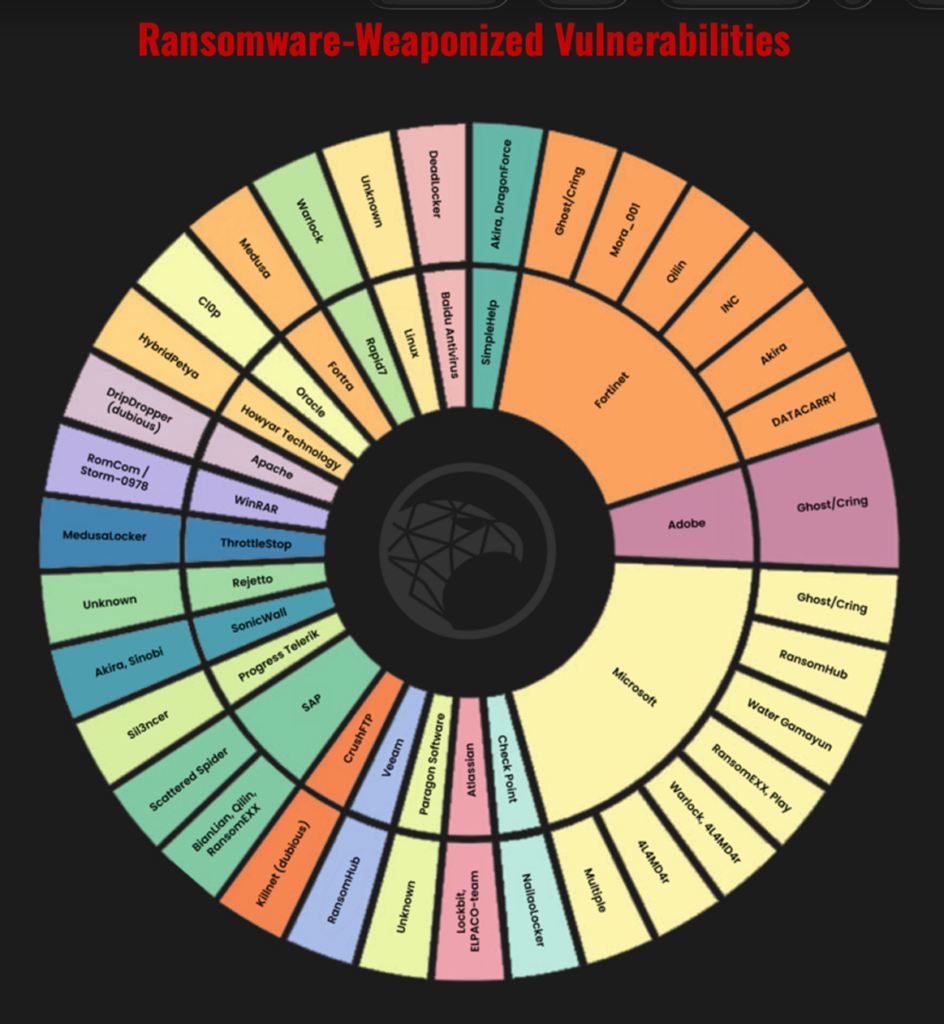
Regional and Sector-Specific Exploitation Patterns
Certain industries and regions faced disproportionate exposure to specific vulnerabilities in 2025. The healthcare sector was repeatedly targeted through missing encryption, SQL injection, and authentication bypass flaws, impacting patient monitoring and electronic health record systems.
Critical infrastructure, particularly energy, transportation, and water utilities, saw concentrated attacks exploiting ICS-specific memory corruption and path traversal vulnerabilities. Attackers often leveraged sector-specific knowledge to chain exploits, causing operational disruptions and safety risks.
Regionally, North America and Europe remained top targets for ransomware and APT activity, while APAC saw increased exploitation of cloud and mobile vulnerabilities. Awareness of these patterns allows organizations to implement threat-informed defenses tailored to sectoral and geographic risk profiles.
How to Mitigate These Vulnerabilities
Understanding which vulnerabilities are exploited is only valuable if organizations can take action to reduce their risk exposure.
- Prioritize Vulnerability Management: Focus on actively exploited vulnerabilities rather than attempting to patch everything equally. Risk-based prioritization is critical.
- Strengthen Authentication Mechanisms: Implement multi-factor authentication (MFA) and eliminate weak or default credentials to prevent unauthorized access.
- Adopt Secure Coding Practices: Ensure proper input validation, output encoding, and secure development practices to mitigate injection and logic flaws.
- Reduce Attack Surface: Limit exposure of internet-facing systems and disable unnecessary services and ports.
- Implement Network Segmentation: Restrict lateral movement by isolating critical systems and enforcing least-privilege access.
- Continuously Monitor and Respond: Deploy threat detection and monitoring solutions to identify suspicious activity early and respond quickly.
- Patch and Update Systems Regularly: Timely patching remains one of the most effective defenses, especially for vulnerabilities known to be actively exploited.
A proactive, intelligence-driven approach to security enables organizations to stay ahead of efficient and automated threat actors.
Conclusion: The Weaponization Cycle Accelerates
The 2025 vulnerability landscape reveals that threat actors have become increasingly efficient at weaponizing disclosed flaws, with the time between public disclosure and active exploitation shrinking dramatically.
AI-driven exploitation frameworks like HexStrike now combine LLM-driven reasoning with automated patch-diff analysis to generate functional exploits faster than manual workflows, fundamentally accelerating the weaponization cycle.
The concentration of exploitation activity on specific vulnerability classes—particularly authentication bypass, RCE, and input validation flaws—demonstrates that attackers prioritize flaws offering immediate, high-impact access over more complex exploitation chains.
For defenders, the message is loud and clear: vulnerability management must evolve from reactive patching to predictive prioritization based on active exploitation intelligence.
Organizations must focus resources on the vulnerability types threat actors actually weaponize—prioritizing authentication mechanisms in internet-facing systems, input validation in enterprise applications, and memory safety in critical infrastructure.
As we enter 2026, the convergence of AI-accelerated exploitation, persistent threat actor innovation, and the growing attack surface of cloud, ICS, and IoT environments demands that vulnerability management become a core strategic function rather than a technical afterthought. The threat actors have industrialized their exploitation capabilities—it’s time defenders do the same with their remediation processes.
FAQ About Vulnerability Types
What are the 14 strands of vulnerability?They are categorized in security frameworks covering software, hardware, network, human, physical, and procedural weaknesses.