Key Takeaways
- Cyble Research and Intelligence Labs (CRIL) tracked 6,046 global data breach and leak incidents in 2025, with government/LEA (998 incidents) and BFSI (634 incidents) the two most targeted sectors.
- Over 15 billion stolen credentials are estimated to be circulating on dark web and underground marketplaces.
- 88% of attacks against basic web applications involved the use of stolen credentials, according to Verizon’s 2025 Data Breach Investigations Report.
- Global cybercrime costs are projected to hit $10.5 trillion annually, making proactive dark web monitoring a board-level priority rather than an IT line item.

What Is Dark Web Monitoring?
Dark web monitoring is the ongoing search of the hidden, unindexed areas of the internet, including Tor sites and I2P networks, along with private blogs, encrypted chatrooms, cybercriminal marketplaces, and even Telegram channels, for signs of stolen credentials, leaked data, and early hints of an attack before they are launched against a company. Done properly; it changes a responsive security stance into a preventative one, bringing threats to the surface while there is an opportunity to respond.
Why Dark Web Monitoring Is a 2026 Enterprise Priority
The economics of cybercrime have made dark web monitoring less of a nice-to-have and more of a baseline control. Cybersecurity Ventures projects that global cybercrime will cost the world $10.5 trillion annually — enough that, treated as a national economy, it would rank third in the world behind only the United States and China. That cost isn’t abstract for individual enterprises: IBM’s 2025 Cost of a Data Breach Report puts the average global breach at $4.44 million, a number that climbs sharply for regulated industries like healthcare and financial services.
Underneath all of this is a rising underground economy for credentials. More than 15 billion stolen credentials are believed to be in the underground marketplaces and criminal forums, where they are traded as commodities in the form of login pairs, session tokens, and complete identity packages. In its 2025 DBIR, Verizon found that stolen credentials were used in 88% of attacks on basic web applications and that credential abuse was the most common initial access vector for the second year running.
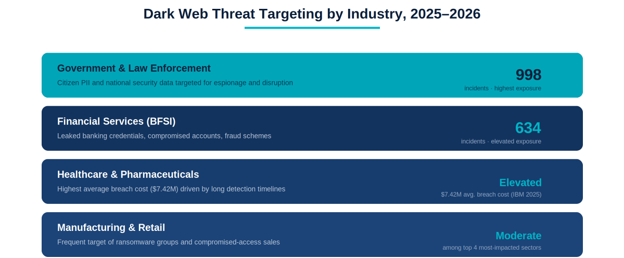
Cyble’s own research exhibits that same pressure at the incident level. Cyble monitored 6,046 global data breach and leak incidents in 2025, with the government and law enforcement agencies carrying the heaviest load (998 incidents, roughly 16.5% of the total) — followed closely by BFSI (634 incidents, about 10.5%).
Combined, these two sectors accounted for more than a quarter of all tracked breach activity — a clear signal of where threat actors are concentrating effort, and why dark web monitoring can’t be a generic, one-size-fits-all control.
How Dark Web Monitoring Works
Dark web monitoring platforms generally operate across three stages:

- Data is continuously gathered by automated crawlers and human analysts from Tor and I2P sites, paste bins, cybercriminal forums, breach databases, and — in recent years — from Telegram channels, where much of the illicit trading has shifted.
- The raw data is normalized and then processed by AI and machine learning models that detect organization domain names, employee credentials, executive names, or other proprietary information in what is otherwise an enormous volume of noise.
- Once matches are verified, they should be sent to the security team as prioritized alerts, and ideally, they should be integrated with the existing SIEM, identity management, or incident response workflow so that a detected exposure can automatically trigger a password reset, session revocation, or further investigation without requiring any manual handoffs.
The quality of a monitoring program depends heavily on the first stage — how broad and how fresh the collection is — which is why coverage breadth has become a key differentiator between platforms, discussed further below.
Major Dark Web Monitoring Trends in 2026
In 2026, monitoring the dark web will be redefined by a number of factors, as the professionalized underground economy changes and shifts its infrastructure.
The Infostealer Epidemic & Stealer Log Markets
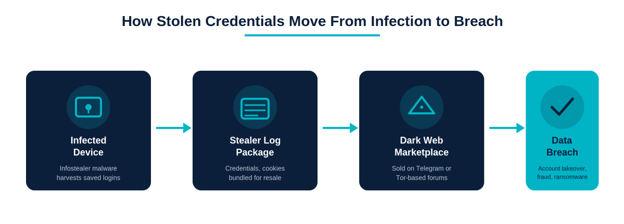
Infostealer malware, such as RedLine, Raccoon, and Vidar, has become the main supply for the credential economy. These tools secretly gather saved passwords, browser cookies, and session tokens from the infected device and then bundle the haul into a ‘stealer log’ for sale in bulk, often within hours of the infection.
The 2025 DBIR from Verizon revealed that 30% of corporate-managed devices and 46% of unmanaged devices appearing in infostealer logs contain company credentials. It also stated that 54% of the victims of ransomware had prior credential exposure in a stealer log before the attack.
Watching the stealer log markets and not just the old breach dumps has become the bare minimum, not something extra you pay for.
Rise of Initial Access Brokers (IABs)
Initial Access Brokers are threat actors who specialize in breaching an organization and then selling the foothold (VPN credentials, RDP access, compromised admin accounts, etc.) to other criminals, mostly ransomware affiliates.
IAB listings on dark web forums work as an early warning system — an organization showing up in an IAB’s inventory often means they’re being scoped for a ransomware attack before the attack itself is launched. And monitoring that tracks IAB activity, in particular, not just completed breaches, gives defenders a much earlier window to respond meaningfully.
Ransomware-as-a-Service (RaaS) Expansion
RaaS keeps dropping the barrier to entry for ransomware operations — allowing affiliates to rent malware and infrastructure from more established operators in the business. Cyble’s research on the 2025 threat landscape also saw significant operational churn in this space — established groups rebranding, splintering, or pivoting toward models that pursue only extortion, skip encryption entirely, and threaten to leak stolen data.
The volatility makes it difficult to trace the identity of ransomware groups through the use of name-based monitoring alone, which is one of the reasons why the detection of behavior and infrastructure has become more important.
Telegram Replacing Dark Web Forums
With heavy law enforcement scrutiny and occasional takedown over the years, a significant portion of cybercriminal activity has moved from traditional dark web forums to encrypted messaging platforms, with Telegram being the most popular of them. The quickness of Telegram, its simplicity, and the lower visibility compared to Tor-based forums make it attractive to threat actors.
For enterprises, this means a monitoring program that only watches traditional dark web sources is watching an increasingly incomplete picture; coverage of Telegram channels has become a necessary, not optional, part of the collection layer.
Dark Web Monitoring Tools
Not all dark web monitoring platforms cover the same ground, and the differences matter operationally. When evaluating a solution, enterprises should weigh:
- Source coverage — Tor, I2P, Telegram channels, paste sites, and stealer log markets, not just a handful of well-known forums
- Alerting speed — how quickly a new exposure is detected and surfaced, since the gap between exposure and detection is where most damage occurs
- Infostealer log detection — dedicated capability to catch stealer logs, given their outsized role in credential-driven breaches
- AI-powered threat scoring — to cut through alert volume and surface what’s actually actionable
- Remediation workflows — native integration with SIEM, identity and access management, and incident response tooling
- Proprietary threat intelligence — insight generated by a dedicated research team, rather than solely aggregated public data
Coverage breadth and data freshness are consistently the two factors that separate genuinely useful platforms from ones that generate noise without context.
Dark Web Monitoring by Industry
Threat exposure on the dark web isn’t uniform — different sectors face distinct data types, adversaries, and regulatory pressure.
Financial Institutions
The primary data theft targets are still banks and financial institutions, as the direct value of the information they store is of a monetary nature. According to Cyble, there were 634 breach and leak incidents in the BFSI sector in its 2025 research. Monitoring on the dark web for this sector usually centers on leaked banking credentials, customer accounts taken over, and chatter about fraud schemes which usually comes before organized campaigns to take over accounts.
Healthcare & Pharmaceuticals
Healthcare organizations are a prime target because they combine highly valuable patient data with security teams that have historically been under-resourced. The average breach in healthcare, according to IBM’s 2025 report, was estimated at $7.42 million, the highest among all industries and this is partly driven by the long timelines for detection and containment. Monitoring must cover patient PHI exposure, as well as the risk of operational disruption due to a ransomware incident on clinical systems.
Government & Critical Infrastructure
In Cyble’s 2025 tracking, the government and law enforcement agencies were the most targeted sector, with 998 incidents. The motivations here split between theft of citizen data for espionage and attacks on critical services to cause disruption. For this sector, dark web monitoring often needs to extend beyond monitoring for credential exposure to include tracking chat about planned hacktivist or disruptive activity.
Dark Web Risk Management Strategies for 2026
A mature dark web risk management program typically combines several layers:
- Continuous IOC monitoring: Ongoing tracking of indicators of compromise across forums, marketplaces, and Telegram channels, rather than periodic point-in-time scans.
- Credential rotation and hygiene: Rapid response processes for rotating exposed credentials the moment they’re detected, therefore reducing the window attackers have to exploit them.
- Employee training: Because credential theft and social engineering remain the dominant entry points, ongoing training in phishing recognition and safe browsing habits directly reduces the volume of new exposures feeding the underground economy.
- Third-party and vendor risk monitoring: Vendor credential exposure is a growing route into otherwise well-defended organizations; monitoring needs to extend to the supply chain, not just the enterprise’s own domains.
- Compliance alignment: Frameworks like GDPR, HIPAA, and NIS2 increasingly carry breach notification obligations that hinge on how quickly an organization can detect exposure — making dark web monitoring part of the compliance toolkit, not just the security one.
How Cyble Helps Enterprises Monitor the Dark Web
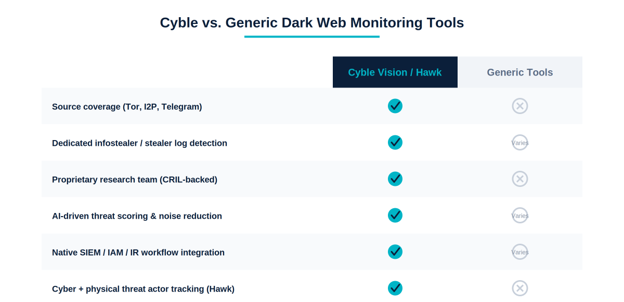
Cyble’s dark web monitoring is built on proprietary intelligence from Cyble Research and Intelligence Labs (CRIL), which tracked 6,046 global data breach and leak incidents in 2025 alone — giving Cyble’s platforms a research foundation drawn from direct observation of the underground ecosystem rather than aggregated third-party feeds alone.
Cyble Vision provides continuous monitoring across Tor, I2P, ZeroNet, encrypted forums, and Telegram channels, surfacing exposed credentials, leaked data, and brand mentions with AI-driven prioritization to cut down on alert fatigue.
Cyble Hawk extends this further into dedicated threat actor tracking, mapping emerging attack trends and providing intelligence that spans both cyber and physical risk domains — useful for organizations that need to understand not just what’s been exposed, but who’s likely behind it and what they tend to do next.
Together, these platforms are designed to plug into existing SIEM, identity management, and incident response workflows, so detection translates into action rather than another dashboard to check.
Ready to enhance your threat detection capabilities? Book a demo to discover how Cyble Vision and Cyble Hawk can help your team identify and respond to cyber threats faster.
Conclusion
The dark web isn’t slowing down, and neither is the underground economy built on stolen credentials, infostealer logs, and access brokerage. With more than 15 billion credentials in circulation and cybercrime costs climbing toward $10.5 trillion annually, dark web monitoring has moved from a specialized add-on to a baseline requirement for any enterprise serious about reducing breach risk.
The organizations getting ahead of this shift are the ones treating exposed credentials as an active threat signal — not a compliance checkbox — and pairing that visibility with a platform built on real, ongoing research into how the underground actually operates.
Frequently Asked Questions
What is dark web monitoring?
Dark web monitoring is the continuous process of scanning hidden corners of the internet — including Tor sites, encrypted forums, dark web marketplaces, and Telegram channels — to detect stolen credentials, leaked data, and early threat signals before they’re weaponized against an organization. It turns reactive security into proactive threat prevention.
Why do enterprises need dark web monitoring in 2026?
With more than 15 billion stolen credentials circulating on dark web marketplaces and cybercrime costs projected to reach $10.5 trillion annually, enterprises can no longer rely solely on perimeter defenses. Dark web monitoring detects compromised employee accounts, leaked customer data, and planned attacks before they cause damage.
What types of data are found on the dark web?
The dark web hosts stolen login credentials, corporate VPN access, session cookies, API keys, credit card data, personal identification numbers, healthcare records, and ransomware-as-a-service toolkits. Infostealer malware packages — “stealer logs” — bundle an infected device’s full browser data and credentials for sale, often within hours of infection.
How does infostealer malware relate to dark web monitoring?
Infostealer malware quietly harvests credentials and session tokens from infected devices, which are then packaged into stealer logs and sold on Telegram and dark web markets. Monitoring that covers stealer log sources catches these exposures before attackers can use them for account takeover.
What is the difference between the dark web, deep web, and surface web?
The surface web is everything indexed by search engines — a small fraction of the internet. The deep web includes content behind logins and paywalls, such as email and banking portals. The dark web is a subset of the deep web that requires specialized software like Tor to access, and is intentionally hidden.
How do Initial Access Brokers (IABs) operate on the dark web?
IABs are specialized cybercriminals who breach organizations and sell that access — VPN credentials, RDP sessions, admin accounts — to other threat actors, particularly ransomware groups. IAB listings are an early warning signal that an organization is actively being targeted, and monitoring that tracks IAB activity can catch this before a ransomware attack is deployed.
What should an enterprise look for in a dark web monitoring solution?
Enterprises should evaluate source coverage (Tor, I2P, Telegram, paste sites, stealer log markets), real-time alerting speed, dedicated infostealer log detection, AI-powered threat scoring, and remediation workflows integrated with IAM and SIEM tools. Coverage breadth and data freshness are the most critical differentiators.
How does Cyble’s dark web monitoring differ from other platforms?
Cyble’s dark web monitoring is powered by proprietary intelligence, which tracked 6,046 global data breach and leak incidents in 2025. Cyble Vision and Cyble Hawk cover Tor, I2P, ZeroNet, Telegram, and encrypted forums, delivering real-time alerts and AI-driven threat scoring for enterprise and government security operations.