
Banking, Financial Services & Insurance (BFSI) Threat Landscape Report United States | H1 2026
Cybercriminals aren’t simply breaching banks anymore.
They’re targeting the entire financial ecosystem—from payment processors and fintech platforms to insurance providers and financial infrastructure.
In the first half of 2026, threat actors combined ransomware, data theft, unauthorized access, AI-driven fraud, and zero-day exploitation to launch increasingly coordinated attacks against the U.S. BFSI sector.
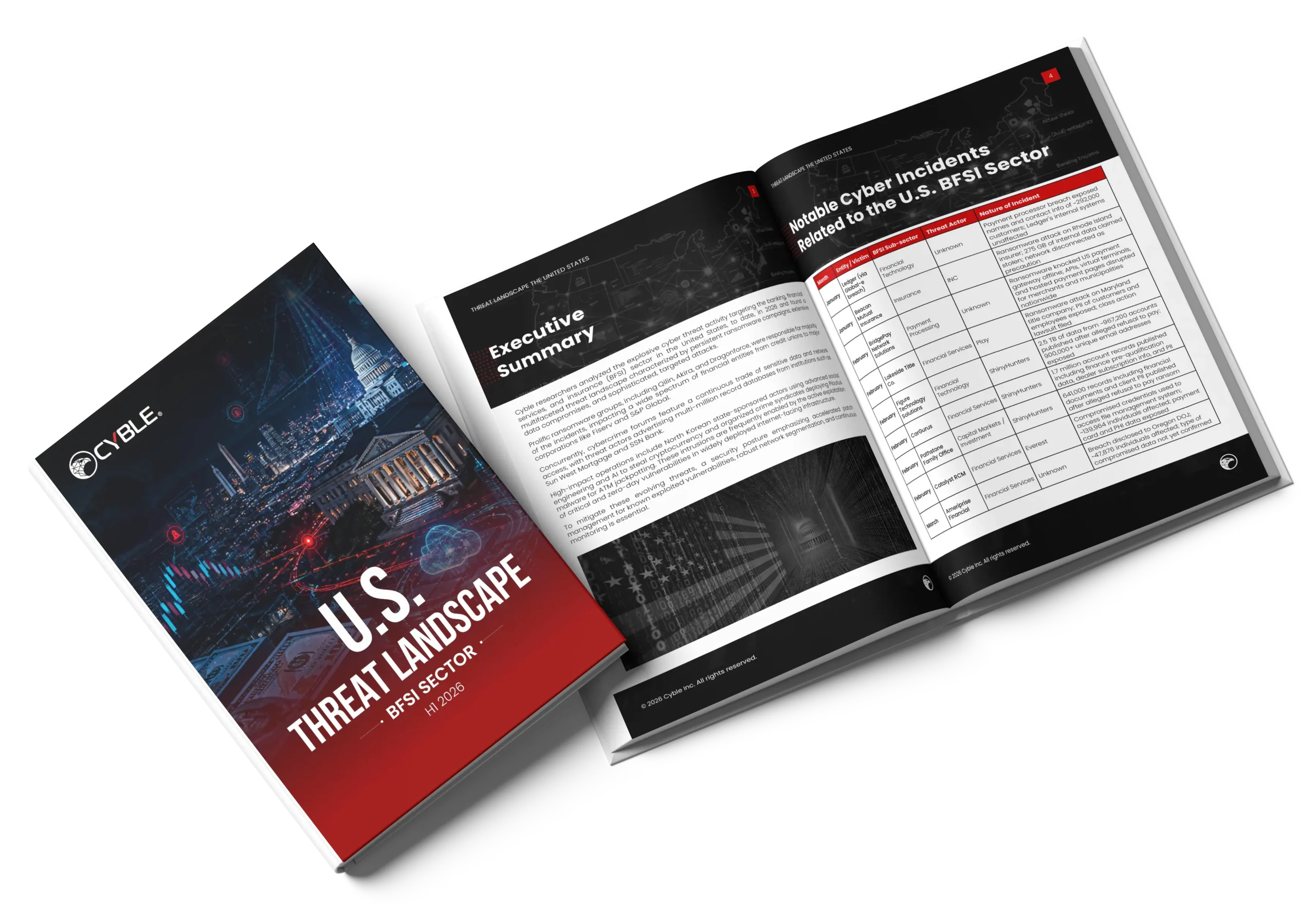
The BFSI Threat Landscape Report – United States (H1 2026) provides an intelligence-led view of the threats reshaping one of the world’s most targeted industries.
US BFSI Cyber Threat Landscape for H1 2026 at a Glance
Cyble Research and Intelligence Labs (CRIL) observed 32 APTs targeting the sector.
Ransomware attacks were observed.
Top six ransomware groups accounted for three quarters of the attacks.
The sector was targeted 10 times more as compared to the 2nd closest Canada.
CVEs likely impacting the US BFSI sector observed.
A small number of ransomware groups—including Qilin, Akira, and DragonForce—were responsible for nearly half of all observed ransomware activity targeting the U.S. financial sector.
AI Is Reshaping Financial CybercrimeOne of the defining trends of H1 2026 was the increasing use of AI-enabled social engineering.
Threat actors combined sophisticated phishing campaigns with AI-assisted deception to target customers, employees, and cryptocurrency platforms, making fraud operations more scalable and convincing than ever before.
Financial attacks have become faster, smarter, and significantly harder to detect.
Threat actors are no longer relying on a single technique. Instead combining:
The result is a threat landscape where a single compromise can rapidly evolve into operational disruption, financial fraud, and large-scale data exposure.
What You’ll Learn in This Report
- How underground markets are enabling unauthorized access and financial fraud
- Critical vulnerabilities actively exploited against enterprise infrastructure
- Emerging AI-powered social engineering techniques targeting BFSI
- Hacktivist activity and its growing impact on financial services
- Strategic recommendations to strengthen resilience against evolving threats