A fake website, a lookalike domain, or a phishing email using your company’s name can damage customer trust in minutes. And these days cybercriminals don’t just target networks either. They go after brands because customers are simply more likely to trust what feels familiar, even when it’s not.
With brand impersonation, phishing, and domain spoofing still climbing, online brand protection has become important piece of enterprise cybersecurity. Still, lots of organizations lean on old beliefs about how brand abuse happens and where attackers hang out.
In this article, we clear up five common brand protection myths that can leave your organization exposed, and we walk through why modern brand protection really needs ongoing visibility across the whole digital threat landscape.
Key Takeaways
- Brand monitoring goes beyond tracking online mentions. It helps identify phishing sites, fake domains, impersonation attempts, and other external threats before they impact your business.
- Modern organizations need visibility across domains, social media, app stores, messaging platforms, and the dark web to detect brand abuse early.
- Believing common brand protection myths can create security blind spots that attackers are quick to exploit.
- Effective brand protection strategy combines continuous monitoring, threat intelligence, automated detection, and rapid response.
- This article debunks five common brand protection myths and explains how organizations can strengthen their defenses against evolving brand threats.
What Is Brand Monitoring?
Brand monitoring is ongoing work where you keep noticing how an organization’s identity is being used, misused, or even plain impersonated across digital channels. Like from phishing sites and fake mobile apps, all the way through bogus domains and those executive impersonation runs. Good monitoring gives security teams a chance to spot danger early, before it turns into something that customers actually see and feel.
It’s worth saying though, because people sometimes mix things up, not to confuse brand intelligence and brand monitoring. Brand monitoring mostly zooms in on spotting unauthorized use of your brand on external channels. Brand intelligence then takes it a bit further, by linking together threat details from multiple intelligence sources—think domains, social media, underground forums, malware infrastructure, and even the dark web. With that wider context, security teams can figure out which threats are risky for the business, and where the fastest move should happen.
| Brand Monitoring | Brand Intelligence |
| Identifies suspicious use of a brand across digital channels | Correlates threat intelligence from multiple external sources |
| Detects phishing sites, fake accounts, and fraudulent domains | Prioritizes threats based on attacker activity and business impact |
| Helps identify incidents | Helps security teams investigate and respond faster |
| Supports monitoring activities | Enables proactive digital risk protection |
For modern enterprises, these capabilities work together rather than independently. Effective brand monitoring for enterprises depends on combining continuous visibility with actionable intelligence.
Myth #1: Brand Monitoring Is Only for Large Enterprises
Reality: Organizations of every size face brand abuse because attackers target opportunity, not company size.
One of the most persistent brand protection myths is that brand monitoring is only necessary for global enterprises with millions of customers. In reality, attackers increasingly target mid-sized organizations, regional businesses, healthcare providers, financial institutions, and technology companies because they often have fewer dedicated resources to detect and respond to external threats.
From a cybercriminal’s perspective, a trusted regional brand can be just as valuable as a multinational corporation. If customers recognize the logo, they are more likely to trust a phishing email, click a malicious link, or enter their credentials into a fraudulent website.
This has made brand impersonation cybersecurity one of the fastest-growing concerns for organizations of every size.
Consider how a typical phishing campaign unfolds. An attacker registers a domain that closely resembles a legitimate company website, creates convincing login pages, and distributes phishing emails using the organization’s branding. In other cases, criminals impersonate executives or customer support teams to trick employees into sharing sensitive information or authorizing financial transactions. These campaigns are often active for days before anyone notices them.
Without continuous brand risk monitoring, security teams typically discover these attacks only after customers begin reporting suspicious emails or fraudulent websites. By then, reputational damage has already occurred.
Instead of viewing monitoring as an enterprise-only investment, organizations should treat it as a core element of cyber brand protection. Visibility into newly registered domains, executive impersonation attempts, counterfeit applications, and suspicious brand mentions allows security teams to respond before attackers gain momentum.
Myth #2: Monitoring Social Media Means Your Brand Is Protected
Reality: Social media represents only one part of today’s digital attack surface.
Many organizations equate brand monitoring with tracking mentions on LinkedIn, Facebook, Instagram, or X. While these platforms remain important, they represent only a fraction of where attackers operate.
Most modern phishing campaigns begin somewhere else.
Attackers frequently register fraudulent domains weeks before launching an attack. They publish counterfeit websites that closely resemble legitimate portals, distribute malicious mobile applications through unofficial marketplaces, and advertise phishing kits in underground communities. Stolen credentials are traded on cybercrime forums long before customers realize their accounts have been compromised.
These activities rarely appear in traditional social media monitoring tools.
This is where brand threat intelligence becomes essential. Rather than monitoring a single channel, organizations need visibility across domains, messaging platforms, app stores, underground forums, paste sites, and other external environments where attackers prepare and launch campaigns.
The difference is significant.
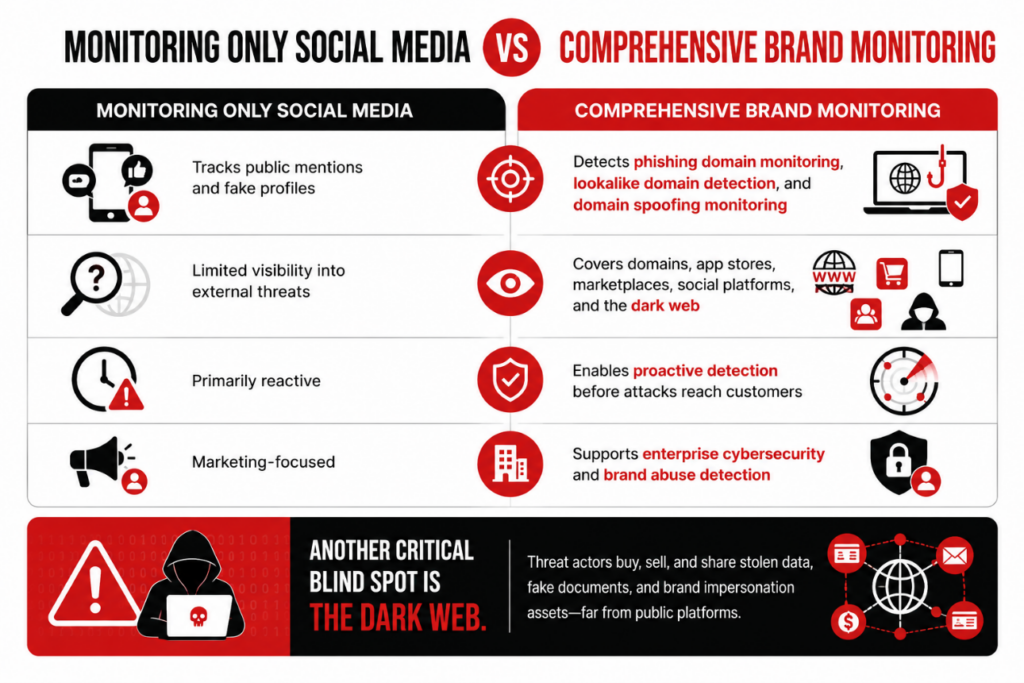
Another critical blind spot is the dark web.
Many phishing campaigns begin with stolen credentials, leaked customer data, or malicious infrastructure traded in underground communities. Organizations that lack visibility into dark web brand exposure often become aware of an attack only after customers report fraud or credentials begin appearing in breach databases.
Effective digital brand protection enterprise programs therefore extend beyond social media to monitor every channel where a brand can be impersonated or exploited.
Protect Your Brand Before Attackers Exploit It
Brand abuse is rarely confined to a single channel. A phishing campaign may involve fraudulent domains, fake social media profiles, executive impersonation, and stolen credentials simultaneously. Identifying these connections early is the difference between preventing an incident and responding after customers have already been affected.
Myth #3: Manual Monitoring and Google Alerts Are Enough
Reality: Free tools and manual searches cannot keep pace with today’s threat landscape.
One of the most dangerous brand protection myths is the belief that occasional Google searches, Google Alerts, or manual reviews provide adequate protection. While these methods may identify public mentions of a brand, they offer little visibility into the sophisticated tactics cybercriminals use today.
Modern attacks move far faster than manual processes.
A phishing domain can be registered, weaponized, and taken offline within hours. Fake mobile applications can appear on third-party app stores before security teams even become aware of them. Likewise, fraudulent websites may only remain active long enough to steal credentials before attackers abandon them and move to new infrastructure.
Manual monitoring also struggles to identify coordinated attacks. A phishing campaign rarely relies on a single asset. Attackers often register multiple lookalike domains, create fake executive profiles, launch spoofed websites, and distribute phishing emails simultaneously. Viewing each indicator in isolation makes it difficult to understand the scale of an attack.
This is where automated brand protection software becomes essential. Instead of relying on periodic searches, organizations need continuous monitoring capable of identifying suspicious activity as it emerges.
An effective platform combines phishing domain monitoring, lookalike domain detection, and brand spoofing detection with threat intelligence to help security teams prioritize the incidents that require immediate action.
The goal is not to generate more alerts. It is to generate meaningful intelligence that enables faster response.
Why Automation Makes the Difference
The gap between manual monitoring and automated intelligence continues to widen as attackers adopt AI, automation, and phishing-as-a-service platforms.
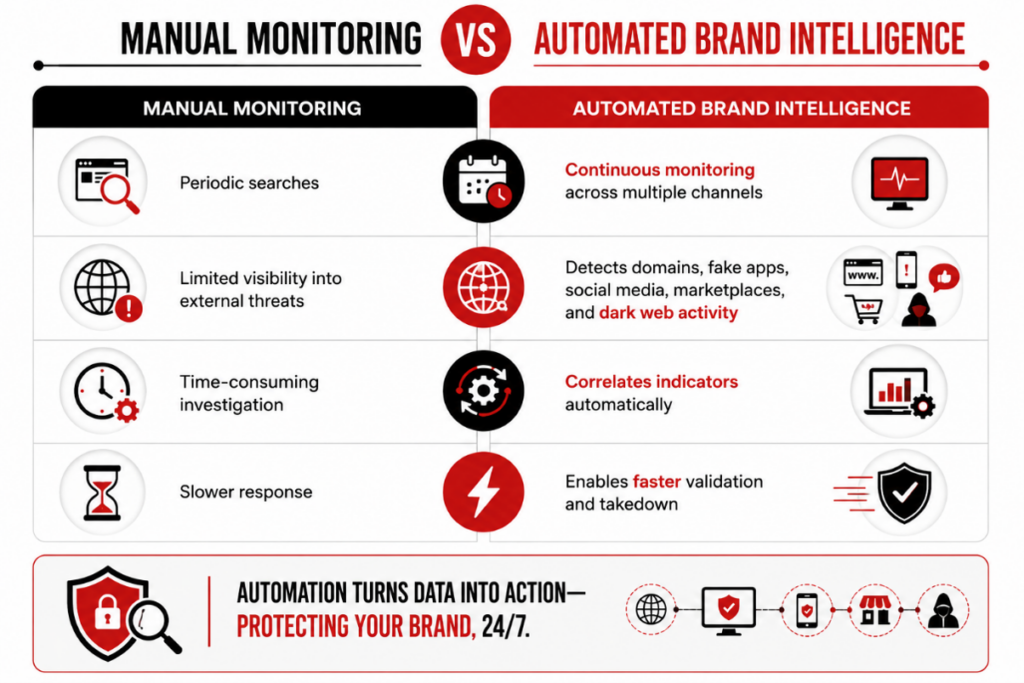
Organizations investing in brand monitoring solutions are no longer simply looking for alerts. They want context, prioritization, and actionable intelligence that reduces investigation time.
Myth #4: Brand Monitoring Is Only Useful After an Attack Happens
Reality: Effective brand monitoring is proactive, not reactive.
Another common brand protection myth is that brand monitoring only helps after a phishing website or impersonation campaign has already gone live.
In reality, many attacks leave warning signs long before customers become victims.
Threat actors often register suspicious domains days or even weeks before launching phishing campaigns. They test counterfeit websites, prepare email infrastructure, or advertise phishing kits in underground communities while waiting for the right opportunity to strike.
Organizations capable of identifying these early indicators can disrupt campaigns before they reach customers.
This shift from reactive response to proactive detection is becoming increasingly important as cybercriminals industrialize brand abuse. Europol’s 2025 assessment highlighted the growing number of criminal services supporting ransomware, phishing, malware distribution, and credential theft. Although international law enforcement disrupted hundreds of malicious domains and thousands of servers through Operation Endgame, new criminal infrastructure continues to emerge just as quickly.
Brand monitoring should therefore be viewed as an early warning capability rather than an incident response tool.
Continuous brand threat intelligence enables organizations to identify suspicious activity across domains, social platforms, mobile applications, and underground communities before attacks gain momentum.
It also supports faster takedown efforts by providing evidence that links multiple indicators to the same campaign.
The organizations that respond fastest are usually those that detect threats earliest.
Get your Brand Threat Exposure Assessment with Cyble Brand Intelligence & Protection.
Myth #5: Once Brand Monitoring Is Set Up, It Runs Itself
Reality: Brand protection requires continuous adaptation.
Perhaps the most overlooked brand protection myth is the assumption that deploying a monitoring solution permanently solves the problem.
Attackers evolve every day.
New phishing kits appear regularly. AI-generated content makes fraudulent websites more convincing. Deepfake technology is increasingly used to impersonate executives, while attackers constantly register new domain variations designed to bypass traditional detection methods.
The monitoring strategy that worked six months ago may no longer identify today’s threats.
Security teams must continuously refine monitoring rules, review emerging attack patterns, expand keyword coverage, and adjust detection models as new campaigns appear.
This is particularly important for organizations facing executive impersonation monitoring challenges. AI-generated voice cloning and deepfake technology have made executive fraud significantly more convincing than traditional phishing emails.
The financial stakes back this up: the FBI’s 2025 Internet Crime Complaint Center (IC3) report recorded $3.046 billion in business email compromise losses last year, up from $2.77 billion in 2024 — much of it enabled by convincing brand and executive impersonation.
Effective monitoring is therefore a continuous process that combines technology, threat intelligence, and analyst expertise.
Organizations that regularly review findings, investigate emerging trends, and refine detection logic are significantly better positioned to prevent future attacks.
The Real Cost of Believing These Brand Protection Myths
Every misconception discussed so far creates a visibility gap that attackers are quick to exploit.
Organizations that rely solely on social media monitoring may never detect a phishing domain until customers begin reporting fraudulent emails. Businesses that depend on manual searches often miss short-lived phishing infrastructure entirely. Those that treat monitoring as a one-time project gradually lose visibility as attackers adopt new tactics.
The consequences extend well beyond reputation.
Successful brand abuse can result in customer credential theft, financial fraud, executive impersonation, regulatory scrutiny, and long-term erosion of customer trust. Recovery often requires significantly more effort than prevention.
The challenge is no longer identifying whether brand abuse exists. It is identifying it before customers do.
How Cyble Brand Intelligence Helps Organizations Stay Ahead
Effective digital risk protection requires more than monitoring mentions across the internet.
Cyble’s Brand Intelligence & Protection platform is designed to help organizations detect and respond to brand abuse before it escalates into business risk.
Rather than monitoring a single channel, the platform combines brand intelligence, brand threat intelligence, and continuous monitoring across domains, social media platforms, app stores, messaging channels, and the dark web to provide a comprehensive view of an organization’s external threat landscape.
Organizations can detect phishing infrastructure, identify fake social media account detection opportunities, uncover brand impersonation threats, monitor suspicious domain registrations, and accelerate takedown efforts through a single platform.
What further strengthens Cyble’s capabilities is its intelligence foundation. With visibility into more than 200 billion dark web records, security teams can identify emerging threats, leaked credentials, and malicious infrastructure long before they become customer-facing incidents.
Instead of reacting after an attack succeeds, organizations gain the intelligence needed to reduce exposure, prioritize response, and strengthen their overall brand protection strategy.
Identify phishing domains, fake accounts, and brand impersonation before attackers strike with Cyble Brand Intelligence & Protection.
Conclusion
The way organizations think about brand monitoring has changed dramatically over the past few years. What was once viewed as a marketing function has become a critical component of enterprise cybersecurity.
As attackers continue to exploit trusted brands through phishing campaigns, executive impersonation, fraudulent domains, and counterfeit digital assets, relying on outdated assumptions is no longer an option. The five brand protection myths discussed in this article highlight a common problem: organizations often underestimate where threats originate and how quickly they evolve.
An effective brand protection strategy is built on continuous visibility rather than periodic checks. It combines external attack surface monitoring, threat intelligence, automated detection, and rapid response to identify threats before customers, employees, or partners are affected.
The goal is not simply to monitor your brand. It is to understand how attackers are abusing it, prioritize the risks that matter most, and take action before those threats turn into business incidents.
As cybercriminals continue to industrialize phishing and impersonation campaigns, organizations that invest in proactive cyber brand protection will be significantly better positioned to safeguard customer trust and protect their digital reputation.
Frequently Asked Questions About Brand Monitoring Myths
Is brand monitoring only necessary for large enterprises?
No. Organizations of all sizes face the risk of phishing, impersonation, and domain abuse.
What is the difference between brand monitoring and brand intelligence?
Although the terms are often used interchangeably, there is an important distinction between brand intelligence vs brand monitoring. Brand monitoring focuses on identifying where your brand is being mentioned or misused across digital channels. Brand intelligence adds context by correlating information from domains, social media, phishing infrastructure, the dark web, malware campaigns, and threat actor activity. This enables security teams to understand which threats pose the highest risk and respond accordingly.
How does brand monitoring help prevent phishing attacks?
Brand monitoring helps identify suspicious domains, fake websites, impersonation attempts, and phishing infrastructure before attackers begin targeting customers. Capabilities such as phishing domain monitoring, lookalike domain detection, and domain spoofing monitoring allow organizations to identify fraudulent assets early and initiate takedown actions before large-scale phishing campaigns are launched.
Does social media monitoring provide complete brand protection?
No. While social media monitoring is an important component of online brand protection, it only covers one part of the attack surface.
Why is dark web monitoring important for brand protection?
Many attacks begin long before customers receive a phishing email. Threat actors frequently sell stolen credentials, advertise phishing kits, and discuss targeted campaigns on underground forums. Monitoring dark web brand exposure allows organizations to identify these early warning signs and respond proactively rather than waiting for an incident to occur.
What should organizations look for in brand monitoring tools and services?
The best brand monitoring tools go far beyond simple mention tracking. When evaluating brand monitoring services, look for continuous coverage across domains, social media, app stores, and the dark web; automated detection of phishing infrastructure and executive impersonation; brand spoofing detection; and built-in takedown workflows rather than alerts alone. Whether you call it a brand monitoring service or a brand protection platform, the deciding factor is how quickly it turns detection into action — not how many alerts it generates.