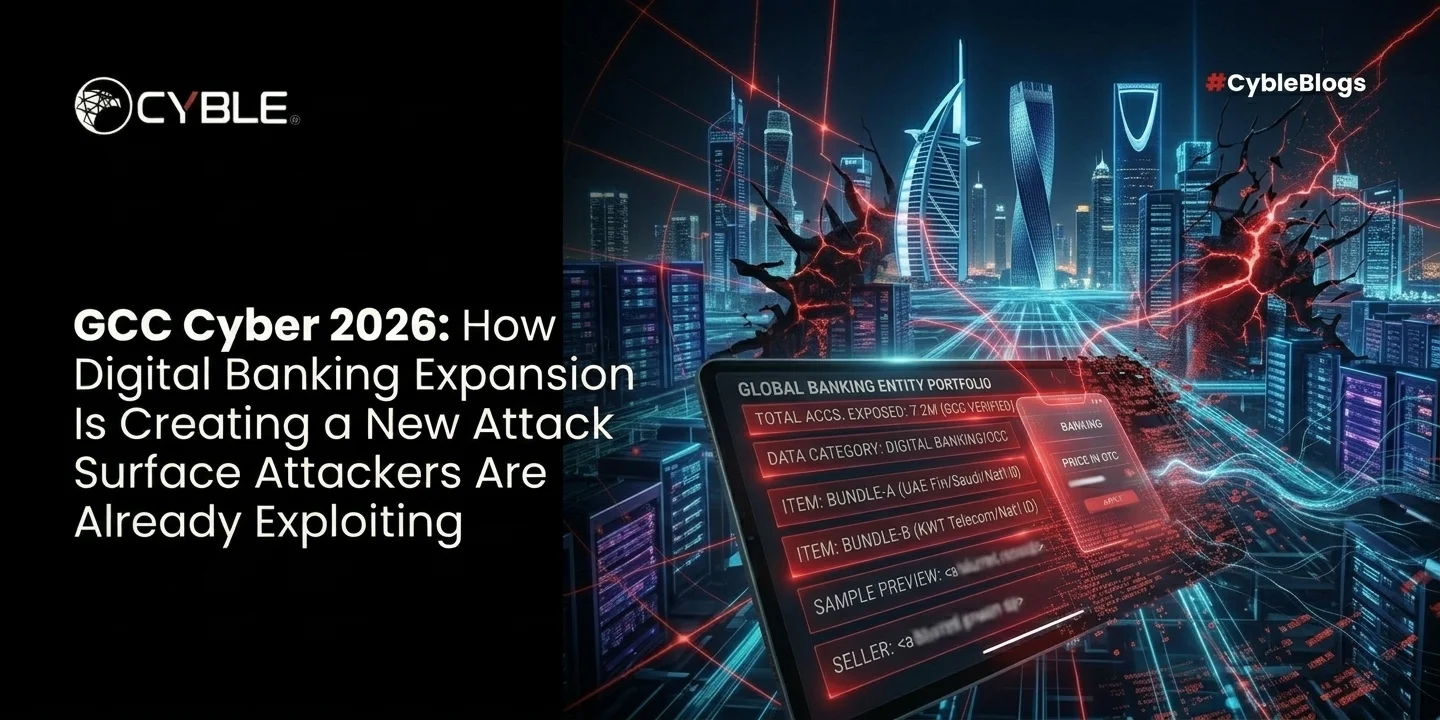
The Gulf Cooperation Council (GCC) region has spent the last several years building one of the world’s most ambitious digital economies. Across Bahrain, Kuwait, Oman, Qatar, Saudi Arabia, and the UAE, governments and enterprises have accelerated investments in cloud infrastructure, AI-driven services, smart cities, and digital banking technology at a pace rarely seen elsewhere. Banks are rolling out instant payments, embedded finance services, mobile-first platforms, and API-driven ecosystems designed to support a rapidly expanding fintech economy.
But this transformation has introduced a difficult reality for security teams: every new integration, cloud workload, mobile application, and third-party service expands the digital banking attack surface.
In 2026, attackers are no longer merely probing isolated systems. Fintech companies, telecom infrastructure, SaaS platforms, APIs, cloud environments, and vendor supply chains are just a few of the interconnected ecosystems they are taking advantage of.
Due to the GCC’s modernization efforts, ransomware operators, state-backed threat actors, and financially motivated cybercrime groups that use automation and AI-enhanced attack methodologies now view the area as a high-value target. As a result, the environment for banking cybersecurity is becoming faster, more dispersed, and much more difficult to defend.
Ransomware Operations Are Targeting GCC Financial Ecosystems
Throughout 2024 and 2025, ransomware continued to be one of the GCC’s most disruptive cyberthreats, especially for industries linked to economic stability and national infrastructure. Organized cybercrime gangs consistently targeted financial institutions, telecommunications businesses, healthcare providers, logistics companies, and government agencies.
Because digital banking technology extensively relies on cloud services, third-party integrations, and networked platforms, the danger has become particularly acute for banks and fintech companies. Instead of going straight against institutions, attackers take advantage of these connections to spread laterally across contexts.

Attacks impacting enterprises around the Middle East have been connected to groups like Qilin, DarkVault, and remnants of the Conti ransomware network. Qilin, which is well-known for its double-extortion strategy, allegedly targeted energy and logistics companies by obtaining confidential information, encrypting networks, and then requesting money. DarkVault leveraged recently discovered vulnerabilities impacting high-availability systems and VPN vulnerabilities to target companies in Qatar and Oman.
Additionally, the strategies have advanced beyond conventional encryption attacks. Threat actors frequently use watering hole attacks, credential theft operations, and Man-in-the-Middle (MiTM) interception tactics to infiltrate websites that employees in targeted industries frequently visit.
The rate of exploitation has emerged as a key issue. Within days of being made public, vulnerabilities like CVE-2024-4577 and CVE-2024-26169 were allegedly weaponized. CISOs are being forced to completely reconsider patch management, exposure monitoring, and incident response workflows due to this decreasing reaction window
Open Banking Security Is Becoming a Regional Pressure Point
The expansion of open banking security standards across the Gulf Cooperation Council (GCC) has created enormous opportunities for innovation, but it has also raised exposure, which many institutions are still finding challenging.
Modern banking ecosystems heavily rely on APIs to connect banks with fintech apps, payment gateways, digital wallets, lending platforms, and customer analytics tools. These integrations improve consumer satisfaction and expedite service delivery, but they also provide attackers with extremely attractive access points.
Cybercriminal organizations target exposed APIs, inadequate authentication processes, overpermissioned connections, and incorrectly configured cloud services. In several recent instances, attackers have gained access through trusted third-party connections rather than getting into institutions directly.
This shift is changing the fundamentals of fintech cybersecurity. Security forces no longer guard a single perimeter. Instead, they are attempting to protect dynamic ecosystems that include remote developers, SaaS platforms, cloud-native applications operating across many jurisdictions, and external vendors.
Gaps in visibility make the issue worse. Many firms still lack real-time visibility of all externally exposed assets connected to their surroundings. Because of forgotten APIs, abandoned web apps, insecure VPNs, and uncontrolled cloud instances, attackers still have low-friction access points.
Data Breaches and Dark Web Exposure Continue to Rise
Data breaches and underground market activities have significantly grown as digital banking technology spreads throughout the Gulf Cooperation Council.
In just the first half of 2025, researchers found over 90 instances of GCC-related data being released on illicit marketplaces and dark web forums. Sensitive company documents, financial details, login credentials, and personally identifiable information were allegedly among the leaked data.
Stolen financial and fintech data is now a very lucrative commodity for cybercriminals. Credentials can be sold to other criminal organizations that specialize in financial theft or utilized for ransomware operations, fraud campaigns, and account takeover attempts.
One noteworthy event was a cloud provider in the United Arab Emirates that was allegedly infiltrated, resulting in the exfiltration of customer data from the fintech and healthcare industries. Later, the stolen data appeared on black marketplaces where hackers tried to profit from the hack.
E-Commerce and Digital Payments Are Expanding the Digital Banking Attack Surface
Another quickly growing attack surface has been produced by the GCC’s thriving e-commerce industry. Attackers are focusing more on customer-facing infrastructure as online payments, digital wallets, and real-time financial services expand.
Researchers found that phishing and credential-stuffing attacks against GCC e-commerce platforms increased by 25% between the first and third quarters of 2025. In other instances, after attackers took advantage of lax password policies or unpatched web applications, hacked administrator credentials subsequently surfaced on underground forums.
Attacks on software supply chains increased dramatically at the same time. Researchers monitored about 16 software supply chain threats every month on average throughout the region between October 2024 and May 2025.
These examples highlight the preference of attackers for indirect compromise. Instead, then breaking into a big bank directly, they go after software manufacturers, cloud service providers, managed service providers, or API partners that can give access to several downstream victims at once.
Fintech cybersecurity executives are being compelled by this development to examine third-party risk management more closely than in the past.
AI-Driven Cybercrime Is Accelerating Faster Than Defenders Can Respond
One of the defining characteristics of the 2026 threat landscape is the industrialization of cybercrime.
Cybercrime-as-a-service ecosystems have matured into structured underground marketplaces where attackers can purchase malware kits, leased infrastructure, stolen credentials, penetration testing tools, and even negotiation services for ransomware operations.
Ransomware groups such as Qilin and Akira expanded beyond malware deployment by offering affiliates industry-specific attack playbooks and outsourced operational support. Global ransomware payments surpassed $2.1 billion over the last three years while the cost of enterprise-grade attack tools declined substantially.
Artificial intelligence is amplifying this trend.
Attackers now use AI-generated phishing campaigns, automated reconnaissance systems, and deepfake-enabled fraud operations to scale attacks far more efficiently than traditional methods allowed. AI tools are also being used to scrape social media, map executive hierarchies, and craft highly personalized phishing messages capable of bypassing conventional detection systems.
For financial institutions operating complex digital banking technology environments, this creates an asymmetrical problem: attackers can automate offensive operations faster than many organizations can modernize defensive workflows.
Compliance Enforcement Is Becoming More Aggressive
Regulators across global markets strengthened cybersecurity enforcement significantly throughout 2025, and GCC organizations are feeling that pressure.
Compliance requirements now extend far beyond annual audits and policy documentation. Regulators expect measurable operational resilience, continuous monitoring, rapid breach disclosure, and stronger oversight of third-party vendors.
For banks and fintech providers, open banking security obligations are becoming especially demanding because institutions must demonstrate visibility into API activity, cloud risk exposure, and interconnected vendor ecosystems.
This shift reflects a growing recognition that cybersecurity failures can rapidly evolve into systemic economic risks when digital financial services become deeply interconnected.
As a result, enterprises are investing more heavily in automated evidence collection, AI-assisted security operations centers, continuous attack surface monitoring, and intelligence-driven risk management programs.
Speed Has Become the Defining Factor in Banking Cyber Security
The most critical lesson from the GCC cyber landscape is that modern attacks are defined by speed. Threat actors are no longer taking days or weeks to progress from initial access to privilege escalation and data exfiltration; they are completing the entire attack chain in a matter of hours. Organizations relying on manual investigations and fragmented tooling often struggle to contain incidents before they translate into real operational and financial impact.
To keep pace, security teams are shifting toward AI-driven defense models that reduce response time through behavioral analytics, automated triage, and intelligent incident response workflows. Platforms like Cyble, the world’s first AI-native unified cybersecurity platform, are enabling this transformation by delivering continuous threat intelligence, real-time attack surface visibility, and autonomous response capabilities across complex digital ecosystems.
Cyble’s AI-native approach, powered by Cyble Vision, Cyble Titan EDR, and Blaze AI—helps organizations detect, correlate, and respond to threats faster than traditional security stacks, reducing dwell time and improving resilience across cloud, API, and fintech environments.
In 2026, cybersecurity effectiveness is no longer defined by prevention alone, but by how quickly organizations can detect anomalies, contain threats, and disrupt attacker movement across interconnected systems.
As the GCC’s digital transformation accelerates, the digital banking attack surface continues to expand with every new API, cloud workload, and third-party integration. Attackers are already adapting to this reality, automating their operations and targeting the weakest links in the ecosystem.
Organizations that succeed will be those that move faster than the threat itself. With Cyble’s AI-native cybersecurity platform, security teams can unify intelligence, automate response, and stay ahead of evolving cyber risks in real time.
Strengthen your defense against modern cyber threats with Cyble. Book a demo to see how an AI-native security platform can help you detect, respond, and outpace attackers across your entire digital banking attack surface.