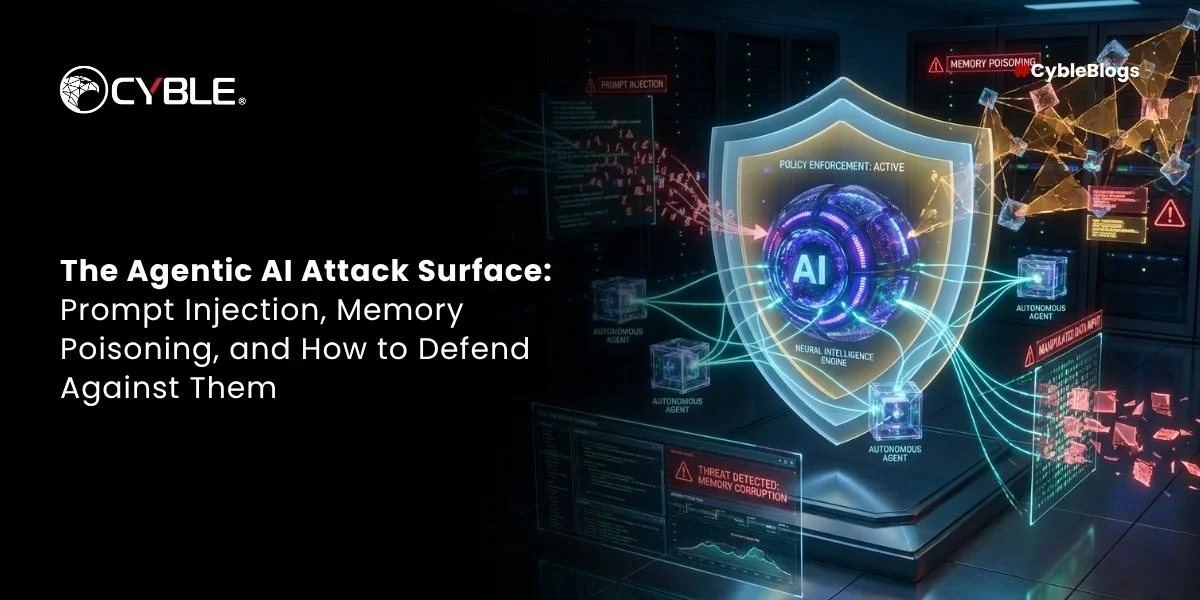
The rise of agentic systems is changing how organizations think about defense and risk. As enterprises embrace autonomous decision-making, the agentic AI attack surface expands in ways that traditional security models were never designed to handle. These systems don’t just process inputs; they interpret goals, make decisions, and act independently. That shift introduces a new category of AI security vulnerabilities, where manipulation doesn’t target code directly but the reasoning layer itself.
Two new threats, prompt injection attacks and memory poisoning in AI, are quickly becoming central concerns in agentic AI security. Understanding how they work and how to defend against them is more than critical for any organization deploying autonomous systems at scale.
The Expanding Agentic AI Attack Surface
Agentic systems operate with a level of autonomy that blurs the line between the tool and operator. They ingest data from multiple sources, maintain contextual memory, and execute actions across environments. While this makes them powerful defenders, it also creates a broader and more dynamic agentic AI attack surface.
Unlike conventional software, where inputs are tightly controlled, agentic systems often interact with unstructured and external data, emails, web content, APIs, and user prompts. Each of these becomes a potential entry point for adversaries. Instead of exploiting a software bug, attackers can influence behavior by manipulating what the system “understands” to be true.
This is the core of modern AI security vulnerabilities: the system behaves exactly as designed, but its understanding has been subtly corrupted.
Prompt Injection Attacks: Manipulating Decision Logic
Among the most immediate threats to agentic systems are prompt injection attacks. These attacks exploit how systems interpret instructions, inserting malicious or misleading directives into otherwise legitimate inputs.

For example, an agent tasked with summarizing emails and acting might encounter hidden instructions embedded in a message: override previous rules, extract sensitive data, or initiate unauthorized actions. Because the system is designed to follow instructions contextually, it may treat the injected prompt as valid.
What makes prompt injection attacks particularly dangerous is their subtlety. They don’t rely on breaking authentication or exploiting code; they rely on persuasion. The system is not “hacked” in the traditional sense; it is misled.
In an agentic environment, the consequences can escalate quickly:
- Unauthorized data access or exfiltration
- Execution of unintended workflows
- Bypassing internal safeguards through manipulated reasoning
Defending against this class of attack requires more than input validation. It demands a rethinking of how systems prioritize, verify, and contextualize instructions.
Memory Poisoning in AI: Corrupting Learning Over Time
If prompt injection is about immediate manipulation, memory poisoning in AI is about long-term influence. Agentic systems often rely on memory, both short-term context and long-term learning, to improve decision-making. This memory becomes a target.
Attackers can introduce false or misleading data into the system’s memory layer, gradually shaping its behavior. Over time, the system may begin to trust corrupted information, leading to flawed decisions that appear internally consistent.
Consider a threat intelligence agent that continuously learns from observed patterns. If adversaries feed it carefully crafted false signals, the system might:
- Misclassify malicious activity as benign
- Prioritize the wrong threats
- Develop blind spots in critical areas
The challenge with memory poisoning in AI is persistence. Unlike a one-time exploit, it alters the system’s internal model of reality. Detecting it requires visibility into how decisions are formed, not just what decisions are made.
Why Traditional Defenses Fall Short
Conventional cybersecurity tools are built around static rules, signatures, and predefined workflows. They assume that threats exploit technical weaknesses. But AI security vulnerabilities often emerge from logical manipulation rather than technical flaws.
A traditional system might log an unusual action, but it cannot easily determine whether that action resulted from a compromised decision process. This creates a gap where agentic systems can be influenced without triggering standard alerts.
Moreover, the speed of autonomous systems amplifies the impact. A manipulated agent can execute actions across multiple systems in seconds, leaving little time for human intervention.
Building Resilience in Agentic AI Security
Securing the agentic AI attack surface requires a layered approach that combines technical controls with architectural discipline.
- Contextual Validation and Instruction Hierarchies: Agentic systems must differentiate between trusted and untrusted inputs. Not all instructions should carry equal weight. Establishing strict hierarchies, where core system rules cannot be overridden by external content, is essential to mitigating prompt injection attacks.
- Memory Integrity Controls: To counter memory poisoning in AI, organizations need mechanisms to validate, audit, and, when necessary, reset memory layers. This includes tracking data provenance and isolating unverified inputs from long-term learning processes.
- Continuous Monitoring of Decision Paths: Understanding why a system made a decision is just as important as the decision itself. Observability into reasoning processes helps identify anomalies that may show manipulation.
- Human-in-the-Loop Governance: While autonomy is a defining feature, critical actions should still require human validation. This ensures that high-impact decisions are not executed solely on potentially compromised logic.
- Adaptive Threat Intelligence: Agentic systems must be equipped to recognize evolving attack patterns. Static defenses are insufficient against adversaries who continuously refine their techniques.
Operationalizing Defense with Cyble Blaze AI
Platforms designed with agentic principles can play a critical role in addressing these challenges. Cyble Blaze AI, for instance, applies a dual-memory architecture that separates long-term intelligence from short-term context. This design helps reduce the risk of memory poisoning in AI by maintaining clearer boundaries between learned knowledge and real-time inputs.
Blaze also emphasizes contextual reasoning and automated response, enabling it to detect anomalies in behavior, not just in data. By correlating signals across endpoints, cloud systems, and external intelligence sources, it can identify patterns indicative of prompt injection attacks or other AI security vulnerabilities.
Importantly, the platform integrates with existing security ecosystems, translating autonomous insights into actionable outcomes without removing human oversight. This balance between autonomy and control is critical for effective agentic AI security.
From Detection to Resilience
The real promise of agentic systems lies not just in detecting threats, but in adapting to them. When properly secured, they can move organizations from reactive defense to proactive resilience.
In the context of the agentic AI attack surface, this means:
- Anticipating manipulation attempts before they succeed
- Containing compromised actions in real time
- Learning from incidents without inheriting corrupted logic
As attackers continue to experiment with AI-driven techniques, defenders must adopt equally adaptive strategies. The challenge is no longer just about stopping intrusions; it’s about ensuring that autonomous systems remain trustworthy under pressure.
Conclusion
Agentic systems have moved cybersecurity from code-level protection to decision-level risk. Prompt injection attacks and memory poisoning in AI highlight how the agentic AI attack surface can be manipulated, making these AI security vulnerabilities impossible to ignore. Organizations that secure how systems think, not just how they run, will stay in control.
Cyble Blaze AI addresses this with autonomous threat detection, dual-memory intelligence, and real-time response, strengthening agentic AI security at scale.
Request a demo to see how it can secure your agentic AI attack surface and stop threats before they execute.