Dark web Telegram groups are encrypted, semi-public channels through which threat actors share their ill-gotten gains, breach claims, malware, and fraud resources openly – no Tor browser is needed. In most cases, these are the first places where claims of attacks and leaked credentials are found, sometime before they appear anywhere else.
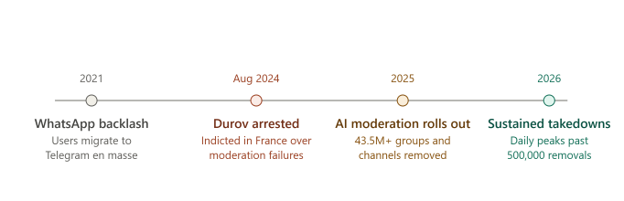
This is not the case with the free-for-all that they were a couple of years ago. Telegram has increased its moderation and enforcement in response to regulatory pressures and law enforcement requests, as can be seen in its transparency disclosures and platform governance requirements under the EU Digital Services Act framework. This framework requires stronger controls on illegal content and rapid takedown mechanisms for very large online platforms.

That shift has changed what analysts track and how they track it. The article then outlines who these groups are, how threat actors leverage the platform, the key categories to monitor, and 11 priority channels for security teams, along with safe monitoring practices.
What Are Dark Web Telegram Groups?
“Dark web Telegram groups” is a bit of a misnomer in that they’re not hosted on Tor or any hidden service; they run on the regular, surface-web infrastructure of Telegram. What earns them the name is, of course, their content: stolen databases, claims from victims of ransomware, advertisements for malware-as-a-service, and hacktivist operations, all of it more or less the same as what one would find on a dark web forum, only now conveniently more accessible.
And that’s the whole draw for the bad guys. Technically, setting up a leak site on Tor takes work and brings in less traffic. Anyone can spin up a Telegram channel in minutes and push the content in front of an already built-in audience of millions, with encryption and pseudonymity included. However, this ease of deployment now exists alongside a progressively stricter enforcement landscape, summarized in the timeline below from 2021 through 2026.
How Do Threat Actors Use Telegram?
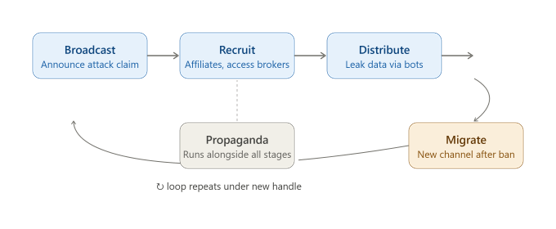
Threat actors lean on Telegram for five main things: fast publicity, resilience, recruitment, automated distribution, and propaganda.
- Rapid broadcasting of attack claims. Ransomware groups and hacktivists often announce a victim on Telegram before, or instead of, posting full details on a dedicated leak site.
- Channel migration and resilience. When Telegram pulls a channel down, the group is typically back up under a new handle within hours, often with a pinned post pointing followers to the new home.
- Recruitment and affiliate programs. Ransomware-as-a-service operations recruit developers, initial access brokers, and affiliates directly through Telegram, sometimes with public “now hiring” posts.
- Automated leak distribution. Bots push out stolen databases, credential dumps, and malware samples on a schedule, no human moderator required.
- Propaganda and ideological messaging. Hacktivist groups mix attack claims with political commentary, using the platform as much for narrative-building as for technical disclosure.
It’s a fast-moving ecosystem, and that’s exactly why it needs structured monitoring rather than occasional manual checks.
Telegram vs. Traditional Dark Web Forums
The two share a purpose, but the mechanics are quite different. Forums take work to get into and tend to have more durable, vetted communities; Telegram trades that durability for quickness and reach.
| Mechanics | Telegram Channels | Traditional Dark Web Forums |
| Access | Surface web, any browser or app | Requires Tor browser or similar |
| Setup effort | Minutes, no technical skill needed | Hosting, hardening, ongoing uptime |
| Audience reach | Built-in user base, instant discovery | Smaller, more insular communities |
| Resilience | Vulnerable to bans, but trivial to recreate | Harder to take down, but harder to rebuild trust |
| Vetting | Minimal; open joining is common | Often requires reputation, invites, or fees |
| Best for | Fast claims, leak distribution, recruitment | Long-form discussion, vetted trading, reputation systems |
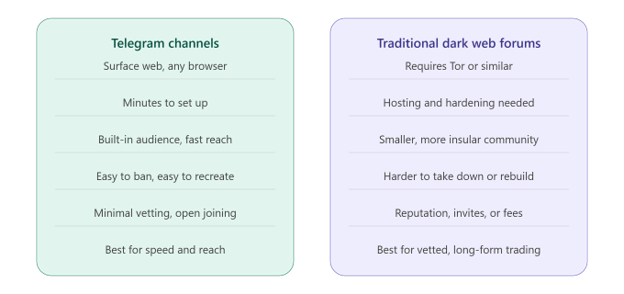
In practice, many threat actors run both, a forum presence for credibility and a Telegram channel for speed.
What Types of Dark Web Telegram Groups Exist?
Rather than one undifferentiated mass of “hacker channels,” the ecosystem breaks down into a handful of recognizable categories. Each category provides insight into the activity, content, and risks likely to be encountered.
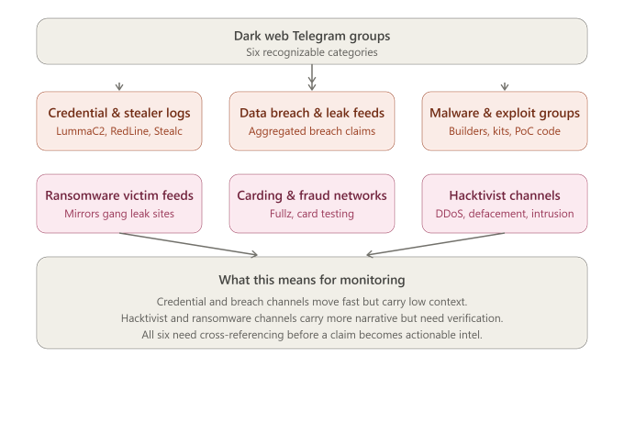
Credential & Stealer-Log Channels
These channels distribute logs harvested by infostealer malware, usernames, passwords, session cookies, and browser data pulled from infected machines.
Families like LummaC2, RedLine, and Stealc dominate this space; according to threat intelligence reporting from Cyble, these infostealer ecosystems operate at massive scale as Malware-as-a-Service offerings, while government advisories from the Indian government’s CERT-In confirm their widespread use in global cyber campaigns targeting credentials, cookies, and session tokens.
Their logs get repackaged and redistributed on Telegram long after the original infection. A single log dump can contain corporate VPN credentials sitting right next to someone’s streaming account password.
Data Breach & Leak Announcement Channels
These act as a clearinghouse for breach claims, often aggregating posts from multiple leak sites and forums into one feed. They’re high-volume and low-context by design, useful for spotting a mention of one’s organization fast, less useful for judging whether the claim is real.
Malware & Exploit Distribution Groups
Here, the product is the tooling itself: malware builders, exploit kits, and proof-of-concept code for newly disclosed CVEs. Some of this is genuinely novel; a lot of it is recycled or non-functional, sold to less technical buyers who can’t tell the difference.
Ransomware Victim-Listing Feeds
These channels mirror ransomware gangs’ leak-site posting, naming victims, sometimes with partial proof, often before the official leak site updates. They’re a fast way to catch a victim announcement, but they rarely carry the full context a leak site eventually provides.
Carding & Fraud Networks
Focused on payment card data, “Fullz” (full identity packages), and the infrastructure around financial fraud, money mule recruitment, card-testing services, and the like. BidenCash has been one of the more persistent names in this category, regularly resurfacing under new domains and channels after takedowns.
Hacktivist & Threat-Actor Channels
This is where ideology and cyberattacks meet. Pro-Russian, pro-Ukrainian, and pro-Palestinian hacktivist groups all maintain active Telegram presences, mixing DDoS claims, defacements, and more disruptive intrusions, with political messaging aimed at sympathizers and media alike.
11 Dark Web Telegram Groups to Monitor
The first four channels below function more like a shared intelligence feed, raw data straight from the sources threat researchers and platforms already work with. The rest are threat-actor channels in their own right. Subscriber counts and posting cadence shift constantly as channels get banned and migrate; the table below shows when each entry was last confirmed, and we’ll update it as channels move.
| Channel | Type | Subscribers | Post Frequency | Last Verified |
| Dark Monitor | Threat intel aggregator | Unverified (high) | Continuous, dozens/day | June 2026 |
| Data Leak Monitor | Leak announcement feed | 25,000+ | Several/minute at peak | June 2026 |
| Daily Dark Web | Leak announcement feed | Unverified (mid) | 5–10 digests/day | June 2026 |
| Ransomlook | Ransomware victim feed | Unverified (mid) | ~20 victims/day | June 2026 |
| NoName057(16) | Hacktivist (pro-Russia) | Unverified (high) | Several/day | June 2026 (channel ~10 days old at verification) |
| Z-Pentest | Hacktivist / ICS intrusion | Unverified (mid) | Several/week | June 2026 |
| IT Army of Ukraine | Hacktivist (pro-Ukraine) | ~115,000 | Daily | June 2026 |
| Ghost Princess | Hacktivist (pro-Palestine) | Unverified (mid) | Several/week | June 2026 |
| RipperSec | Hacktivist (pro-Palestine) | Unverified (mid) | Daily | June 2026 |
| Cyber Security – Information Security – IT Security | Practitioner discussion | 52,000+ | Continuous discussion | June 2026 |
| Threat Intelligence Sharing | Researcher collaboration | 2,000+ | Several/day | June 2026 |
1. Dark Monitor
One of the more active cybersecurity channels on Telegram, full stop. The volume, CVEs, ransomware victims, breach claims, research links, is substantial, and a decent argument for why AI-powered threat intelligence platforms exist: something has to sift through it and identify what actually matters.
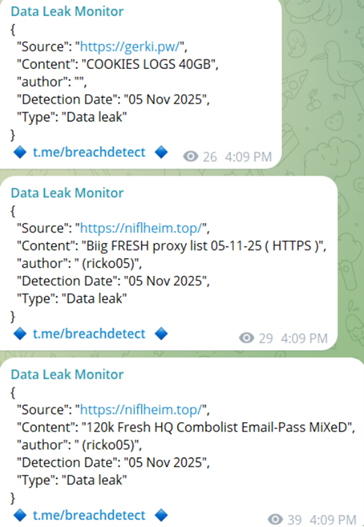
2. Data Leak Monitor
Even higher volume than Dark Monitor, sometimes posting several new leak detections a minute. It has more than 25,000 subscribers, which tells if there’s real demand for a firehose like this, noise and all.
3. Daily Dark Web
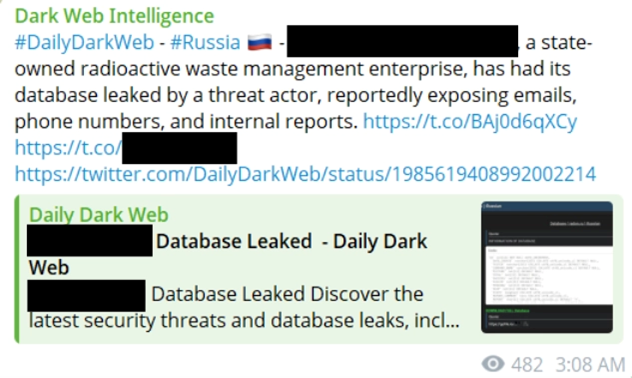
A more manageable pace, roughly five to ten digests a day, pulling from ransomware and breach claims circulating on leak sites. One recent post we tracked claimed a data leak tied to a Russian state-owned entity, a reminder that geopolitics shows up here as often as garden-variety cybercrime.
4. Ransomlook
Posts around 20 alleged ransomware victims daily, names and the bare-bones claim details, no embellishment. Good for a quick scan of who’s allegedly been hit recently.

5. NoName057(16)
The Russia-linked hacktivist group NoName057(16) is arguably the single most active group on this list, and also the most itinerant, it gets banned and re-platforms constantly. Its current English-language channel was barely ten days old at the time of our research and was already posting several new claimed victims a day, including DDoS operations against Italian targets.

This handle should be expected to change again, see the table above for the most recently verified date.
6. Z-Pentest
One of the more unsettling channels to follow. Members have posted videos of themselves apparently tampering with industrial control panels at energy facilities, content that’s less “interesting from a distance” and more “concerning that this is happening at all.” The group represents a broader shift among hacktivists away from DDoS and defacement and toward more destructive territory: unauthorized access and data breaches against critical infrastructure.

7. IT Army of Ukraine
One of the more stable channels on this list, with roughly 115,000 followers and a consistent posting cadence since the early days of the invasion. A solid source for pro-Ukraine hacktivist activity and claimed operations against Russian infrastructure.

8. Ghost Princess
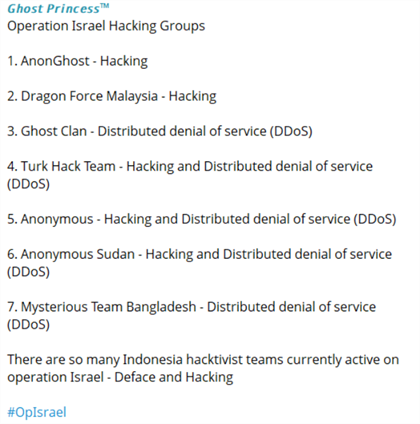
Self-described as journalism and activism rather than hacktivism outright, this channel is a useful window into Middle East-focused cyber activity, including #OpIsrael-style campaigns, alongside pro-Palestinian political commentary.
9. RipperSec
Another pro-Palestinian channel, focused on hacktivist operations against Israeli and allied targets. On the day we researched this list, the group had shared documents it claimed were stolen from the Israel Defense Forces, alongside a DDoS claim, a reasonably representative day for the channel.

10. Cyber Security – Information Security – IT Security
A genuinely interactive group rather than a one-way broadcast feed. With over 52,000 members, it runs real-time discussion on emerging threats, incident response tactics, and general best practice, useful less for raw intel and more for networking with other practitioners.

11. Threat Intelligence Sharing
Smaller, at just over 2,000 members, but built for collaboration among researchers, with links to adjacent groups covering SOC operations, malware analysis, reverse engineering, and incident response. A solid hub for crowdsourced input rather than a one-directional feed.
What Should Security Teams Monitor Inside These Channels?
Following these channels passively isn’t enough; the value comes from catching specific, actionable signals inside the noise. At minimum, security teams should watch for:
- Mentions of a company name, domains, or named executives.
- Credential dumps and database leak announcements relevant to one’s sector.
- Ransomware victim listings tied to industry or supply chain.
- Exploit discussions targeting technologies in stack.
- Recruitment posts seeking affiliates, access brokers, or insiders.
- Geopolitical developments are likely to trigger hacktivist campaigns against a sector or region.
Telegram generates an enormous volume of unverified, reposted, and sometimes outright fabricated claims. Separating signals from noise requires cross-referencing against other intelligence sources, leak sites, forum chatter, and one’s internal telemetry, rather than taking any single post at face value.
Is It Legal to Monitor Dark Web Telegram Groups?
Yes, in most jurisdictions, simply viewing or monitoring public and semi-public Telegram channels for threat intelligence purposes is legal; it’s the same principle as monitoring any other open-source intelligence feed. What changes the legal picture is action, not observation: purchasing stolen data, interacting with sellers, or participating in illicit transactions crosses into legally risky territory regardless of stated intent.
Most enterprise security teams handle this by using dedicated threat intelligence platforms or vetted researchers rather than having individual staff join and interact with these channels directly, which keeps both legal exposure and personal risk to a minimum.
How Can Teams Monitor Telegram Safely and at Scale?
Manual monitoring of even a handful of these channels quickly becomes unsustainable; posting volumes are high, channels migrate constantly, and a human analyst can only watch so many feeds at once. A few practical OPSEC principles apply regardless of scale:
- Use isolated, non-attributable accounts for any direct monitoring, never accounts tied to a personal or corporate identity.
- Never engage directly with threat actors, sellers, or recruiters, observation only.
- Assume everything is logged by channel admins; treat monitoring presence as visible to the people watching.
- Automate collection where possible. Bots and scrapers can track high-volume channels far more reliably than a human scrolling a feed.
- Raw Telegram posts mean little in isolation; they need to be checked against leak-site data, forum activity, and own asset inventory to become useful intelligence.
This is also exactly the kind of repetitive, high-volume, low-context work that’s hard to staff manually, which is where automated platforms tend to earn their keep.
The first sign of a breach may be a Telegram post. Find it with Cyble!
How Cyble Helps
Cyble’s threat intelligence platform handles the monitoring overhead described above automatically, tracking thousands of threat-related Telegram channels and groups without requiring analysts to join or interact with them directly.
Through automated collection paired with AI-driven analysis, Cyble filters this firehose of raw chatter down to what’s relevant to your organization, credential leaks tied to your domains, ransomware claims touching your industry, and exploit chatter aimed at technologies in your environment.
Real-time alerts and detailed threat actor profiles turn what would otherwise be an unmanageable stream of unverified claims into intelligence your team can actually act on.
Conclusion
The channels covered in this article are where threat actors announce breaches, share stolen credentials, recruit affiliates, and publicize attacks—often before they appear in mainstream reporting. The question isn’t whether these channels matter; it’s whether your organization is already being mentioned in them.
Cyble continuously monitors Telegram, dark web forums, leak sites, and threat actor communities to identify exposures tied to your organization. When threats are discovered, Cyble goes beyond monitoring to help disrupt phishing campaigns, remove impersonation sites, and take down malicious infrastructure before attackers can capitalize on it.
Your data is already circulating. We help you erase it. Take it down with Cyble!
FAQ Abouts Dark Web Telegram Groups
Is using Telegram a red flag?Not inherently; Telegram is widely used, but suspicious activity or encrypted channels may raise concerns for security monitoring.
Can police or law enforcement track Telegram groups?
Yes. Law enforcement agencies routinely monitor public and semi-public Telegram channels, and Telegram has said it will share user IP addresses and phone numbers with authorities in response to valid legal requests — a policy shift that followed CEO Pavel Durov’s August 2024 arrest in France.
Is it legal to view or monitor dark web Telegram groups?
Generally, yes, viewing public or semi-public channels for research or threat intelligence purposes isn’t illegal on its own. Legal risk arises from actions like purchasing stolen data or transacting with sellers, not from observation.
What’s the difference between the dark web and Telegram?
The dark web refers to sites that require special software like Tor to access; Telegram is a mainstream, surface-web messaging app. “Dark web Telegram groups” describes channels on that mainstream platform that host the kind of illicit content typically associated with the dark web, not channels hosted on the dark web itself.
Where do cybersecurity teams find threat-actor Telegram channels?
Through a mix of OSINT research, threat intelligence platforms that track channel migrations automatically, and cross-references from leak sites and forums where threat actors often link to their current Telegram presence.
Is using Telegram a red flag?
Not inherently. Telegram is used by well over a billion people for entirely ordinary purposes. What’s notable from a security monitoring standpoint isn’t Telegram to use itself, but specific channels, content, or behavior that indicates illicit activity.
What sites are part of the dark web?
The dark web includes Tor-based marketplaces, forums, and leak sites that require specialized browsers to access, distinct from the surface-web Telegram channels covered in this article, even though both can host similar threat actor content.
How is this different from monitoring dark web forums directly?
Telegram channels are easier to access and faster-moving, making them good for early warning, but they tend to carry less vetted, less contextualized information than established dark web forums, where reputation systems and longer-form discussion give claims more scrutiny before they spread.