A large healthcare organization’s SOC receives nearly 12,000 security alerts every single day. Out of those, only about 400 are actually reviewed. And from those 400, maybe 15 turn out to be real threats that need action.
Everything else? Just noise.
False positives, duplicate alerts, routine activity flagged as suspicious, and low-risk findings that don’t deserve attention—but still demand it.
This isn’t an extreme case. It’s what most SOC teams are dealing with today.
Analysts spend a huge chunk of their time just trying to figure out what matters and what doesn’t. This constant filtering is at the heart of SOC alert fatigue, and it’s becoming one of the biggest challenges in cybersecurity. When teams are buried under thousands of alerts, the real threats don’t stand out—they get lost.
And that’s where the real risk begins.
Too Many Alerts, Not Enough Clarity
Modern security environments are built to detect everything. SIEMs, EDR tools, network monitoring, cloud security, vulnerability scanners, and even dark web intelligence feeds are all doing their job—generating alerts.
The problem isn’t detection. It’s the lack of context.
Each system works in isolation, producing its own stream of alerts without understanding how they connect. What might actually be a single coordinated attack often shows up as dozens of separate, unrelated alerts. Analysts are left to manually piece everything together, jumping between tools and trying to make sense of fragmented data.
It’s exhausting work. And over time, it takes a toll.
Burnout among analysts is high, turnover is constant, and teams are stuck in a loop of reacting instead of improving. Even worse, a significant number of alerts go completely uninvestigated—not because they aren’t important, but because there simply isn’t enough time.
This is where the need to reduce security alerts with AI becomes critical—not as a convenience, but as a necessity.
Why Traditional Automation Falls Short
Security teams have tried to solve this problem. SOAR platforms and automation tools have helped streamline some workflows. They can enrich alerts, trigger predefined responses, and reduce repetitive tasks.
But they still rely on fixed rules.
They follow instructions, not reasoning.
When something new or ambiguous happens—and it often does—these systems don’t adapt. They escalate the issue to human analysts. Which means the hardest, most time-consuming problems still land on already overwhelmed teams.
Attackers know this.
They deliberately design attacks that don’t match known patterns. They move slowly to stay under the radar. They use legitimate tools to blend into normal operations. And they exploit the exact gaps where traditional automation stops working.
Even more importantly, legacy automation struggles to connect the dots. It doesn’t recognize when multiple small signals—like unusual logins, lateral movement, and odd data access—are actually part of a larger attack chain.
That’s still left to humans.
And in an environment flooded with alerts, those connections are easy to miss.
The Shift to AI Native Cybersecurity
This is where AI native cybersecurity changes everything.
Instead of layering AI on top of existing tools, these platforms are built with AI at their core. They don’t just process alerts—they understand them.
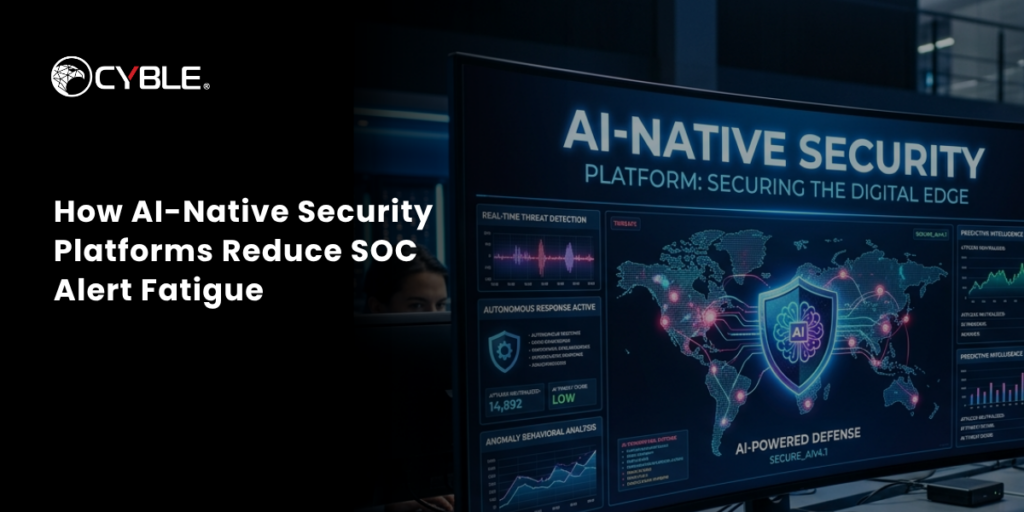
With AI SOC automation, the system doesn’t stop at detection. It investigates, correlates, prioritizes, and even responds—all in real time.
This is what makes an AI cybersecurity platform fundamentally different.
It continuously analyzes data across endpoints, networks, cloud environments, and external intelligence sources. It connects signals that occur seconds—or even days—apart. It understands context, identifies patterns, and determines whether something is truly a threat.
Most importantly, it dramatically improves AI alert triage.
Instead of flooding analysts with every anomaly, it filters out the noise automatically. It investigates alerts on its own, determines what’s real, and only surfaces what actually requires human attention.
The result is simple but powerful: fewer alerts, better decisions, faster response.
What This Means for SOC Teams
When AI takes over the heavy lifting, everything changes.
Alert volumes drop—not because threats disappear, but because irrelevant noise is removed. Analysts no longer spend hours triaging alerts that don’t matter. Instead, they focus on real threats, strategic investigations, and proactive defense.
This directly improves SOC analyst productivity.
Teams move from reactive firefighting to meaningful security work. Detection becomes faster. Response becomes immediate. And the constant pressure of alert overload begins to ease.
How Blaze AI Makes This Real
Cyble’s Blaze AI is designed specifically for this shift toward AI native cybersecurity.
It doesn’t just automate workflows—it understands the entire security environment. It combines historical threat intelligence with real-time context, allowing it to make decisions the way an experienced analyst would—but at machine speed.
Instead of waiting for alerts, Blaze continuously monitors and investigates activity across systems. It connects signals from different sources, builds a complete picture of potential threats, and acts instantly when something needs attention.
This is where AI SOC automation becomes truly effective. The system doesn’t just assist analysts—it works alongside them, handling the majority of investigations automatically.
What makes it even more impactful is how it prioritizes risk. Blaze understands which systems are critical, which data is sensitive, and which users have elevated access. It doesn’t rely on generic severity scores—it focuses on what actually matters to the organization.
And when action is needed, it doesn’t wait. It can isolate compromised systems, block malicious activity, and contain threats in seconds—while still providing full visibility into how and why those decisions were made.
A Smarter Way Forward
The goal of cybersecurity isn’t to generate more alerts. It’s to stop real threats.
Right now, too many teams are stuck dealing with noise instead of focusing on what matters. That’s why AI native cybersecurity is becoming essential.
By using AI to reduce security alerts, improve AI alert triage, and enhance SOC analyst productivity, organizations can finally break free from alert fatigue.
Because in the end, it’s not about handling more alerts.
It’s about making sure the right ones never get missed.