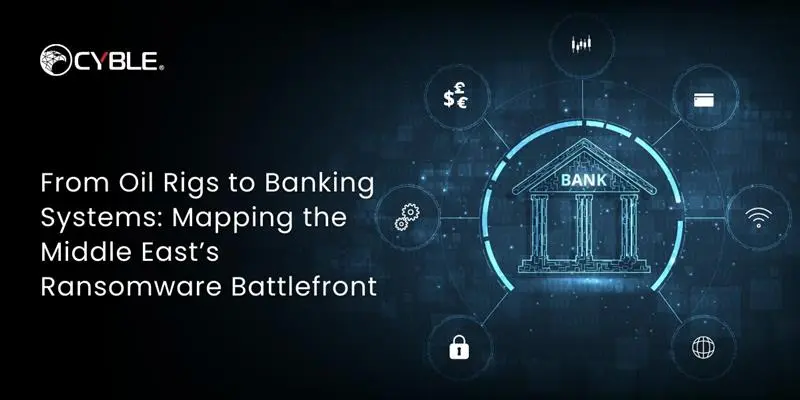
The Middle East has become the prime target of global ransomware operations. These operations are run by ransomware groups that target critical infrastructure to financial institutions without showing any signs of stopping.
Cybercriminals are exploitation everything that comes in their way or exploit open vulnerabilities before a patch is released, something we call zero-days. The Middle East is actively mitigating these risks since these industries are the backbone of the regional economy.
Ransomware’s Relentless Advance into the Gulf
In the last few months, ransomware spree in the Middle East has grown so much it has gone out of control. These attacks have manifested from simple pen testing techniques to large scale, corporate-style, ransomware operations.
What was once a sporadic threat is now a sustained and well-coordinated assault on critical infrastructure. Cyble’s recent threat intelligence reports reveal that cyberattacks with ransomware payloads have increasingly targeted energy grids, oil rigs, and, most notably, banking systems.
Banking systems ransomware in the Middle East has become a prime concern, with institutions across Saudi Arabia, the UAE, and Qatar reporting disruptions. This isn’t just about data encryption anymore; attackers are actively exfiltrating sensitive financial records and login credentials, then threatening public leaks if ransom demands are not met.
Supply Chain Attacks as a Ransomware Gateway
A rather interesting trend identified by Cyble is the role of software supply chain compromises in ransomware attacks. Between April and May 2025 alone, Cyble documented a 25% rise in supply chain-related ransomware incidents, several of which had direct consequences for Middle East-based enterprises.
These supply chain attacks act as a force multiplier. When IT service providers or telecom vendors are compromised, the infection cascades across all connected clients. This method was notably seen in attacks against financial service vendors supplying banks across the Gulf.
Mapping Middle East Ransomware: A Target-Rich Environment
According to Cyble’s intelligence, 10 documented ransomware incidents in early 2025 specifically impacted organizations in the Middle East and North Africa (MENA). Four of these targeted the UAE, with the remainder split between Israel and surrounding regions.
The sectors hit the hardest include oil and gas, telecommunications, and financial services. These sectors not only offer lucrative extortion potential but also hold national security implications, making them high-priority targets on the Middle East ransomware battlefront.
The DragonForce, Everest, and DarkVault ransomware groups have been particularly active in the region. For example, DarkVault, a newer entrant to the ransomware ecosystem, leveraged zero-day exploits to compromise high-availability systems in Oman and Qatar. These were not opportunistic attacks, but deliberate campaigns aimed at crippling banking and transport operations.
Banking Systems Under Siege
Cyble’s threat analysis shows a worrying spike in Banking systems ransomware in the Middle East. Financial services firms are now under near-constant threat. Attackers are not merely encrypting files, they’re stealing login credentials, exfiltrating client data, and gaining administrative access to banking applications.
This is evident from ransomware incidents targeting fintech platforms and enterprise security providers linked to banks. These breaches allow threat actors to potentially impact thousands of downstream users and customers, raising the stakes for incident response and regulatory compliance.
Critical Infrastructure: High Stakes, High Risk
The Middle East is home to some of the world’s most valuable and sensitive infrastructure, from oil fields in the Gulf to high-throughput maritime logistics hubs. Cyble’s researchers have highlighted how vulnerabilities in operational technology (OT) are being systematically exploited by ransomware groups.
The Middle East critical infrastructure ransomware threat is evolving from random attacks into a sustained campaign against OT environments. Maritime automation systems, telecommunications networks, and energy distribution platforms are all under siege.
Cyble has documented attackers using newly disclosed vulnerabilities, such as CVE-2024-4577, within days of public release, demonstrating the speed and efficiency of adversaries in the region.
Ransomware-as-a-Service (RaaS) Fuels the Fire
Cyble’s intelligence platform has traced many recent ransomware incidents back to the rise of Ransomware-as-a-Service (RaaS). This model enables even amateur threat actors to launch highly advanced attacks using pre-built payloads and back-end support from ransomware operators.
RaaS has democratized cybercrime in the Gulf. Affiliates now regularly target industries such as energy, banking, and telecom, leading to new layers of complexity in the Middle East ransomware ecosystem. Cyble has observed Qilin and Hellcat ransomware variants being used in conjunction with supply chain breaches, often to devastating effect.
Psychological Warfare via Data Leak Sites
Ransomware groups are increasingly turning to data leak sites as tools for psychological coercion. Cyble reports that over 90 unique Gulf-related data dumps appeared on dark web forums in the first half of 2025. These leaks frequently include customer data, government correspondence, financial transactions, and internal strategies.
The threat of exposure is now as potent as encryption. For many Middle East organizations, the fear of reputational damage compels ransom payment more than the operational downtime itself, especially for entities in the banking sector.
Conclusion
Despite growing awareness, the Middle East’s defenses still lag behind the modern ransomware landscape. While nations like Saudi Arabia, Qatar, and Oman are tightening their cybersecurity frameworks, Cyble emphasizes that regulation alone isn’t enough. Organizations must adopt proactive, intelligence-driven strategies.
With its AI-native threat intelligence platform, Cyble delivers unmatched visibility across the dark web, ransomware groups, and data leak markets, empowering security teams to anticipate, detect, and neutralize threats before damage is done. As the Middle East ransomware battlefront intensifies, Cyble remains a crucial force in helping the region shift from reactive defense to predictive protection.
Schedule a demo today to find out how Cyble can protect your organization today!