Key Takeaways
- Best Hidden Wiki alternatives in 2026: Ahmia for safety-filtered results, Torch for the largest general index, OnionLand for categorized directory browsing, and Kilos for investigators who need market-indexing depth.
- Not Evil has been offline since 2024. Any site or clone using that name today should be treated as unverified or a possible impersonation.
- DuckDuckGo’s .onion address is a privacy-friendly way to search the regular web over Tor, it does not crawl or index other .onion sites.
- Modern dark web links use 56-character V3 addresses. A 16-character V2-style link is outdated and a red flag for an impersonation site.
Getting into the Dark Web in 2026 is still a bit like trying to find your way through a maze with no map. The Hidden Wiki has been a good starting point for a while, but it is certainly not the only one and to rely on it exclusively will have you sitting with old links, or worse, directed to unsafe sites.
This guide presents ten Hidden Wiki alternatives that one should know about in 2026, along with their differentiating factors and the safety measures one should take before clicking anything.
What Is the Dark Web?
The internet is divided into three layers – the surface web, the deep web, and the dark web. The surface web consists of all those things that are indexed by search engines such as Google and Bing, news sites, blogs, and all public pages. It is a very small fraction of what actually exists out there. Estimates are that the deep web is 90-95% of total internet content; this can be compared to about 7,500 TB stored in the deep web and about 19 TB on the surface web.
The deep web is just everything unindexed by search engines: private databases, academic records, subscription content, and all the rest of that jazz, and then some more behind a login wall. The dark web is a much smaller piece sitting inside that deep web, reachable only through special software like Tor Browser. Tor routes traffic through multiple encrypted relays, which seriously hampers any attempts to trace a user’s activity back to them.
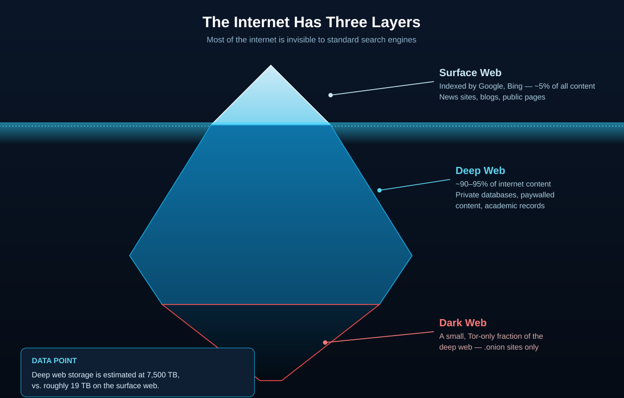

Dark websites have addresses ending in “.onion” instead of common domain names. The reputation, of course, is largely slanted toward illegal activities; a study by King’s College London involving over 2,700 dark web sites revealed that about 60% of them hosted some kind of illicit content. That, however, is not the whole story; legitimate uses of the dark web include anonymous communication for journalists, activists, whistleblowers, and people living under internet censorship.
What Is a Hidden Wiki Alternative?
A Hidden Wiki alternative is any directory or search tool that helps people find .onion sites without depending on the original Hidden Wiki page, which is known for having outdated links, low moderation, and many clone sites that use its name. Generally, the alternatives fall into two types: search engines that crawl and index .onion content like Google does with surface web content and curated directories that list links by category. Some do both, like OnionLand.
What Is the Difference Between a Dark Web Directory and a Search Engine?
A dark web search engine is a site that automatically crawls .onion sites and indexes whatever it finds, similar to how Google works on the surface web; examples include Torch and Haystak. A dark web directory, on the other hand, is a curated list of links organized by category—often maintained manually—closer to an old-school web directory than a search index. The original Hidden Wiki was a directory, not a search engine. This matters for freshness and trust: directories can go stale if not actively maintained, while search engines can let harmful content surface automatically because they’re not curated by a human editor.
This is also where Cyble’s own content separates: this article focuses on directories and link-list alternatives to the Hidden Wiki, while our companion guide, Top 10 Dark Web Search Engines, covers crawler-based search tools in more depth, including evaluation criteria and V3 support comparisons across engines. If you’re specifically comparing search engine indexing technology, that’s the better starting point.
How to Access the Dark Web Safely
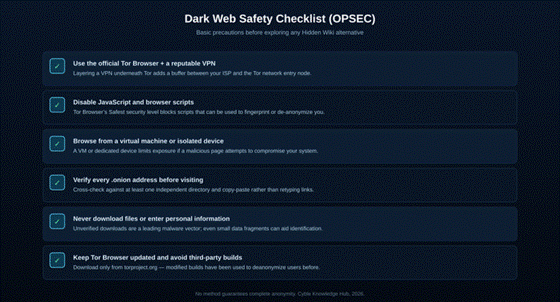
Before trying any Hidden Wiki alternative, it’s worth taking a few precautions. None of this guarantee complete anonymity, but together they meaningfully cut your exposure to malware, scams, and surveillance.
- Use the official Tor Browser: download it only from torproject.org, modified or third-party builds have been used to deanonymize users in the past.
- Pair Tor with a reputable VPN: this adds a layer between your ISP and the Tor entry node.
- Disable scripts where possible: Tor Browser’s “Safest” security setting blocks scripts that can be exploited to reveal your identity.
- Avoid downloading files: files from unverified .onion sites are a common malware vector.
- Never share personal information: even small, seemingly harmless details can be pieced together to identify you.
- Verify every .onion address before visiting: copy-paste links rather than retyping them, and cross-check against a second source.
V2 vs. V3 Onion Addresses — What Changed and Why It Matters
If you’ve spent any time looking at .onion links, you’ve probably noticed they vary wildly in length. That’s not random. It reflects a major security upgrade the Tor Project made in 2021, when it formally retired the older V2 onion address format.
V2 addresses were 16 characters long and derived from a truncated hash of an RSA-1024 public key. V3 addresses are 56 characters long and derived from an Ed25519 key pair, which offers stronger cryptography and meaningfully better resistance to address impersonation and enumeration attacks.
Tor stopped supporting V2 addresses entirely in 2021, meaning any 16-character .onion link you encounter today is, at best, outdated, and at worst, a sign you’re looking at a stale or spoofed listing rather than the legitimate current service.
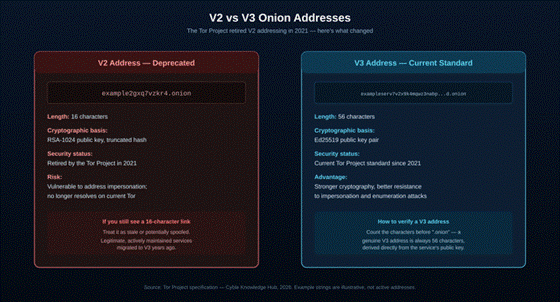
Practically speaking: if a directory or search result shows you a short .onion link, treat it as a signal to dig further rather than click through. We cover this in more depth in the clone-detection checklist later in this article.
Top 10 Hidden Wiki Alternatives for 2026
https://en.wikipedia.org/wiki/Dark_webEach entry below follows the same template, type, .onion access, logging policy, V3 support, content filtering, and best-fit use case, so you can compare tools at a glance rather than parsing inconsistent descriptions. Statuses were last checked in June 2026; dark web tool availability changes quickly, so verify independently before relying on any single source, including this one.
1. Torch
- Type: Search engine
- .onion access: Tor-only
- Logging policy: No search-query tracking stated
- V3 support: Yes
- Content filtered: No, unfiltered index
- Best for: First-time explorers who want the largest general index
- Last verified: June 2026
Torch is one of the oldest dark web search engines still active, often called the “Google of the dark web” for the size of its .onion index. It doesn’t track search queries or store user data, and it runs ad-free. Because it’s unfiltered, expect a mix of legitimate and low-quality results.
- Pros: Large index, no ads, no tracking.
- Cons: Unfiltered results mean more dead links and low-quality sites to sort through.
2. Torgol
- Type: Search engine
- .onion access: Tor-only
- Logging policy: Zero-logging policy (vendor-stated, unaudited)
- V3 support: Yes
- Content filtered: No
- Best for: Users who want a frequently refreshed index
- Last verified: June 2026
Torgol is a fast, privacy-focused search engine with a sleek interface and a frequently updated .onion index. Some independent testing suggests it edges out Torch on link freshness, though its zero-logging claim, like most dark web search engines, isn’t independently audited.
- Pros: Clean interface, frequent index refreshes, minimal dead links reported.
- Cons: Logging claims can’t be independently verified.
3. Not Evil (OFFLINE SINCE 2024)
- Type: Search engine (defunct)
- .onion access: N/A
- Logging policy: N/A
- V3 support: N/A
- Content filtered: N/A
- Best for: Not recommended, verify any clone independently
- Last verified: Confirmed offline, June 2026
Not Evil has been offline since 2024 and has not returned in a stable, verifiable form. It previously positioned itself as an unfiltered alternative to Google, named in homage to Google’s retired “don’t be evil” motto. If you encounter a site using the Not Evil name today, treat it as a possible impersonation or unrelated mirror rather than the original service, run it through the clone-detection checklist later in this article before trusting it.
4. Candle
- Type: Search engine
- .onion access: Tor-only
- Logging policy: No tracking stated; uptime inconsistent
- V3 support: Partial
- Content filtered: Partial
- Best for: Beginners who want a minimal, distraction-free interface
- Last verified: June 2026
Candle is a lightweight, no-frills search engine with an interface reminiscent of early-2000s search pages. There are no ads and no tracking by design. Some recent independent reports flag inconsistent uptime, so don’t be surprised if it’s unreachable on a given day — that’s a reason to keep a backup tool on hand rather than a sign something’s wrong with your setup.
- Pros: Simple, ad-free, beginner-friendly.
- Cons: Uptime has been inconsistent in recent reports.
5. DuckDuckGo (.onion Version)
- Type: Surface-web search engine, accessed via Tor
- .onion access: Tor-accessible mirror of the surface-web engine
- Logging policy: No personal data stored
- V3 support: Yes
- Content filtered: Standard DuckDuckGo filtering applies
- Best for: Private surface-web search while already running Tor
- Last verified: June 2026
DuckDuckGo’s .onion address is genuinely useful, but it’s commonly misunderstood. It is not a dark web search engine and does not crawl or index .onion sites. What it does is let you search the regular surface web through Tor with DuckDuckGo’s usual privacy protections, which is handy if you’re already in Tor Browser and don’t want to drop back to a standard browser for ordinary searches. If you’re looking for .onion content specifically, you’ll still need a dedicated dark web search engine like Torch or Ahmia.
- Pros: Reputable, no personal data logging, useful bridge between surface and Tor browsing.
- Cons: Does not search .onion content,a common point of confusion.
6. Haystak
- Type: Search engine (free + paid tiers)
- .onion access: Tor-only
- Logging policy: Policy unverified; paid tier adds filtering options
- V3 support: Partial
- Content filtered: Optional, paid tier
- Best for: Power users and researchers who want filtering tools and a larger historical index
- Last verified: June 2026
Haystak built a reputation on the size of its index, and a paid tier aimed at researchers and cybersecurity professionals who need deeper filtering. Some recent user reports describe intermittent outages, so treat it as one tool in a rotation rather than a sole source.
- Pros: Large historical index, advanced filtering on the paid tier.
- Cons: Reliability has been inconsistent in recent independent reports.
7. Ahmia
- Type: Search engine (clearnet-accessible)
- .onion access: Both clearnet (ahmia.fi) and Tor-only
- Logging policy: Filters illegal content; Tor Project-endorsed since 2014
- V3 support: Yes
- Content filtered: Yes, actively filters known illegal and malware-linked content
- Best for: Safety-conscious users, journalists, and researchers
- Last verified: June 2026
Ahmia takes a deliberately curated approach, filtering out illegal marketplaces and known malware-linked sites rather than indexing everything it finds. It’s accessible from the regular surface web at ahmia.fi for browsing the index, though you’ll still need Tor to actually visit any .onion result. Its safety-first philosophy and Tor Project endorsement make it a sensible starting point for anyone newer to dark web research.
- Pros: Strong filtering, surface-web accessible index, long-standing reputation for safety.
- Cons: Filtering means a smaller index than fully unfiltered engines.
8. OnionLand
- Type: Directory + search hybrid
- .onion access: Tor-only
- Logging policy: No independent audit
- V3 support: Yes
- Content filtered: No
- Best for: Categorized browsing with live uptime indicators
- Last verified: June 2026
OnionLand functions as both a search engine and a categorized directory, with a clean, accessible interface that includes autocomplete suggestions. A standout feature is real-time status indicators showing whether a listed .onion link is currently reachable, which saves time compared to manually testing dead links. Independent user reports flag a higher-than-average rate of scam sites in results, so verify links independently before engaging.
- Pros: Categorized browsing, live up/down status checks, accessible interface.
- Cons: Higher-than-average scam site prevalence reported by users; may require JavaScript for some features.
9. DeepSearch
- Type: Open-source search engine
- .onion access: Tor-only
- Logging policy: Source-auditable, community-maintained
- V3 support: Partial
- Content filtered: Partial
- Best for: Technical users who want a lower-profile, auditable tool
- Last verified: June 2026
DeepSearch focuses on precision over scale, aiming for accurate, relevant results rather than the largest possible index. Being open-source, technically inclined users can review how it crawls and ranks content rather than taking vendor claims at face value, a meaningful trust signal that most closed dark web search tools can’t offer.
- Pros: Auditable source code, high-precision results, lightweight.
- Cons: Smaller index, less mainstream support than larger engines.
10. Kilos
- Type: Market-indexing search engine
- .onion access: Tor-only
- Logging policy: Unfiltered, no independent audit
- V3 support: Yes
- Content filtered: No, indexes marketplaces without restriction
- Best for: Investigators and CTI teams, not casual users
- Last verified: June 2026
Kilos indexes dark web marketplaces, including listings other engines deliberately exclude. It’s a genuinely useful tool for investigators and threat intelligence teams who need visibility into marketplace activity, but its unfiltered nature means it surfaces content most casual users should avoid entirely. We’d only recommend this one to people who understand exactly what they’re walking into.
- Pros: Deep marketplace visibility, valuable for professional investigators.
- Cons: Unfiltered and not appropriate for general or casual use.
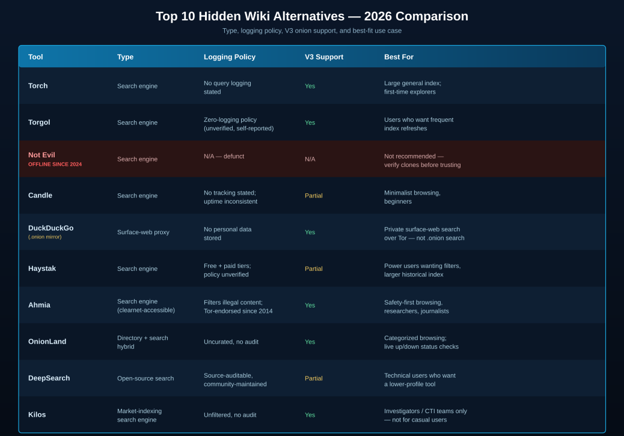
Hidden Wiki Alternatives at a Glance
Here’s the same ten tools side by side. Use this as a quick-reference index and treat logging-policy claims as vendor-stated rather than independently audited unless we’ve noted otherwise above.
Are Hidden Wiki Alternatives Actually Safe?
Easier access doesn’t mean safer access. Most of these directories and search engines index content automatically or semi-automatically, which means harmful or misleading material can still slip through, even on tools with a strong safety reputation.
- Malicious links: some .onion sites are built specifically to spread malware or harvest information from visitors.
- Phishing scams: fake versions of well-known sites are common, and convincing clones can trick users into handing over sensitive data.
- Outdated or dead links: the dark web infrastructure changes constantly, so a link that worked last week may be dead, hijacked, or reassigned today.
- Lack of moderation: there’s little to no content oversight compared to the surface web, even on engines that attempt filtering.
Because of this, it’s worth treating every dark web link with a healthy dose of caution, including ones from the tools we’ve recommended above. No directory or search engine, however well-regarded, can guarantee that every result is safe.
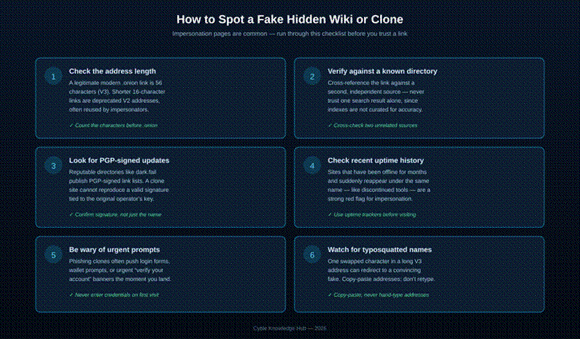
How Do I Know If a Hidden Wiki Link Is a Scam or Clone?
The Hidden Wiki name has been cloned, mirrored, and impersonated for years, and the same risk applies to alternatives once they become well-known, Not Evil’s current status is a good example of a brand that outlived the actual service. Run any unfamiliar link through this checklist before trusting it.
How Tor Routing Actually Protects You
Every safety tip above relies on understanding, even at a basic level, how Tor anonymizes traffic. When you connect to a .onion site, Tor Browser wraps your traffic in three layers of encryption and routes it through three relays, a guard relay, a middle relay, and an exit relay, before it reaches its destination. Each relay only peels away one layer and only knows the relay immediately before and after it in the chain.
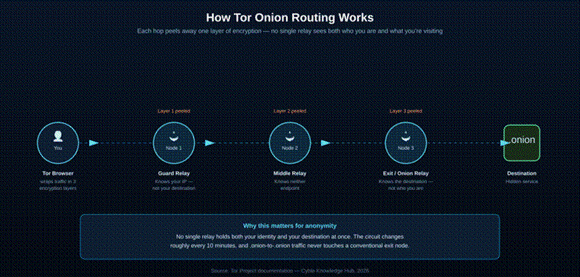
This is why no single point in the network can connect your identity to your destination: the guard relay knows your IP address but not where you’re headed, and the exit relay knows the destination but not who you are. Circuits rotate roughly every ten minutes, and traffic between two .onion services never touches a conventional exit node at all.
Legitimate Organizations on Tor
It’s easy to assume everything with a .onion address is illicit, but a number of well-known, legitimate organizations maintain official Tor mirrors specifically so people in censored or surveilled regions can reach them safely.
- BBC News runs a Tor mirror aimed at audiences in countries that block its standard site.
- The New York Times operates a similar onion service for censorship circumvention.
- SecureDrop instances let whistleblowers securely submit information to news organizations.
- The CIA launched an official .onion site in 2019, explicitly to give people a more secure way to share tips.
The presence of these mirrors is a useful reminder that .onion infrastructure itself is neutral; it’s a privacy and censorship-resistance tool, not an inherently illicit one. What you do with it determines the risk, not the underlying technology.
How Do Security Teams Use Dark Web Directories for Threat Intelligence?
For security and threat intelligence teams, dark web directories and search engines are reconnaissance tools, useful for spotting early chatter about a vendor, a leaked credential set, or a planned attack, but limited by the same problems casual users face: incomplete indexing, dead links, and zero guarantee of safety or legality. Most professional teams don’t manually browse marketplaces or forums at all; they rely on automated monitoring platforms built specifically for the job.
This is where a dedicated dark web monitoring vendor differs meaningfully from a public search engine or directory. Cyble Vision, continuously indexes .onion pages, forums, and marketplaces, giving security teams visibility without requiring analysts to manually navigate the dark web themselves.
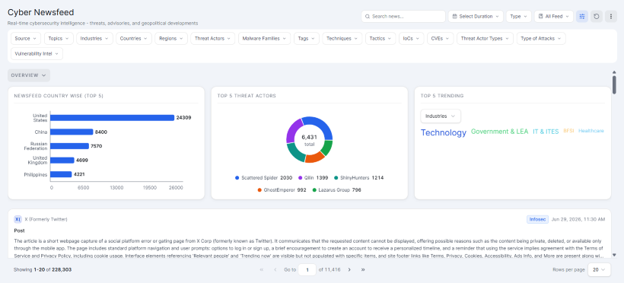
As a dark web monitoring vendor, Cyble’s platform indexes over 14 million .onion pages and tracks more than 340 active marketplaces and forums in real time — the kind of continuous, structured visibility that manual browsing through directories like the ones above simply can’t match at scale. For organizations that need ongoing monitoring rather than occasional manual lookups, that’s the practical difference between a Hidden Wiki alternative and a purpose-built threat intelligence platform.
Cyble is recognized by Gartner and Forrester as a leading cyber threat intelligence vendor. Explore the Dark Web Monitoring Dashboard to see how real-time .onion indexing supports your security team.
What Dark Web Sites Shut Down in 2025–2026?
Law enforcement activity against dark web infrastructure has continued at a fast pace into 2026, and it’s a useful freshness signal for anyone trying to gauge how the landscape is actually shifting. A few recent actions worth knowing about:
- Operation Alice (March 2026): authorities from 23 countries, led by German investigators with Europol support, dismantled a network of more than 373,000 fraudulent dark web sites run by a single operator. It stands as one of the largest dark web infrastructure takedowns on record.
- Nemesis Market sentencing (June 2026): a vendor who sold fentanyl and methamphetamine through the Nemesis Market dark web marketplace was sentenced to more than 26 years in federal prison, following the marketplace’s takedown by German, US, and Lithuanian authorities back in 2024.
- AlphaBay’s legacy: AlphaBay, once one of the largest dark web marketplaces, was shut down by authorities in 2023. Newer marketplaces have since positioned themselves as successors, a recurring pattern across the darknet market ecosystem. When one platform falls, others move quickly to absorb its user base.
The pattern across all three: dark web marketplaces and infrastructure are far less durable than they appear. Treat “established” status as temporary, and don’t assume that because a tool or marketplace has existed for years, it will still be there, or still be trustworthy, next month.
Is It Legal to Use Hidden Wiki Alternatives?
In most jurisdictions, using a dark web directory or search engine is legal on its own. The Tor network is legal software in the large majority of countries, and simply accessing it isn’t prohibited. What carries legal risk is what you access and what you do once you’re there — visiting illegal marketplaces, downloading illegal content, or transacting for prohibited goods or services carries legal exposure regardless of which search tool helped you find the site. As always, this is general information, not legal advice; if you have specific legal questions about dark web access in your jurisdiction, consult a qualified attorney.
Conclusion
Dark web directories and search engines open up real possibilities, and real risks. A secure, current version of Tor Browser, a healthy skepticism toward any link you haven’t verified, and a firm rule against sharing personal information will cover most of the basics. Beyond that, the tools above vary meaningfully in scope, filtering, and reliability, so the right pick depends on what you’re actually trying to do: Ahmia for a safety-first start, Torch for raw index size, OnionLand for organized category browsing, and Kilos only if you understand exactly why you need marketplace-level visibility.
Whether you’re a privacy advocate, a researcher, or a security professional, treat this list as a starting point rather than a final answer, the dark web’s tools and infrastructure shift quickly, and what’s accurate in June 2026 may not hold by year’s end. We’ll keep this page updated as that changes.
FAQs Abouts for Hidden Wiki Alternatives & Dark Web Browsing
What are the best Hidden Wiki alternatives in 2026?
The strongest picks depend on what you need: Ahmia for safety-filtered, curated results; Torch for the largest general .onion index; OnionLand for categorized directory browsing with live uptime checks; and Kilos for investigators who specifically need marketplace-level visibility. Not Evil, previously a common recommendation, has been offline since 2024 and should not be treated as an active alternative.
Is the Hidden Wiki safe to use?
Not entirely. The Hidden Wiki lists many legitimate links, but it can also surface unsafe, outdated, or impersonation sites because it isn’t tightly moderated. Pairing it with a more actively maintained, safety-filtered alternative like Ahmia, and verifying any unfamiliar link before clicking, is a safer approach than relying on it alone.
What should I do if Hidden Wiki is down?
If the Hidden Wiki is unreachable, try a search-engine alternative like Ahmia or Torch, or a directory-style tool like OnionLand, rather than searching for a replacement Hidden Wiki mirror — mirrors and “updated link” pages are a common vector for impersonation, especially for a brand as widely cloned as this one.
How can I access the dark web safely in 2026?
Use the official Tor Browser downloaded directly from torproject.org, pair it with a reputable VPN, disable scripts where possible, and never download files or share personal information on unfamiliar .onion sites. Verify every link against at least one independent source before visiting it. See the full safety checklist earlier in this article for the complete list.
What is the difference between a dark web directory and a search engine?
A search engine like Torch or Haystak automatically crawls and indexes .onion sites, similar to how Google indexes the surface web. A directory, like the original Hidden Wiki, is a curated, often manually maintained list of links organized by category. Search engines tend to have larger coverage but less curation; directories are more organized but can go stale without active maintenance.
What is the difference between V2 and V3 onion addresses?
V2 addresses are 16 characters long, derived from an RSA-1024 key hash, and were formally retired by the Tor Project in 2021. V3 addresses are 56 characters long, derived from an Ed25519 key pair, and offer meaningfully stronger resistance to address impersonation. Any 16-character .onion link you see today is outdated and worth treating with suspicion.
Are there dark web forums I can join safely?
Yes, several dark web forums list communities focused on privacy, security, and research. Use hidden wiki alternatives like OnionLand to find safer forums with active moderation.
What are the best tools for secure dark web browsing?
The best secure dark web browsing tools include the Tor Browser, Tails OS, and VPN services. Pair these with deep web directories 2026 to enhance both safety and anonymity online.
What’s inside a dark web?
Illegal marketplaces, forums, leaked data, cryptocurrency services, and anonymous communication platforms.
Disclaimer
This article is intended for informational and educational purposes only. It does not promote, endorse, or encourage any illegal activities on the dark web. While the tools and directories mentioned can assist in secure and private browsing, users are solely responsible for their actions online. Always adhere to local laws and regulations when accessing any content on the dark web. Use caution, protect your privacy, and never engage in suspicious or unlawful sites.