
Overview
- A dark web search engine indexes .onion sites the way Google indexes the surface web, but it needs the Tor Browser to reach the pages it finds.
- Ahmia is the safest starting point for research because it filters illegal content and carries a Tor Project endorsement dating to 2014. Torch has the largest unfiltered index. DarkSearch is the only one in this list with a public API.
- A dark web search engine and a dark web browser are different tools: the browser (Tor) gets you onto the network; the search engine helps you find something once you’re there.
- Search engines only index what crawlers can reach. Private forums, invite-only marketplaces, and Telegram-based channels, where most credential trading happens, stay invisible to every tool on this list.
- According to Cyble Research and Intelligence Labs, 6,046 data breach and leak incidents were tracked globally in 2025, with government, healthcare, and financial services absorbing the largest share, activity that surfaces on the dark web long before it reaches the headlines.

What is a Dark Web Search Engine?
A dark web search engine is a tool that indexes .onion sites on the Tor network and allows them to be found by keywords, much like how Google indexes normal websites. Because regular search engines cannot crawl Tor’s hidden services, other dedicated tools like Ahmia and Torch are available to do so for the benefit of researchers, journalists, and security teams.
This is something that, unlike a Google search, the results you get back are necessarily incomplete and often out of date. .onion addresses change, sites go away without any notice, and most dark web destinations actively resist being indexed at all. A search engine narrows the haystack; it doesn’t guarantee the needle is still there by the time you arrive.
The tools are generally divided into two categories: the cleaned, filtered engines (Ahmia, DuckDuckGo’s onion service, Haystak, OnionLand, WormWeb, DarkSearch) that do not include illegal categories and the unmoderated, maximum-coverage engines (Torch, Excavator, Kilos, Not Evil) that index more widely and with little or no editorial filtering. The trade-off is pretty uniform across the board: more filtering means a safer experience and a smaller index; less filtering means broader coverage and a much higher chance of landing on something illegal, fake, or actively malicious.
Dark Web Search Engine vs. Dark Web Browser — What’s the Difference?
A dark web browser is what gets you onto the Tor network; a dark web search engine is what helps you find something once you’re there. They’re not interchangeable, and this is the most common mistake that new visitors to the dark web make, confusing the two.
The Tor Browser is the browser—it’s a solidified version of Firefox that directs your traffic through several encoded relays so that neither a single point on the path knows both who you are and what you are requesting. Without it, .onion addresses just won’t resolve—Chrome, Safari, and Edge have no clue what to do with them.
A dark web search engine is a site, accessible once Tor is up and running, that crawls and indexes other .onion sites. Ahmia, Torch, and DuckDuckGo’s onion service do that work in different ways. None of them is a browser — all of them need Tor Browser to open the results they return.
In short: install Tor Browser first, connect to the network, then use one of the search engines below to find what you’re looking for. For a deeper walkthrough of browser options and setup, see Cyble’s best dark web browsers for security researchers in 2026.
How Do Dark Web Search Engines Work?
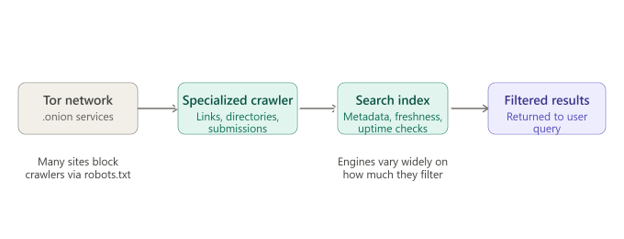
Dark web search engines work by running specialized crawlers inside the Tor network, following links and directory submissions to discover .onion sites, then indexing what they find so it can be retrieved by keyword.
The process looks similar to surface-web crawling in outline, but every step is harder. Crawlers can’t rely on sitemaps or consistent linking conventions; many operators block indexing through robots.txt or simply don’t want to be found, and .onion addresses rotate or vanish without redirects. Once a crawler does reach a page, the engine extracts whatever metadata it can: titles, descriptions, freshness signals, uptime history- and stores it in a search index. At query time, some engines run that index through a content filter before returning results; others return everything the crawler found, unfiltered.
This is also why index size is a misleading metric on its own. A larger index just means a more aggressive, less selective crawler, not necessarily a more useful or safer one.
Why Safe Dark Web Searching Matters in 2026
Tor traffic has continued climbing through 2026, and so has the volume of credentials, access listings, and stolen data changing hands in places a standard search engine will never show you. The Tor network recorded between 2.5 and 3 million daily users in 2026, and it hosts an estimated 65,000 to 100,000 active .onion services at any given time. For security teams, that scale is exactly the problem: manual search, even with a good engine, only samples a fraction of what’s actually out there.
According to Cyble Global Cybersecurity Report 2025, there were 6,046 global data breach and leak incidents in 2025 alone, with government and finance among the most heavily targeted sectors. That figure is a reasonable proxy for how much of this activity originates or surfaces on the dark web well before it becomes public knowledge, which is precisely why the search engines below matter for research and monitoring, even though, as the next section covers, they only get you partway there.
How we selected the top 10 dark web search engines in 2026
Each engine on this list was evaluated against six criteria:
- Privacy and anonymity: Logging policy, encryption practices, and whether the engine itself tracks queries.
- Index size and coverage: How broadly the engine crawls .onion domains across forums, marketplaces, and general hidden services.
- Filtering and safety controls: Whether the engine actively excludes illegal or abusive categories.
- Uptime and reliability: How consistently the engine itself stays reachable, given how often dark web infrastructure goes dark.
- Search accuracy and usability: Interface quality, filtering options, and result relevance.
- Relevance for professional use: Adoption in cybersecurity research, OSINT investigations, and threat intelligence workflows.
Top 10 dark web search engines in 2026
1. Ahmia Search Engine
- Founded: 2014, by Finnish security researcher Juha Nurmi during Google Summer of Code, with Tor Project support.
- Filtered: Yes, and as of late 2023, filtering extends beyond CSAM to all sexually related searches.
- Access: Clearnet (ahmia.fi) and onion.
- API: No.

Ahmia is a clearnet search engine for Tor’s onion services, accessible through both a clearweb site and an onion service version, and is one of the primary tools Tor users rely on to discover and access onion websites. Its open-source crawler, index, and front end are unusual in this space, most competing engines are closed-source and operator-anonymous, which makes Ahmia’s published blocklist and removal-request process a genuine trust signal rather than a marketing claim.
Best for: Journalists, researchers, and security teams who want the lowest-risk entry point into .onion discovery.
Pros: Tor Project endorsement since 2014; open-source codebase; usable from a regular browser for initial research before switching to Tor.
Limitations: Aggressive filtering means a smaller index, if you need maximum marketplace or forum coverage, Ahmia isn’t built for that.
2. DuckDuckGo (Dark Web Version)
- Founded: DuckDuckGo launched in 2008; it has been usable through Tor since 2010, with a modern V3 onion service introduced in 2021.
- Filtered: Yes, by design, it’s a privacy-respecting surface-web engine, not a .onion indexer.
- Access: Onion only (Tor required).
API: No

Operating through Tor, DuckDuckGo provides a non-censored search engine experience without logging personal data.
It’s a favorite among privacy-conscious users looking for unbiased results.
DuckDuckGo’s onion service doesn’t index .onion sites at all, it’s the same no-logging surface-web search you’d use normally, made reachable without leaving the Tor network. Its privacy focus extends to Tor, providing the same privacy-respecting search without logging queries or tracking users. For researchers, that makes it a useful first stop for prep work: gathering names, entities, and context before moving on to a dedicated .onion crawler like Ahmia or Torch.
- Pros: No tracking; familiar interface; doesn’t require leaving Tor to do general research.
- Limitations: Doesn’t index .onion content at all; it’s not a substitute for a dedicated dark web search engine.
- Best for: Privacy-conscious surface-web research conducted from inside the Tor network.
3. Not Evil
- Founded: Active since the mid-2010s; exact founding date is not publicly documented.
- Filtered: No; operators state they index broadly with minimal restriction, though without marketplace coverage.
- Access: Onion only.
- API: No.

Not Evil is one of the cleaner and more consistently maintained options for researchers focused on dark web communities, hidden journalism platforms, and non-commercial onion infrastructure, even though it lacks editorial filtering in the way Ahmia does. Its name is a direct, deliberate jab at Google’s old “don’t be evil” motto.
- Pros: Strong forum and community coverage; consistent uptime relative to peers.
- Limitations: No marketplace coverage, so it won’t surface dark web market activity, stolen data listings, or credential dumps,a broader tool is required for that work; smaller overall index than unfiltered competitors.
- Best for: Tracking forum discussions and community chatter on a specific topic before cross-referencing against a marketplac e-focused engine.
4. VormWeb
- Founded: Not publicly documented.
- Filtered: Partial, by design, built for accessibility over raw coverage.
- Access: Onion only.
- API: No.

WormWeb prioritizes a minimal, low-friction interface over index size. It’s a reasonable on-ramp for someone new to .onion search who wants fewer rough edges than Torch or Excavator, at the cost of the breadth those engines offer.
- Pros: Simple, fast interface; lower cognitive load for first-time dark web researchers.
- Limitations: Smaller index than the major unfiltered engines; thin public documentation on crawling methodology.
- Best for: Newcomers running a first, low-stakes .onion search.
5. Torch
- Founded: Sources place Torch’s launch anywhere from 2012 to 2014, it is consistently described as one of the oldest engines on Tor, even though the exact date is disputed across sources.
- Filtered: No.
- Access: Onion only.
- API: No.

Torch is one of the oldest dark web search engines, operating since the early days of Tor, and its longevity means a massive index built over years of crawling. It’s also one of the most-trafficked onion search engines, reportedly serving over 80,000 requests per day. Torch applies essentially no content filtering, which is the direct trade-off for its size: results span the full spectrum of .onion content, legitimate and otherwise, with no editorial layer in between.
- Pros: Largest practical index of any engine on this list; fast, minimal interface; long operating history.
- Limitations: Zero filtering means routine exposure to scams, phishing clones, and illegal listings; not appropriate for casual or compliance-sensitive use.
- Best for: Deep searches requiring maximum coverage, run by experienced researchers who can handle unfiltered results.
6. Haystak
- Founded: Mid-2010s, exact date undocumented.
- Filtered: Yes, with a free tier and a paid tier offering historical snapshots and email alerts.
- Access: Onion only.
- API: No (premium features instead).

Haystak uses a custom dark web crawler and filters out dangerous content, similar in spirit to Ahmia, and offers a premium version with advanced search, access to historical content, and email alerts. That historical-snapshot capability is genuinely distinctive among engines on this list; most show you the current state of an index, not how a .onion site’s content has changed over time.
- Pros: Built-in filtering; unusual historical-archive feature via the paid tier.
- Limitations: Best features sit behind a paywall; free tier is comparable in scope to other filtered engines.
- Best for: Researchers and security professionals who need to track how a specific .onion page has changed over time, not just its current state.
7. DarkSearch
- Founded: Roughly 2018, based on community references; not officially documented.
- Filtered: Yes.
- Access: Onion only.
- API: Yes, free, the only engine on this list to offer one.

DarkSearch is built specifically for integration into security tooling rather than manual browsing. Its API lets teams fold .onion search directly into existing monitoring scripts and pipelines, and the engine checks whether sites are live before surfacing them in results, a meaningful reliability improvement over engines that return dead links indiscriminately.
- Pros: Free public API; live-status checking on indexed results; built for automation.
- Limitations: Smaller index than the major unfiltered engines; API rate limits constrain large-scale automated use.
- Best for: Security teams who want to wire dark web search directly into existing detection or monitoring tools.
8. OnionLand Search
- Founded: Mid-2010s, exact date undocumented.
- Filtered: Yes.
- Access: Clearnet and onion; indexes both Tor and I2P.
- API: No.

OnionLand functions as a combined dark web and deep web search engine, with the unusual ability to search Tor and I2P together or filter to a single network. A modern interface with search suggestions and autocomplete makes it one of the more approachable engines for newcomers, though like all broad crawlers it indexes without heavy editorial curation.
Best for: Researchers who need visibility into I2P-hosted services alongside standard .onion content.
Pros: Cross-network search across Tor and I2P; modern, approachable interface.
Limitations: Broader network coverage means less consistent filtering than dedicated, narrowly scoped engines.
9. Excavator
- Founded: Created by anonymous activists in 2019.
- Filtered: No, beyond an optional safe-search toggle.
- Access: Onion only.
- API: No.
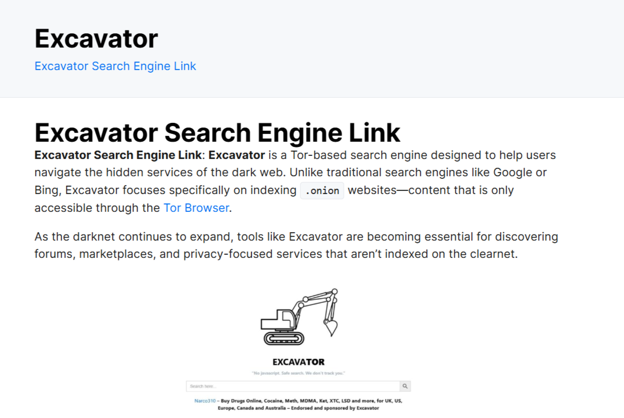
Excavator was built with a design philosophy of maximum anonymity and minimum attack surface, deliberately avoiding JavaScript entirely to reduce browser fingerprinting risk and the potential for script-based de-anonymization. For analysts who care about operational security during dark web research, that’s a meaningful technical distinction from most engines on this list, which run JavaScript by default.
- Pros: No-JavaScript design reduces fingerprinting and script-based exploitation risk; prioritizes index freshness over historical depth.
- Limitations: Independent user reports flag that paid advertising slots on the engine have promoted abusive material, a big concern for any research context; no meaningful content filtering by default.
- Best for: Security-conscious researchers who specifically want to avoid JavaScript-based tracking during dark web sessions.
10. Kilos
- Founded: Around 2019, as a successor to the earlier Grams search engine.
- Filtered: No.
- Access: Onion only.
- API: No.
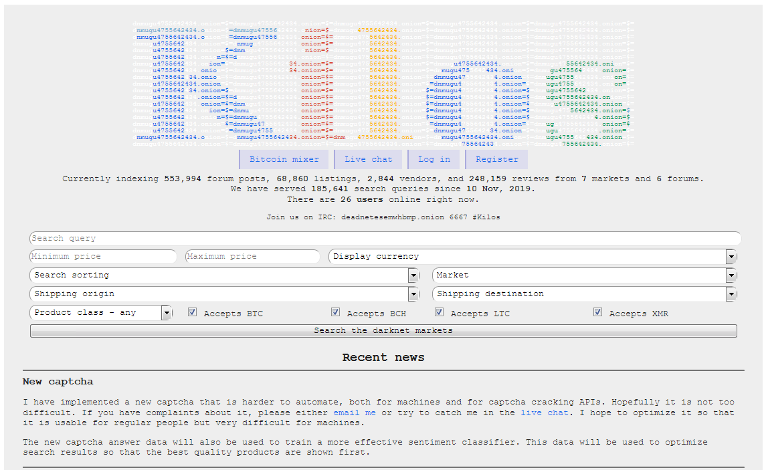
Kilos is built around querying multiple markets and forums simultaneously, and it’s recognized for indexing large volumes of darknet listings, vendor profiles, and forum posts. It evolved directly from Grams, one of the earliest attempts at a dedicated darknet-market search tool and inherited a similar marketplace-first focus.
- Pros: Strong cross-market and cross-forum search; useful for vendor- and listing-level tracking.
- Limitations: No filtering of any kind; closely associated with marketplace and vendor activity, which raises the legal and ethical stakes of casual use considerably.
- Best for: Threat intelligence work specifically focused on marketplace and vendor-level tracking, conducted with appropriate legal awareness.
Dark Web Search Engine Comparison Table
| Engine | Founded | Filtered | Clearnet access | API | Best for |
| Ahmia | 2014 | Yes | Yes | No | Safest starting point, Tor Project endorsed |
| DuckDuckGo (Tor) | 2010 (onion) | Yes | No | No | Private surface-web search on Tor |
| Not Evil | ~2015 | No | No | No | Forum discovery, no marketplace coverage |
| WormWeb | n/a | Partial | No | No | Low-friction first search for beginners |
| Torch | 2012–14 | No | No | No | Maximum index coverage |
| Haystak | ~2015 | Yes | No | No | Historical snapshots (paid tier) |
| DarkSearch | ~2018 | Yes | No | Yes | Automated, API-driven monitoring |
| OnionLand | ~2016 | Yes | Yes | No | Combined Tor + I2P search |
| Excavator | 2019 | No | No | No | JavaScript-free, low-fingerprint browsing |
| Kilos | ~2019 | No | No | No | Cross-market, cross-forum vendor tracking |
Dark Web vs. Deep Web — What’s the Difference?
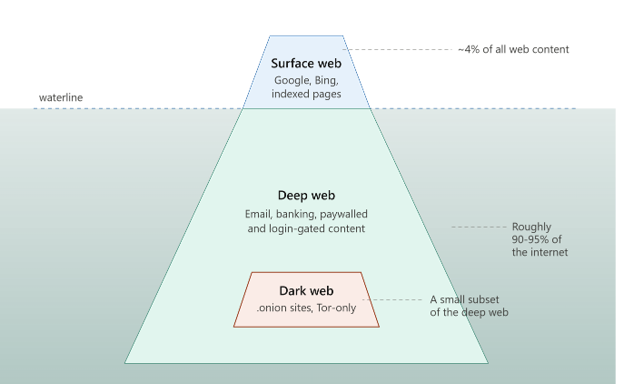
The deep web is the much larger category; it’s simply anything not indexed by a standard search engine, which includes your email inbox and online banking alongside anything genuinely illicit. The dark web is a small, deliberately hidden subset of that deep web, built specifically for anonymity, and it’s the only one of the three that requires dedicated software like Tor to reach at all.
What are the Limitations of Dark Web Search Engines?
Dark web search engines only index what their crawlers can actually reach, which means they systematically miss the places where the most serious threat activity happens, private forums, invite-only marketplaces, and Telegram-based channels that never get indexed at all.
That gap matters more than it sounds. Search engines miss private forums and real-time credential leaks; Telegram channels where serious criminal activity happens are invisible to them entirely, because there is nothing for a .onion crawler to crawl. A credential dump that surfaces yesterday won’t show up in a search engine’s index, and neither will an infostealer harvest pulled from a compromised device last week. Manual searching can’t scale to enterprise needs, and security teams that rely only on dark web search engines will miss threats as a result.
There’s a second, quieter limitation: these tools don’t verify what they index. Dark web search engines do not verify site authenticity, and scammers create cloned onion addresses that appear legitimate in search results. A search engine narrowing a list of candidates is useful; treating its top result as confirmed and safe is a mistake that costs people money and, in research contexts, credibility.
How Do Security Teams Monitor the Dark Web at Scale?
Security teams that need continuous, enterprise-grade visibility move beyond manual search engine queries to automated dark web monitoring, tools that scan forums, marketplaces, paste sites, and credential dumps around the clock rather than at the moment someone happens to run a query.
The difference in practice is the gap between sampling and surveillance. A search engine answers “what’s indexed right now, for this specific query.” A monitoring platform answers “alert me the moment anything relevant to my organization appears, anywhere across these sources.” By combining AI, threat actor tracking, and real-time alerts, this kind of platform can deliver actionable intelligence that lets organizations detect, respond, and fortify defenses before a leak escalates into a full incident.
Legal and Ethical Considerations When Using Dark Web Search Engines
Accessing the dark web is not inherently illegal in most countries and using a search engine to find .onion content is, on its own, a lawful act in the great majority of jurisdictions. Tor itself was built to support privacy, research, and secure communication, what determines legality is what you do once you’re there, not the act of getting there.
What’s illegal is the activity, not the access: buying stolen credentials, participating in fraud, or distributing harmful content remains a crime whether it happens on the surface web or behind a .onion address. Law enforcement actively monitors dark web marketplaces and forums associated with criminal activity, and accidentally clicking into the wrong listing can expose a researcher to real legal or security risk even without intent.
Ethical, responsible use of dark web search engines means:
- Conducting research or security investigations within a defined, defensible scope
- Avoiding direct interaction with illegal marketplaces, even out of curiosity
- Never downloading unknown files encountered through search results
- Respecting applicable privacy and data protection regulations throughout
For journalists, researchers, and cybersecurity professionals, these tools are legitimate investigative instruments when used in this way. For casual users, understanding the legal landscape before exploring hidden services isn’t optional, it’s the difference between research and exposure.
Safety and Best Practices for Using Dark Web Search Engines
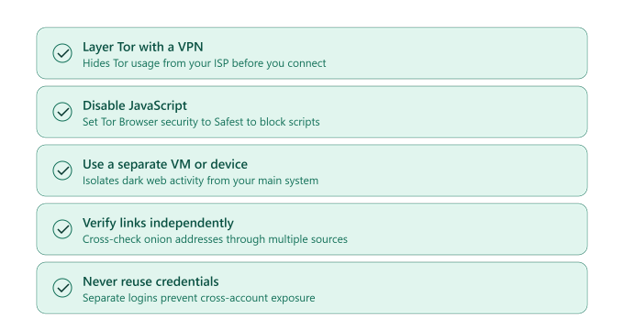
Exploring the dark web safely requires layering several habits, not relying on any single one. Run a VPN underneath Tor Browser so your ISP only sees encrypted Tor traffic, not the destination. Set Tor’s security level to “Safest” to disable JavaScript, since most browser-fingerprinting and exploit techniques on the dark web depend on it running. Keep dark web research isolated to a separate device or virtual machine where possible, so a compromised session can’t reach your primary system.
Verify any .onion address through more than one independent source before trusting it, since cloned and phishing addresses are common across every engine on this list. And never reuse credentials between dark web research accounts and anything tied to your real identity.
Staying alert to phishing attempts, exit scams, and malicious marketplace listings rounds out the basics; none of these precautions are exotic, but skipping any one of them is how most avoidable incidents happen.
Frequently Asked Questions (FAQs) about Dark Web Search Engines
What is a dark web search engine?
A dark web search engine indexes .onion sites on the Tor network and makes them searchable by keyword, similar to how Google indexes the surface web, though it requires Tor Browser to actually open the results.
How do dark web search engines work?
They run specialized crawlers inside the Tor network that follow links and submissions to discover .onion sites, then index what they find, with some engines filtering results before returning them and others returning everything found.
Are dark web search engines legal to use?
Yes, using a dark web search engine is legal in most jurisdictions. What’s illegal is engaging in criminal activity once you reach a .onion site, not the act of searching for it.
What are the most popular dark web search engines?
Ahmia, Torch, and Haystak are the most consistently referenced across security research and OSINT communities, though the right choice depends on whether you need filtering or maximum coverage.
Do dark web search engines require Tor?
Most do, since .onion domains can’t resolve in a standard browser. A few, like Ahmia and OnionLand, also offer a clearnet interface for initial research before switching to Tor.
Is it safe to use dark web search engines?
Safety depends heavily on which engine you use and how you use it. Filtered engines like Ahmia carry meaningfully less risk than unfiltered engines like Torch or Excavator, but no dark web search engine verifies the safety of the sites it indexes.
Why are some search engines on the dark web considered “uncensored”?
Uncensored engines like Torch, Excavator, and Kilos apply no content filtering, returning the full range of what their crawlers find, including scams, phishing clones, and illegal listings alongside legitimate content.
How do hidden wiki websites help users explore the dark web?
Directory sites categorize and link to known .onion services. They work alongside search engines as entry points but are typically community-maintained and unmoderated, which means a meaningful share of their links are dead, misleading, or unsafe.
Are dark web forums only used for illegal discussions?
No. Many forums focus on encryption, whistleblowing, journalism, or freedom-of-information topics. Search engines like Not Evil are specifically useful for finding this kind of legitimate community content while avoiding marketplace-adjacent material.
How is a deep web search engine different from a dark web search engine?
A deep web search engine surfaces non-indexed surface-web content like academic databases or login-gated pages. A dark web search engine specifically targets .onion sites on Tor, which is a different network entirely.
What are the risks of using a dark web application or search engine?
The main risks of using dark web search engine include encountering scams, malware, or illegal content. Many dark web applications are not regulated, and some may try to harvest user data or spread viruses.
What are some Risks of Using Dark Web Search Engines Without Protection?
Using the dark web search engine without protection can be risky. If a hacker is following you on the dark web, and you are not protected, the hacker can target you with personal agendas. A good VPN or an anonymous service conceals your identity on the dark web, making the experience much better.
Is it legal to search on the dark web?
Yes, accessing the dark web itself is legal, but illegal activities (like buying drugs or stolen data) are not.