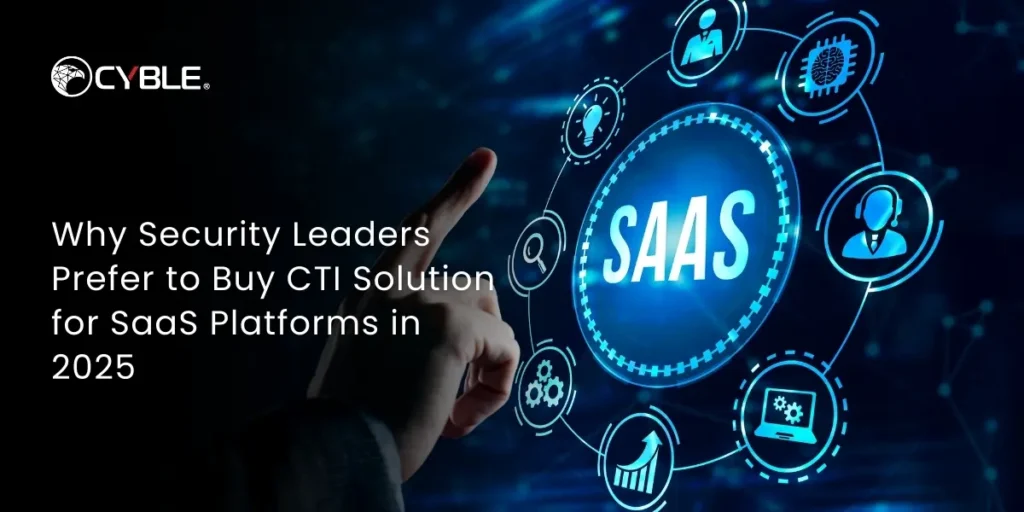
The landscape for enterprises has altered significantly over the past few years. Now, nearly every aspect of business, finance, HR, collaboration, data storage, customer service – operates in SaaS platforms. SaaS platforms have provided businesses newfound flexibility and innovation, but they have also increased the attack surface.
In 2025, security leaders are up against a perfect storm: advanced threat actors, tighter regulations, and increased business dependency on SaaS. This is why many security leaders are opting to purchase a CTI solution for SaaS platforms rather than develop intelligence capabilities in-house.
Let’s break down the forces initiating this transformation and shape the concept of threat intelligence for SaaS security strategies in 2025.
Why SaaS Platforms Will Rely on CTI in 2025
SaaS applications can be thought of as entry points to the most important data in your organization. Attackers do not always come through the door; instead, they often find unpatched cracks, missed configurations, and compromise legitimate credentials. Security monitoring basics cannot keep up with the sophistication of modern attack behaviors that exist in the world today.
Cyber threat intelligence (CTI) is intended to aid organizations in quickly getting a few vital alerts. CTI doesn’t just send alerts; rather it connects the context of threat actor types, specific behaviors, underground chatter, malicious infrastructure, and vulnerabilities.
It is clear the benefits of a CTI solution for SaaS platforms in 2025 include: improved visibility, improved timeliness of detection, and more intelligence information to improve response.
Purchasing versus Building CTI Capabilities
On paper, it’s theoretically possible to build your own intelligence gathering capabilities. The reality is that it’s expensive, time-consuming, and limited. Threat actors innovate every day, and most in-house teams do not have the scale to compete.
In contrast, when security leaders purchase CTI solution(s) for SaaS platforms, they immediately get access to:
- Intelligence pulled from the surface, deep, and dark web.
- Context around vulnerabilities that affect SaaS platforms.
- Threat actor TTPs for SaaS platforms CTI 2025.
Instead of trying to build it themselves, leaders can plug into existing CTI-as-a-Service models that are ready-to-use. This saves time and returns results more quickly, which is why CTI-as-a-Service for SaaS platforms preferred by security leaders 2025 is a standard.
The ROI Question
Security budgets are subject to intense scrutiny and executives want to see measurable returns for every dollar spent, even on cybersecurity tools. So how do security leaders demonstrate that investment? The ROI of a CTI solution for SaaS platforms to security leaders in 2025 is based on costs avoided (breaches, downtime, regulatory fines, etc.).
For example, stopping a ransomware attack on a SaaS-hosted CRM platform could save a million dollars in damages and lost business. You can demonstrate immediate ROI with a threat intelligence platform that finds leaked credentials before criminals can access them.
Worrying about the investment is not about spending more money, it’s about losing less money.
How Security Leaders Assess CTI in 2025
Today, leaders are practical in how they use CTI (cyber intelligence/threat intelligence) for SaaS solutions as there are more to consider than what looks nice in a dashboard, such as:
- Integration with existing SaaS security tools.
- Speed of intelligence delivery.
- AI-enabled context for prioritization.
- Coverage of dark web, malware networks, and threat actor chatter.
- Alignment with regulatory requirements.
For example, with the need of the CTI SaaS security leaders to comply with their data protection regulatory obligations added complexity to the situation. Organizations can no longer afford to have blind spots related to regulatory compliance and need intelligence solutions that map to their compliance obligations.
AI and Automation are Game Changers
Manual analysis of threat data is outdated. The volume is simply too high. That’s why AI-enabled CTI for SaaS platforms choice by security leaders 2025 has become the norm. Machine learning models detect patterns across billions of data points, flagging suspicious activity long before it hits the organization.
Alongside AI, automation plays a critical role. CTI automation for SaaS security response 2025 ensures that intelligence doesn’t sit idle. For example, if a malicious IP is identified, automated rules can block it across SaaS firewalls instantly.
The Human Factor
Technology is only half the story. Security teams must still interpret and act on intelligence. But with curated feeds and contextual reports, CTI platforms make this easier. Instead of drowning in noise, analysts can focus on relevant risks.
Imagine an alert about leaked API keys from a SaaS development environment. Without CTI, this might remain buried in generic alerts. With the right intelligence feed, security leaders get the context: which forum it appeared on, which actor is selling it, and whether it connects to known ransomware groups. That’s actionable intelligence.
How Cyble Fits
One example of such capability is Cyble’s Cyber Threat Intelligence Platform. It collects intelligence from millions of sources, including the deep and dark web, and augments it with context for faster decisions. The platform doesn’t just notify; it integrates with existing tools, correlates Indicators of Compromise, and provides insights into attacker TTPs.
What stands out is its Threat Library and botnet detection features. For SaaS-heavy organizations, this means being able to track malware campaigns, monitor credentials, and uncover exposures before they escalate. It gives leaders a fuller picture of threats without overwhelming them.
This reflects why many CISOs and CIOs in 2025 lean toward purchasing structured CTI platforms rather than piecing together intelligence manually.
Buying Motivations in 2025
The main cyber threat intelligence buying motivations in SaaS 2025 can be summed up in three words: speed, scale, and assurance.
- Speed – Leaders want near real-time visibility.
- Scale – They need global coverage, from dark web chatter to malware networks.
- Assurance – They must prove compliance and resilience to boards and regulators.
Put simply, when leaders buy CTI solution for SaaS platforms, they’re buying confidence.
Conclusion
There can be no doubt that SaaS is an unstoppable force. The security challenges that come with SaaS and Digital Ecosystem adoption are not likely to go away anytime soon. As the adoption of Digital Ecosystems continues to rise, more attackers will exploit weak points. For 2025, the only way to come out ahead is to adopt SaaS while countering Cyber Threats using AI-driven, horizon-scanning threat intelligence.
Industry leaders are not adopting CTI because it is the new trend; they are adopting it because it works. Good CTI cuts through all of the excess noise, and helps organizations save money, meet compliance requirements, and gives organizations a fighting chance in an asymmetric battle.
At the end of 2025, organizations will not simply be using CTI for SaaS as a good practice; it will be the standard practice.