Cyble analyzes the Brain Cipher ransomware group, known for aggressive tactics, data theft, multi-pronged extortion, and sophisticated encryption targeting industries and governments.
The Brain Cipher ransomware group has quickly garnered attention due to its aggressive tactics and its high-profile attacks on various industries and government organizations. With a modus operandi that includes multi-pronged extortion tactics and the use of sophisticated encryption techniques, Brain Cipher is proving to be a formidable ransomware group in the cybercrime world.
Brain Cipher first appeared in June 2024, but it did not take long for the group to make its mark on the world of cybersecurity. The ransomware group became particularly notorious after launching cyberattacks in Indonesia. Brain Cipher ransomware distinguishes itself by employing a data theft tactic before encrypting files, a feature that has become a hallmark of several advanced ransomware groups.
The group’s use of a Tor-based data leak site to further pressure victims into paying the ransom has also been a defining feature of their operations. This tactic is designed to increase the threat of exposure and amplify the sense of urgency for the victim to pay the ransom.
Brain Cipher ransomware is primarily delivered through phishing and spear-phishing attacks, exploiting human error to gain initial access to systems. Upon execution, the ransomware payload works quickly to disable critical Windows security services, such as Windows Defender and the Volume Shadow Copy Service (VSS). These measures are meant to hinder attempts at detection and prevent the recovery of encrypted files.
Once the system has been compromised, Brain Cipher encrypts the targeted files using a strong encryption algorithm. The ransomware then renames the affected files with a random alphanumeric string followed by the extension, rendering the files inaccessible. To inform the victim, the ransomware drops a ransom note in every directory it enumerates, providing instructions on how to pay the ransom and obtain a decryption key.
Targeted Countries and Industries
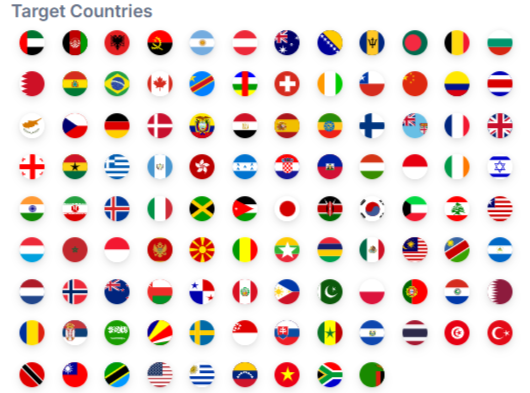
Cyble Vision Threat Library (Source: Cyble Vision)
The Brain Cipher ransomware group first gained limelight by targeting Indonesia – followed by other countries, including Afghanistan, Albania, Angola, Argentina, Austria, Australia, and Barbados. The group targets a wide range of industries, including healthcare, education, manufacturing, and government, and operates across numerous countries worldwide. Some of the key sectors targeted by the group include aerospace, automotive, chemicals, energy, food and beverage, healthcare, technology, telecommunications, and more.
Ransomware Tactics and Techniques
Brain Cipher’s tactics, techniques, and procedures (TTPs) align with the typical modus operandi of modern ransomware groups. One of the most effective strategies employed by Brain Cipher is user execution, where the group relies on social engineering tactics to convince users to open malicious attachments or click on harmful links. This could include phishing emails that trick the user into enabling remote access software or executing malicious code.
Additionally, Brain Cipher has been observed using privilege escalation techniques to manipulate access tokens. By stealing or modifying access tokens, the group can operate under a different user or system security context, allowing them to bypass security restrictions and gain further control over the victim’s network.
As part of its defense evasion techniques, Brain Cipher has been found to disable important recovery mechanisms, such as volume shadow copies, which are crucial for system restoration in the event of a disaster. This ensures that even if victims have backup files, they will be unable to restore their systems without the decryption key.
Once inside the network, the group performs extensive discovery activities, such as querying the Windows registry and gathering system information to further fine-tune their attack strategy. These actions allow Brain Cipher to determine the most effective way to deploy its encryption and achieve maximum impact.
The end result of a successful Brain Cipher attack is data encryption for impact, where the victim’s data is held hostage until the ransom is paid. In some cases, the group also inhibits system recovery by deleting or disabling recovery services, making it even more difficult for the victim to recover their systems without paying the ransom.
Brain Cipher ransomware has not been selective in its choice of victims, targeting a wide range of industries and sectors. The group has been known to strike organizations in various fields, including healthcare, education, manufacturing, government, telecommunications, and finance. The group’s attacks are typically well-planned, often involving both data exfiltration and encryption to maximize the pressure on the victim.
Conclusion
As of early 2025, Brain Cipher continues to expand its operations, drawing inspiration from other notorious ransomware groups in its cyber extortion tactics. With a focus on high-profile industries and government organizations, their strategies have proven highly effective in extracting ransom from victims. As their operations grow, the threat of future attacks on critical infrastructure and private enterprises intensifies.
In response, Cyble’s cutting-edge AI-powered cybersecurity solutions, including its threat intelligence platform, Cyble Vision, offer enterprises and government agencies real-time insights and proactive defense mechanisms. Cyble’s advanced monitoring and threat detection capabilities help organizations stay protected from cybercriminals like Brain Cipher, reinforcing cybersecurity efforts against cyberattacks.
Defensive Measures and Recommendations
Organizations and individuals must adopt comprehensive cybersecurity measures to defend against ransomware threats like Brain Cipher. Some essential steps include:
- Ensure that backup systems are frequently updated and disconnected from the main network to avoid being compromised during an attack.
- Implement regular phishing awareness training for employees to reduce the likelihood of falling victim to social engineering attacks.
- Regularly update and patch software to eliminate known vulnerabilities that could be exploited by ransomware.
- Deploy advanced endpoint protection solutions, including behavior-based detection and malware sandboxing, to identify and block ransomware before it can execute.
- Divide networks into separate segments to prevent ransomware from spreading across the entire network if an initial compromise occurs.
MITRE Attack Techniques Associated with Brain Cipher
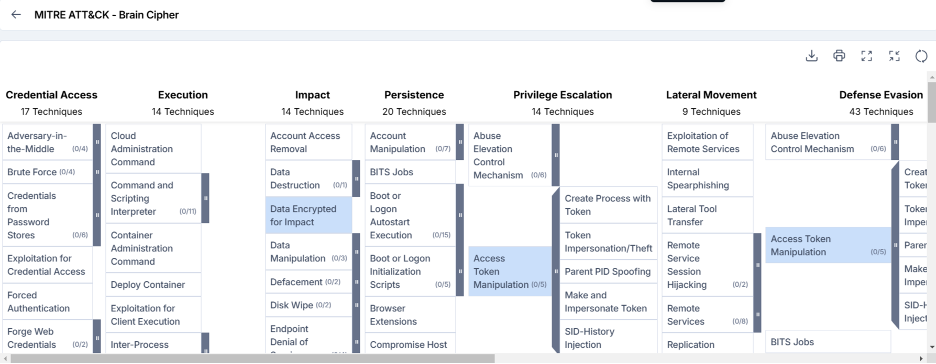 MITRE ATT&CK (Source: Cyble Vision)
- User Execution (TA0002): Brain Cipher exploit user actions, often via social engineering, to execute malicious code, typically through phishing or similar methods.
- Privilege Escalation (TA0004) – Access Token Manipulation (T1134): Adversaries manipulate access tokens to bypass controls and elevate privileges, often using token stealing techniques.
- Defense Evasion (TA0005) – Access Token Manipulation (T1134): Similar to privilege escalation, adversaries manipulate access tokens to avoid detection and bypass security measures.
- Defense Evasion (TA0005) – Impair Defenses (T1562): Adversaries disable or impair defense mechanisms and services, hindering detection and preventing system recovery.
- Discovery (TA0007) – Query Registry (T1012): Adversaries query the Windows Registry to gather system and configuration information to aid their operations.
- Discovery (TA0007) – System Information Discovery (T1082): Adversaries gather detailed information about the system, including OS details, patches, and hardware to inform their attack strategy.
- Impact (TA0040) – Data Encrypted for Impact (T1486): Adversaries encrypt data on targeted systems, often demanding ransom in exchange for decryption keys.
- Impact (TA0040) – Inhibit System Recovery (T1490): Adversaries delete or disable system recovery mechanisms to prevent restoration and maintain control over the system.