Overview
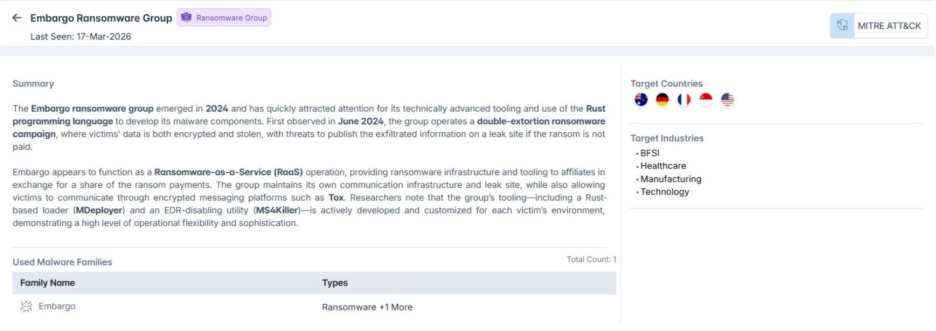
The Embargo ransomware group surfaced in mid-2024 and has rapidly positioned itself as a technically capable and adaptable threat actor within the ransomware ecosystem. First observed in June 2024, the group operates a double-extortion model, encrypting victim data while simultaneously exfiltrating sensitive information. Victims are then pressured to pay a ransom under threat of public exposure via a dedicated leak site.
Embargo is widely assessed to function as a Ransomware-as-a-Service (RaaS) operation. It provides affiliates with tooling, infrastructure, and operational support in exchange for a percentage of ransom payments. The group maintains its own leak portal and communication channels, while also enabling victim interaction through encrypted platforms such as Tox.
A defining feature of Embargo’s operations is its reliance on Rust-based malware, reflecting a broader shift among cybercriminals toward modern programming languages that offer improved performance, memory safety, and resistance to reverse engineering.
Emergence and Evolution
Research by Cyble Research and Intelligence Labs highlights Embargo as part of a growing trend in ransomware innovation. Its development in Rust marks a deliberate move toward more efficient and harder-to-analyze malware frameworks.
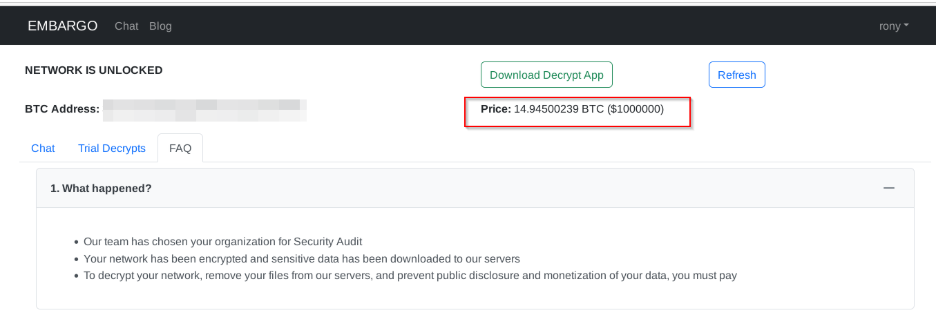
Despite following a familiar attack pattern, initial compromise, data exfiltration, and encryption, Embargo distinguishes itself through its aggressive use of psychological pressure.
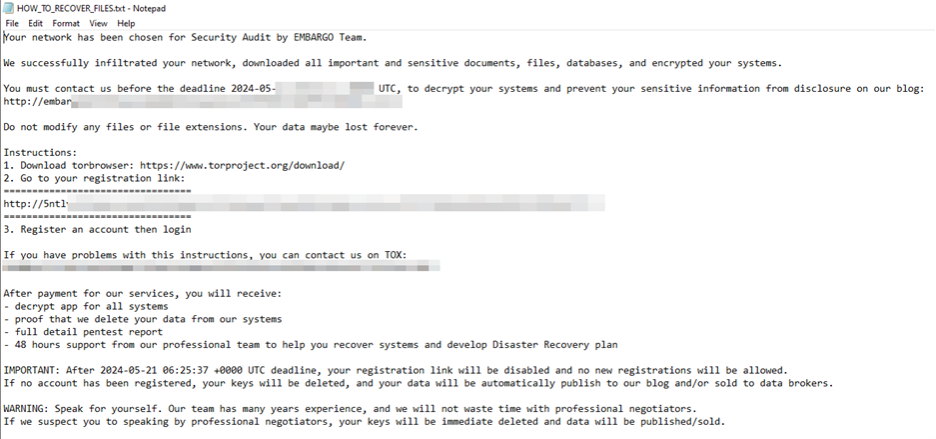
In observed incidents, attackers issued ransom demands of $1 million, accompanied by explicit threats to notify a broad set of stakeholders, including:
- Employees
- Customers
- Business partners
- Investors
- Government authorities
Relationship to Other Ransomware Operations
Embargo exhibits notable similarities to the ALPHV ransomware operation (also known as BlackCat).
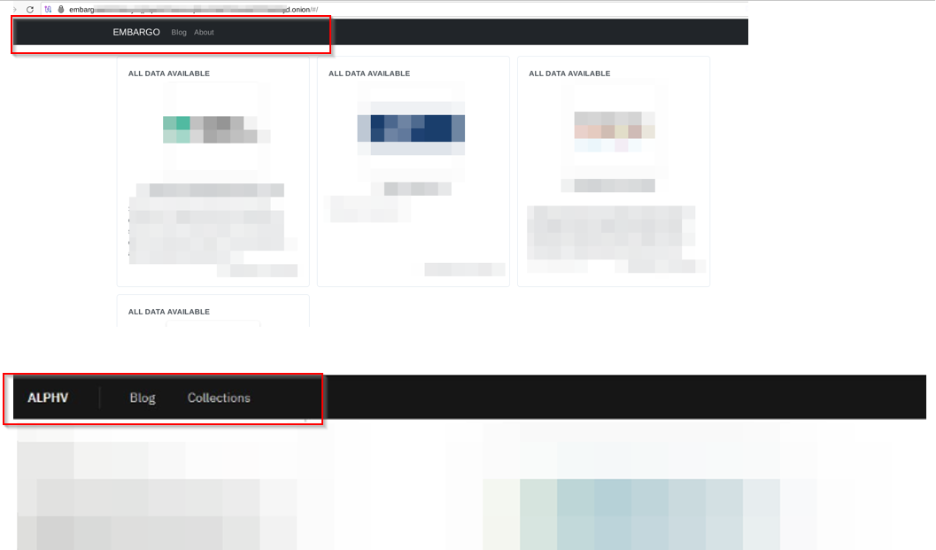
These overlaps include:
- A leak site interface closely resembling ALPHV’s
- Comparable log generation structures within Rust-based binaries
- Shared design patterns in malware execution
Following the disruption of ALPHV infrastructure by law enforcement in March 2024, researchers suspect that Embargo may represent a reworked or successor variant, potentially developed by former affiliates or operators.
Targeting Profile
Embargo’s activity has been observed across a geographically diverse set of regions, including Australia, Germany, France, Singapore, and the United States, indicating a broad and opportunistic targeting approach rather than a narrowly defined regional focus.
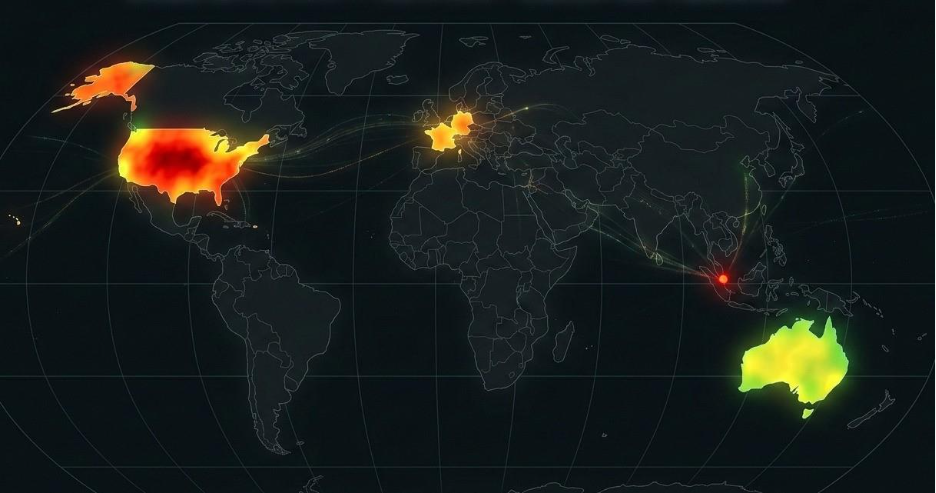
Despite only four confirmed victims being publicly disclosed to date, this relatively small number likely reflects the group’s early operational stage rather than any limitation in capability or intent.
From an industry perspective, Embargo concentrates on sectors where both operational disruption and data exposure can have consequences, particularly Banking, Financial Services, and Insurance (BFSI), healthcare, manufacturing, and technology.
These industries are especially attractive targets due to their access to high-value assets such as sensitive financial data, intellectual property, and critical infrastructure systems, all of which can be leveraged to maximize pressure during extortion.
Malware and Tooling

Core Malware: Embargo
Embargo ransomware is a Rust-based strain that employs strong cryptographic techniques, including:
- ChaCha20 for file encryption
- Curve25519 for secure key exchange
Encrypted files are appended with extensions such as:
- .partial
- .564ba1
- .embargo
The ransomware drops a note titled “HOW_TO_RECOVER_FILES.txt”, which appears to be customized per victim. Interestingly, timestamps within the note are hardcoded, suggesting pre-generated templates rather than dynamic creation.
Supporting Toolset
Researchers identified additional components used in Embargo operations:
- MDeployer – a Rust-based loader
- MS4Killer – a utility designed to disable Endpoint Detection and Response (EDR) solutions
These tools are frequently tailored to individual victim environments, demonstrating operational flexibility and active development.
Cross-Platform Development

There are indications of Linux and ESXi variants, though these appear incomplete or experimental.

While they utilize the same encryption logic, their limited functionality suggests they may still be under development or used for testing.
Technical Behavior
Embargo ransomware follows a highly structured and methodical execution chain designed to maximize impact while limiting recovery options. Upon initial execution, it creates a mutex with a hardcoded name to ensure only a single instance runs and deletes recycle bin contents to hinder file restoration.
It then focuses on defense evasion by disabling Windows recovery mechanisms through system commands and terminating processes that could interfere with encryption, including databases, backup tools, and productivity applications. The malware further strengthens its position by disrupting services, identifying and stopping critical components such as backup systems, enterprise applications, and security tools.
During the discovery phase, it scans local drives and network shares to identify viable targets while deliberately avoiding system-critical directories, essential operating system files, and previously encrypted data to maintain system stability.
Once preparation is complete, Embargo encrypts selected files using the ChaCha20 algorithm and appends unique extensions such as “.564ba1” to mark affected files. Before encryption is finalized, sensitive data is exfiltrated, enabling the group to employ double extortion tactics by threatening to publicly disclose stolen information if the ransom demand is not met.
Associated Threat Actors
- Embargo Ransomware Group (Active as of March 17, 2026)
- Storm-0501 (Last observed July 11, 2025)
The Storm-0501 cluster has been observed deploying Embargo in multi-stage attacks, particularly targeting hybrid cloud environments. Their operations typically involve:
- Exploiting compromised credentials
- Leveraging vulnerabilities for initial access
- Escalating privileges
- Deploying ransomware payloads
Operational Tradecraft
Embargo operators rely heavily on “living off the land” techniques, abusing legitimate system tools to evade detection.
Execution Techniques
- Task Scheduler for timed or remote payload execution
- PowerShell for in-memory execution and payload delivery
- Windows Command Shell for command execution
- Service Control Manager (e.g., sc.exe, PsExec) for remote execution
Persistence Mechanisms
- Scheduled tasks configured for recurring execution
- Creation of domain accounts in Active Directory
- Registry Run Keys and Startup folder modifications
These mechanisms are often disguised to blend in with legitimate system activity.
Privilege Escalation
- Scheduled tasks configured with elevated privileges
- Registry-based persistence running under high-permission contexts
Strategic Assessment
Embargo represents a new generation of ransomware threats characterized by:
- Adoption of modern programming languages like Rust
- Increased operational customization
- Integration of psychological pressure tactics
- Possible lineage from disrupted major ransomware groups
While currently limited to publicly known victims, its design and modular tooling suggest strong potential for rapid expansion.
Conclusion
The Embargo ransomware group highlights how quickly ransomware evolves following disruptions like ALPHV’s takedown in March 2024. With Rust-based malware, modular tooling, and double-extortion tactics, Embargo poses a serious threat to high-value sectors.
Organizations can proactively defend against such attacks using Cyble’s AI-powered threat intelligence, which delivers real-time insights, dark web monitoring, and autonomous threat response. Schedule a personalized Cyble demo to detect, analyze, and respond to emerging ransomware threats with confidence.
Recommendation and Mitigation Strategies
- Maintain Offline Backups: Ensure critical data is regularly backed up and tested for recovery.
- Enforce MFA: Protect all remote and administrative accounts with multi-factor authentication.
- Patch and Harden Systems: Keep OS, applications, and network devices updated to close vulnerabilities.
- Limit Privileges: Apply least-privilege access to reduce ransomware impact and privilege escalation.
- Monitor Endpoints and Network: Detect abnormal activity like unauthorized encryption or process terminations.
- Secure Email and Remote Access: Filter phishing attempts and block malicious scripts or attachments.
- Leverage Threat Intelligence: Use platforms like Cyble for real-time insights and proactive ransomware defense.
MITRE ATT&CK Techniques Associated with the Embargo ransomware group
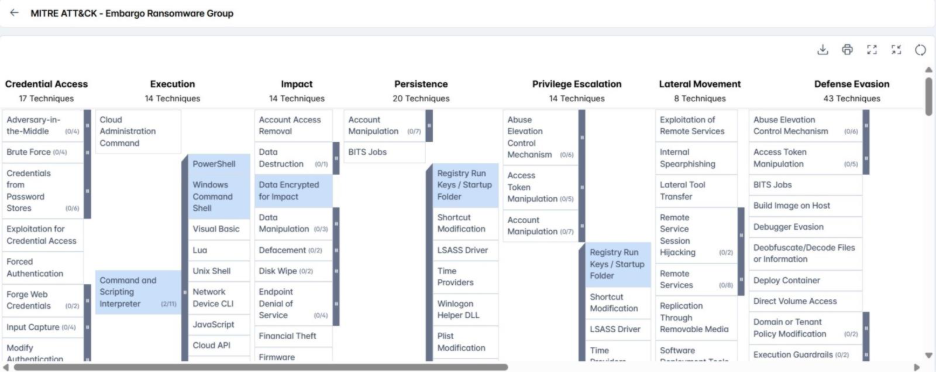
- Scheduled Task (T1053.005 | Execution/Persistence): Abused Windows Task Scheduler to run malware at startup or on a schedule. Tasks may be hidden via registry modifications and used for remote execution or lateral movement.
- PowerShell (T1059.001 | Execution): Ran scripts and commands to execute code, download payloads, and perform discovery, including in-memory execution via System.Management.Automation.
- Windows Command Shell (T1059.003 | Execution): Used cmd.exe or batch files to run commands locally or remotely, often through C2 channels.
- Service Execution (T1569.002 | Execution): Leveraged Service Control Manager, sc.exe, or PsExec to execute payloads locally or remotely, supporting persistence and privilege escalation.
- Domain Account (T1136.002 | Persistence): Created AD domain accounts for credentialed access without malware implants.
- Registry Run Keys / Startup Folder (T1547.001 | Persistence): Added malware to startup folders or Registry keys for automatic execution on login or boot.