Vect is a financially motivated ransomware group operating under a Ransomware-as-a-Service (RaaS) model, enabling affiliates to attack organizations across multiple industries.
The group specializes in double extortion operations, combining data theft with ransomware deployment to maximize pressure on victims. Its campaigns emphasize rapid network compromise, credential abuse, lateral movement, and enterprise-wide encryption.
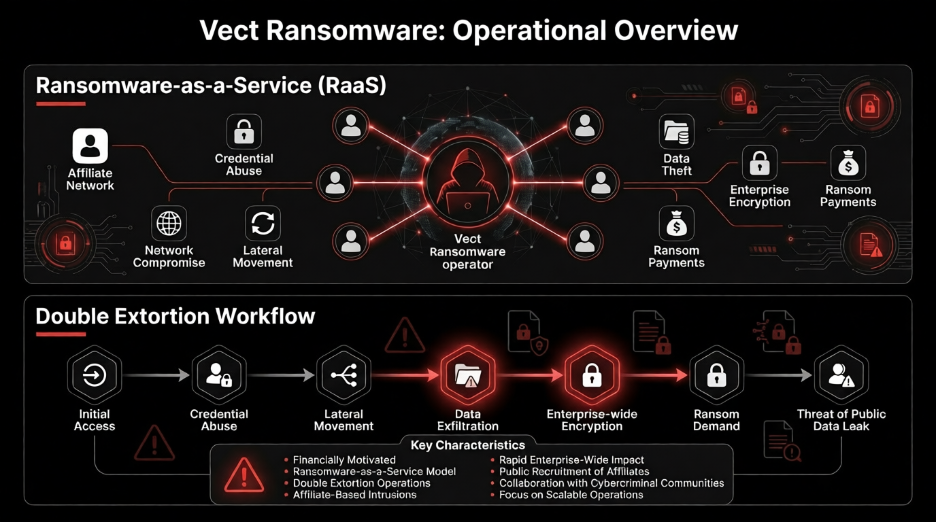
Unlike traditional ransomware operators, Vect relies heavily on affiliate-driven intrusions, providing operational support and ransomware deployment capabilities to partners. The group’s focus on scalable operations, combined with its public recruitment efforts and collaboration with other cybercriminal communities, highlights an aggressive expansion strategy within the ransomware ecosystem.
Origin, Targets, and Global Reach
Vect primarily targets organizations with valuable operational or sensitive data, focusing on sectors where service disruption and data exposure can significantly increase the likelihood of ransom payments.
Observed victims span multiple regions, including Brazil, Colombia, Egypt, Spain, India, Italy, Namibia, South Africa, and the United States.
The group’s operations have affected organizations across the BFSI, Education, Energy & Utilities, Healthcare, IT & ITES, Manufacturing, and Professional Services sectors.
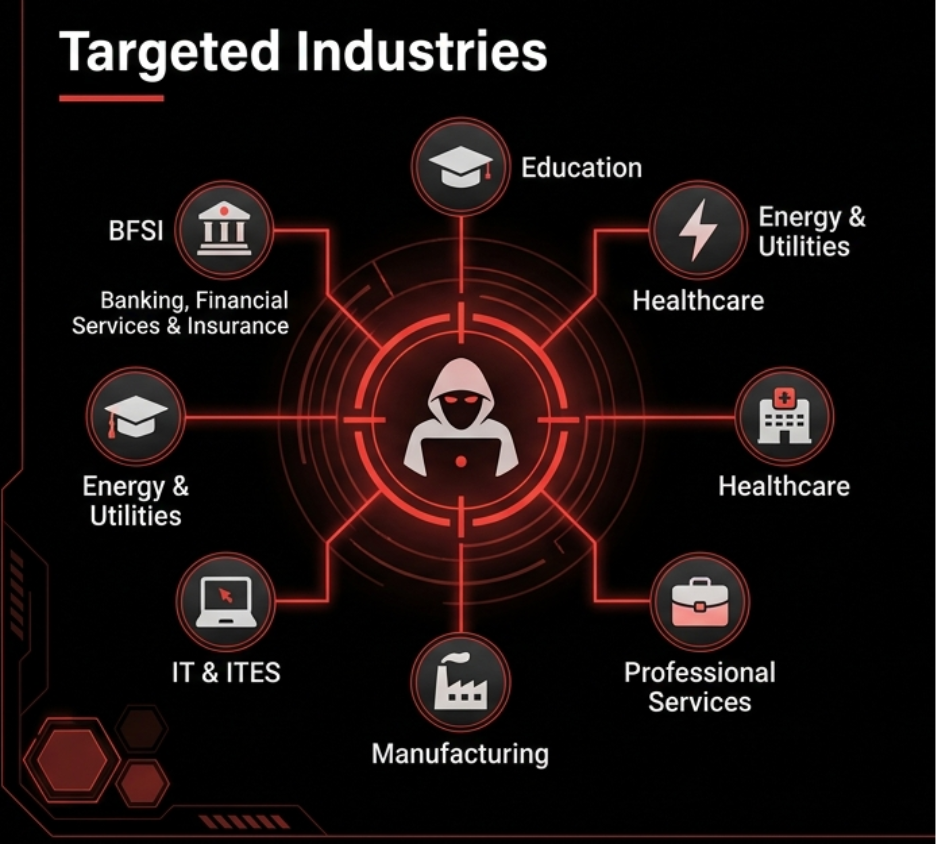
This broad targeting demonstrates an opportunistic approach centered on financial gain rather than geographic or industry-specific objectives.
Operational Capabilities
Vect employs a structured attack workflow designed to compromise enterprise environments while maximizing operational impact rapidly. Key characteristics of its operations include:
- Credential Abuse – Compromised credentials are used to access enterprise environments and bypass traditional authentication controls.
- Remote Access Exploitation – Internet-facing Remote Desktop Protocol (RDP), VPN, and other remote access services are leveraged as initial access vectors.
- Credential Dumping and Reconnaissance – Once inside a network, the group collects credentials and performs extensive reconnaissance to identify critical assets, privileged accounts, and high-value systems.
- Data Exfiltration – Sensitive information is stolen before encryption, enabling double extortion through public leak threats.
- Defense Evasion – Security tools are disabled, and infected systems may be rebooted into Safe Mode to reduce interference during ransomware execution.
- Centralized Deployment – Ransomware payloads are deployed across compromised systems to maximize encryption speed and operational disruption.
Recent Activity
Vect has recently demonstrated an aggressive effort to expand its affiliate ecosystem through public collaboration with prominent cybercriminal communities.
In one of its latest announcements, the group claimed a partnership with BreachForums, encouraging forum members to become Vect affiliates by providing dedicated affiliation keys and operational assistance for ransomware deployment. The announcement also stated that affiliates with initial access capabilities would receive direct support from the group’s operators to facilitate attacks.
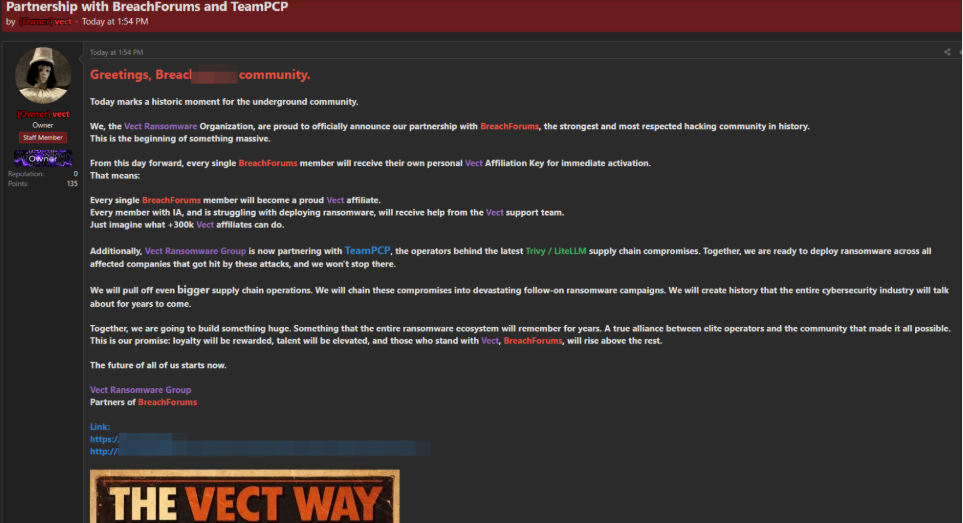
The group additionally claimed a partnership with TeamPCP, alleging plans to leverage organizations affected by recent supply chain compromises as potential ransomware targets. While such public statements often serve as recruitment and intimidation efforts, they illustrate Vect’s intent to expand its operational reach through collaborations with other threat actors.
Consistent with these claims, Vect later asserted that it had compromised two organizations through TeamPCP’s LiteLLM/Trivy supply chain campaign. According to the group’s onion-based data leak site (DLS), the alleged breaches resulted in the theft of approximately 700 GB and 250 GB of data, respectively.
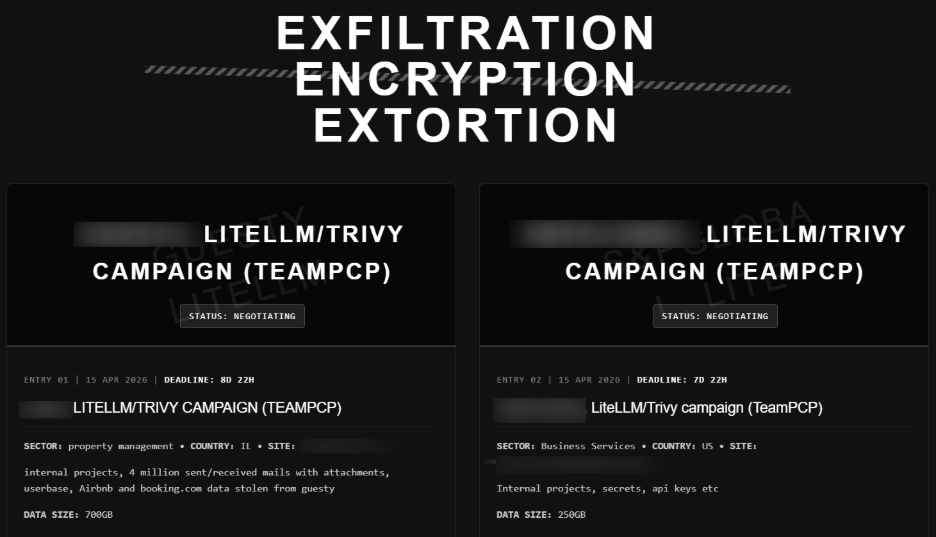
The group claimed the stolen data included internal project files, millions of emails with attachments, user information, integration-related data, secrets, and API keys.
Both organizations were listed on the DLS with active negotiation statuses and countdown deadlines, accompanied by threats to publicly release the allegedly stolen data if negotiations were unsuccessful.
Tactics, Techniques, and Procedures (TTPs)
Vect relies on legitimate credentials and externally accessible remote services to establish initial access. Compromised VPN accounts, exposed RDP services, and other internet-facing remote access solutions provide reliable entry points while reducing the need for exploit-based intrusion.
Following initial compromise, the group executes commands using native Windows utilities and scripting environments, including PowerShell and the Windows Command Prompt. Scheduled Tasks are commonly used to execute ransomware components, establish persistence, and automate malicious activity across compromised systems.
To increase privileges within victim environments, Vect abuses compromised accounts and may manipulate Windows access tokens to obtain elevated permissions. These techniques enable the group to move laterally, deploy ransomware across enterprise networks, and maintain access throughout the intrusion.
Before encryption, Vect conducts credential harvesting, network reconnaissance, and data exfiltration. The theft of sensitive information enables the group to pressure victims through data leak threats in addition to operational disruption caused by ransomware.
Conclusion
Vect has established itself as a modern ransomware operation that combines credential-based intrusions, enterprise-scale ransomware deployment, and double extortion tactics to maximize financial returns. Its affiliate-driven operating model and emphasis on collaboration with other cybercriminal groups demonstrate a strategy focused on expanding both its operational capabilities and attack surface.
Organizations should strengthen identity security, secure externally exposed remote services, continuously monitor privileged account activity, and maintain visibility across enterprise networks to detect and disrupt attacks before ransomware deployment.
To mitigate threats like Vect, organizations should adopt proactive security strategies built on real-time threat intelligence, continuous monitoring, and rapid incident response.
Cyble offers a unified platform that integrates threat detection, dark web monitoring, vulnerability management, and AI-driven analytics to help organizations identify, assess, and respond to emerging ransomware threats.
Protect your organization from threats like Vect. Schedule a demo with Cyble today.
Mitigations and Recommendations
- Enforce multi-factor authentication (MFA) for VPN, RDP, and all externally accessible remote services.
- Restrict or disable exposed Remote Desktop Protocol (RDP) services wherever possible and implement network segmentation.
- Continuously monitor privileged account activity and investigate unusual authentication events.
- Deploy Endpoint Detection and Response (EDR) solutions to detect credential dumping, lateral movement, and ransomware behavior.
- Harden Active Directory environments by enforcing least privilege and regularly auditing privileged accounts.
- Disable unnecessary scheduled task creation and monitor for unauthorized task modifications.
- Maintain encrypted, offline backups and regularly test recovery procedures.
- Monitor outbound network traffic to detect unauthorized data exfiltration attempts.
- Conduct regular security awareness training to reduce the risk of credential theft and phishing attacks.
- Leverage threat intelligence platforms such as Cyble to monitor ransomware activity and emerging indicators of compromise.
MITRE ATT&CK Techniques Associated with Vect
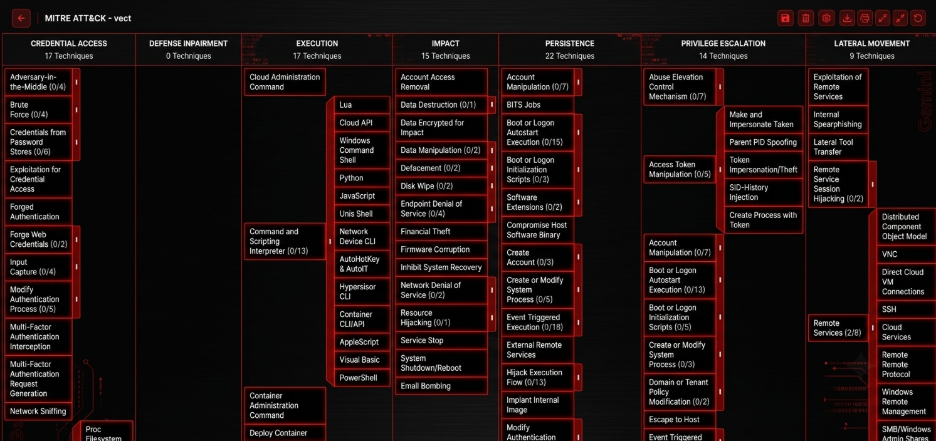
- Initial Access (TA0001) – Valid Accounts (T1078): The group abuses compromised credentials to access enterprise environments and evade traditional authentication controls.
- Initial Access (TA0001) – External Remote Services (T1133): Vect exploits exposed VPN, RDP, and other internet-facing remote access services to gain entry.
- Execution (TA0002) – Command and Scripting Interpreter (T1059): Native command-line utilities and PowerShell are used to execute malicious commands and ransomware payloads.
- Execution (TA0002) – Scheduled Task/Job: Scheduled Task (T1053.005): Scheduled Tasks are used to automate ransomware execution and facilitate lateral deployment.
- Persistence (TA0003) – Scheduled Task/Job: Scheduled Task (T1053.005): The group establishes persistence by creating or modifying scheduled tasks.
- Persistence (TA0003) – Valid Accounts (T1078): Stolen credentials enable continued access throughout the intrusion.
- Privilege Escalation (TA0004) – Access Token Manipulation (T1134): Windows access tokens may be manipulated to obtain elevated privileges and expand control within the environment.
- Privilege Escalation (TA0004) – Valid Accounts (T1078): Compromised privileged accounts are used to elevate permissions and facilitate lateral movement.