Overview
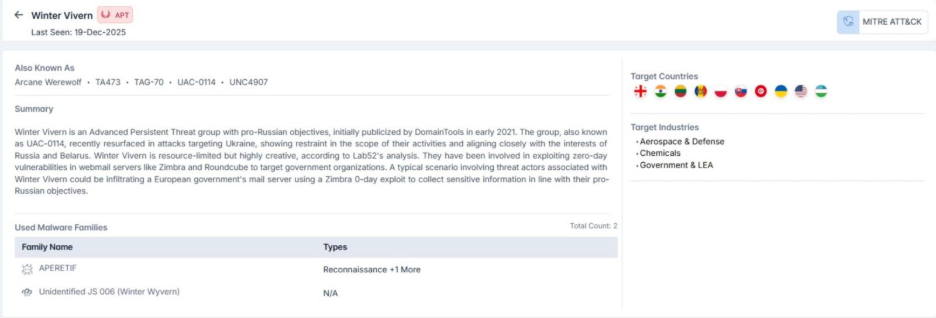
Winter Vivern is a pro-Russian Advanced Persistent Threat (APT) group first reported by DomainTools in early 2021. While resource-limited compared to larger state-aligned operations, the group has demonstrated creativity and persistence, targeting government organizations and sensitive infrastructure with precision. Recent observations indicate that Winter Vivern resurfaced in 2025 with campaigns focusing on Ukraine, showing selective targeting aligned with Russian and Belarusian strategic interests.
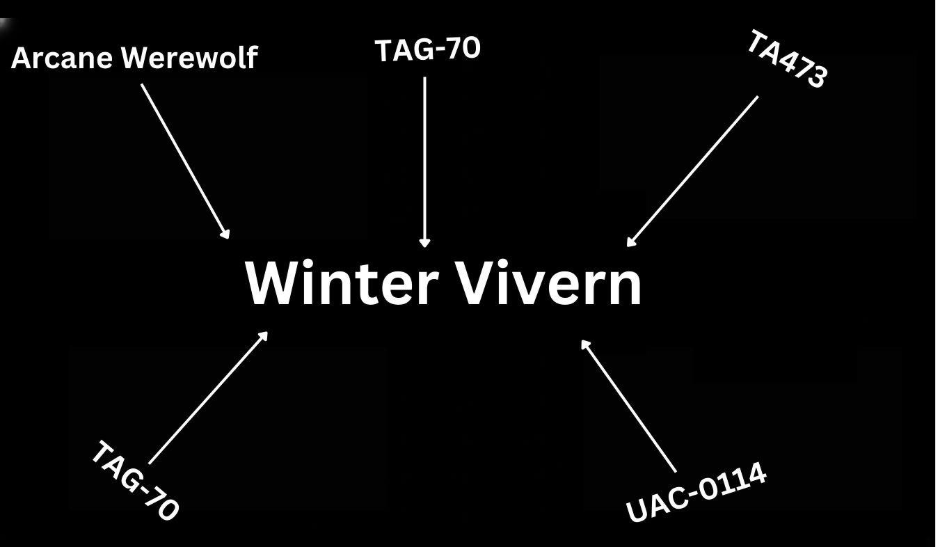
Winter Vivern is highly adaptive, leveraging zero-day vulnerabilities in webmail servers, including Zimbra and Roundcube, to infiltrate targeted systems. A typical attack scenario could involve compromising a European government’s email infrastructure through a Zimbra zero-day exploit, allowing the group to exfiltrate confidential communications and sensitive information.
Target Countries
Winter Vivern operates across a broad geographic range, targeting countries in Europe, including Georgia, Lithuania, Moldova, Poland, and Slovakia, as well as India and Uzbekistan in Asia, Tunisia in Africa, the United States in North America, and Ukraine in Eastern Europe.
This distribution indicates opportunistic exploitation aligned with the group’s geopolitical objectives rather than purely financial motives. In terms of industry focus, Winter Vivern concentrates on strategically significant sectors such as Aerospace & Defense, Chemicals, and Government and Law Enforcement Agencies (LEA).
Organizations within these industries frequently depend on webmail platforms, cloud-based infrastructure, and remote administrative systems, making them particularly vulnerable to the group’s tailored exploitation of public-facing applications and credential abuse tactics.
Malware and Tools

Winter Vivern relies on a compact yet effective arsenal, primarily for reconnaissance and data exfiltration. Two notable malware families are associated with the group:
- APERETIF: A trojan designed for automated data collection and maintaining persistence. APERETIF facilitates stealthy exfiltration of sensitive data, such as intellectual property or confidential communications, from compromised networks. Its capabilities suggest espionage-motivated operations.
- Unidentified JS 006 (Winter Wyvern): A malicious script targeting the Roundcube webmail platform. Winter Wyvern can enumerate mail folders, extract emails, and send them to a command-and-control (C2) server via HTTP. Its main purpose appears to be unauthorized access to email contents, enabling espionage, identity theft, or financial fraud.
Winter Vivern Operations
Winter Vivern uses a layered approach to break into targeted systems, combining deception with technical manipulation to gain and maintain access. The group frequently abuses stolen or inactive login credentials to move through networks without raising suspicion.
It has created fake websites designed to look like legitimate government portals in order to trick victims into downloading malicious software disguised as security tools. The group also takes advantage of weaknesses in publicly accessible email platforms and other internet-facing applications, sometimes exploiting previously unknown flaws.
Malicious email attachments are another common entry point, enabling attackers to compromise systems when recipients open infected documents. Once inside, Winter Vivern establishes persistence by setting up automated processes that regularly retrieve and run additional malicious components.
It relies on built-in system tools and scripts to execute its code, often disguising harmful files as legitimate utilities to avoid detection. The group has also used malicious web-based scripts to compromise email servers and access sensitive communications.
Overall, Winter Vivern’s methods show a careful balance between exploitation and stealth, allowing it to maintain long-term access while minimizing the risk of discovery. Its operations are primarily focused on intelligence gathering aligned with Russian and Belarusian interests, targeting sensitive government information and private communications to advance geopolitical objectives rather than seeking purely financial rewards.
Conclusion
Winter Vivern continues to stand out as a focused and resource-conscious advanced persistent threat group aligned with pro-Russian interests. Through a calculated mix of zero-day exploitation, social engineering, and purpose-built malware such as APERETIF and Winter Wyvern, the group has repeatedly breached webmail platforms and government networks to support long-term intelligence collection.
Active as of late 2025, Winter Vivern remains a credible threat to aerospace, chemical, and government organizations across multiple countries. Defending against such actors requires continuous monitoring for unusual access behavior, strict credential management, and rapid patching of public-facing systems.
Leveraging advanced threat intelligence from platforms like Cyble can significantly strengthen detection and response capabilities. Recognized globally for its AI-powered threat intelligence and brand protection capabilities, Cyble helps organizations gain real-time visibility into emerging threats, map attacker infrastructure, and proactively reduce risk.
Security teams looking to stay ahead of sophisticated actors like Winter Vivern can schedule a free demo to explore how Cyble Vision and Cyble Blaze AI deliver actionable intelligence, automated threat hunting, and faster incident response across cloud and enterprise environments.
Recommendation and Mitigation Strategies
- Regularly patch and update webmail servers, email platforms, and all public-facing applications to address known and emerging vulnerabilities.
- Enforce multi-factor authentication for email, remote access, and administrative accounts, and immediately disable inactive or unused credentials.
- Implement advanced email security controls, including attachment sandboxing and phishing detection, to block malicious documents and fake government-themed lures.
- Continuously monitor for unusual login behavior, abnormal mailbox access, privilege escalation, and suspicious account activity.
- Apply the principle of least privilege and restrict administrative interfaces from direct internet exposure.
- Segment sensitive networks and critical infrastructure to limit lateral movement in case of compromise.
- Monitor and restrict the execution of scripts, automated tasks, and built-in system tools commonly abused for persistence.
- Integrate real-time threat intelligence and conduct proactive threat hunting to identify indicators and behaviors associated with Winter Vivern.
MITRE ATT&CK Techniques Associated with Winter Vivern
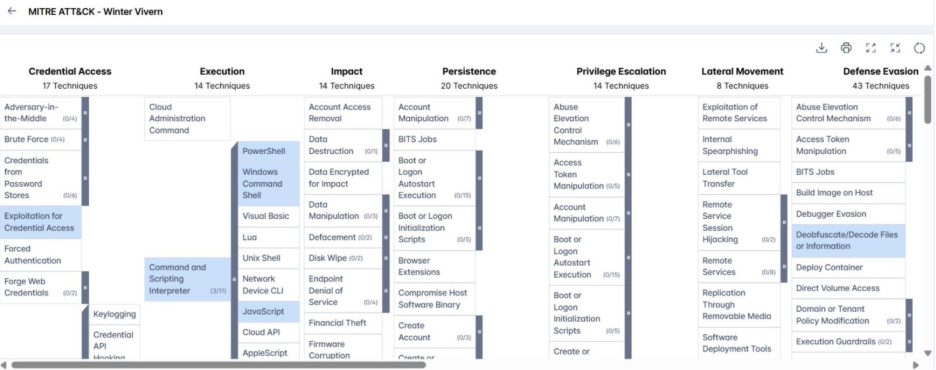
- Valid Accounts (T1078): Abused legitimate and inactive credentials to gain access, maintain persistence, escalate privileges, and move across VPNs, email portals, remote desktops, and cloud or on-prem environments while avoiding detection.
- Drive-by Compromise (T1189): Created fake government-themed websites to distribute malicious software disguised as antivirus tools.
- Exploit Public-Facing Application (T1190): Exploited known and zero-day vulnerabilities in internet-facing systems, including Roundcube webmail servers and the Follina vulnerability, to gain unauthorized access.
- Spearphishing Attachment (T1566.001): Delivered weaponized email attachments to trick users into opening malicious documents for initial compromise.
- Scheduled Task (T1053.005): Used scripts to create recurring scheduled tasks that periodically downloaded and executed remote payloads for persistence.
- Command and Scripting Interpreter (T1059): Leveraged document macros and scripting environments to execute malicious code and initiate follow-on activity.
- PowerShell (T1059.001): Shifted execution from document macros to PowerShell scripts for payload delivery, installation, and persistence.
- Windows Command Shell (T1059.003): Distributed batch scripts disguised as legitimate security tools to trigger malicious downloads using built-in system utilities.
- JavaScript (T1059.007): Deployed malicious JavaScript during exploitation of webmail platforms to execute code within compromised environments.
- Exploitation for Client Execution (T1203): Exploited vulnerabilities in browsers, office applications, and common third-party software to achieve remote code execution.
- Malicious Link (T1204.001): Mimicked legitimate government domains to host malicious webpages containing links to exploit content or weaponized documents.
- Masquerading (T1036): Crafted phishing documents that closely resembled official government materials to increase credibility and improve success rates.