If you are wondering what is a data breach, the simplest answer is this a data breach happens when people without permission somehow get access to confidential or sensitive or protected information. The taken information can include personally identifiable data, financial records, healthcare info , business secrets, passwords, or intellectual property.
The bigger cybercrime is getting shows why learning what a data breach is, matters more than ever. In fact, the Cyble Global Cybersecurity Report 2025 says organizations went through 6,046 data breaches and leaks which makes it the second-highest number ever written down. In that same time, researchers also found 5,967 ransomware attacks, and that comes out to a 50% jump compared with the previous year, meanwhile cybercriminals traded 3,013 compromised corporate access credentials on underground marketplaces, which helps them stage more sophisticated attacks.
These numbers suggest that attackers aren’t only poking at weaknesses anymore. They work like real organized businesses, they buy and sell entry to enterprise networks, and then later they launch ransomware, data theft, or espionage efforts.
So, knowing what is a data breach, how data breaches get going, and the best ways to prevent them is essential if you want to reduce cyber risk overall.
Key Takeaways
- A data breach occurs when unauthorized individuals gain access to confidential information, including personal, financial, healthcare, or corporate data.
- Cybercriminals are increasingly buying compromised network access from Initial Access Brokers (IABs), enabling faster ransomware attacks and cyber espionage campaigns.
- Cyble recorded 6,046 data breaches and leaks in 2025, highlighting the continued rise in global cyber threats.
- Government and Banking, Financial Services, and Insurance (BFSI) organizations remain the most targeted sectors due to the high value of the sensitive data they manage.
- Implementing strong access controls, threat intelligence, employee cybersecurity training, and continuous monitoring can significantly reduce the risk of a data breach and is far more cost-effective than recovering from one.
What is a Data Breach?
The data breach definition is straightforward. A data breach is a security incident in which confidential, sensitive, or protected information is accessed, disclosed, copied, stolen, or used by an unauthorized individual or organization.
Unlike accidental data exposure, a breach generally involves unauthorized access that compromises the confidentiality of information. The stolen data may later be sold on underground forums, used for identity theft, financial fraud, ransomware attacks, corporate espionage, or extortion.

A data breach can affect:
- Personally Identifiable Information (PII)
- Financial records
- Healthcare information
- Customer databases
- Login credentials
- Intellectual property
- Government records
- Source code
- Confidential business documents
The impact often extends far beyond the initial intrusion. Organizations must investigate the incident, notify affected individuals, restore affected systems, satisfy regulatory requirements, and rebuild customer trust.
Why Are Data Breaches Increasing?
Modern organizations generate and store enormous amounts of digital information across cloud platforms, SaaS applications, mobile devices, APIs, and third-party vendors.
This expanding attack surface gives threat actors more opportunities to compromise systems.
Several trends have accelerated the rise in breaches:
| Trend | Impact |
| Cloud adoption | More internet-facing assets increase exposure. |
| Remote work | Larger attack surface and increased credential theft. |
| AI-powered phishing | More convincing social engineering campaigns. |
| Supply chain attacks | Vendors become indirect entry points. |
| Underground access marketplaces | Attackers can simply buy corporate access instead of compromising networks themselves. |
Cyble’s 2025 findings illustrate this shift clearly. Instead of breaking into organizations from scratch, ransomware groups increasingly purchase previously compromised credentials from Initial Access Brokers (IABs).
Why Data Breaches Matter in 2025
To truly grasp what a data breach is you also have to get what is happening in the cyber threat landscape today, it keeps shifting, like constantly.
Cybercriminals are no longer some lone figures in a basement, working in secrecy alone. A lot of them now operate like organized criminal groups, with clear jobs, malware developers, phishing operators, credential brokers, ransomware affiliates, and also money launderers. This “crime as a service” idea has basically made intrusions more advanced, easier to scale, and more lucrative than before.
One of the more notable changes in recent years is the growth of underground markets, where access that was already stolen from companies is bought and sold. So instead of doing the breach themselves, ransomware outfits and other bad actors can simply purchase ready-made pathways from Initial Access Brokers (IABs). That means attacks start faster, and they’re often more precise too.
As companies keep moving into cloud services, leaning into remote work, and connecting more systems together, their attack surface has widened a lot. And when you add sharper phishing attempts, supply chain interference, plus AI-assisted cyberattacks, data breaches stop being “once in a while” and become a steady business risk.
For organizations, it comes down to understanding how these breaches typically happen and putting in preventative security steps early, so sensitive information stays protected, customer trust doesn’t erode, and operations keep running without too much disruption.
Industries Most Targeted by Data Breaches
Some industries remain consistently attractive to attackers because of the sensitive information they manage.
Cyble’s research found that government agencies experienced 998 data breach incidents, accounting for 16.5% of all recorded breaches.
Government organizations hold, national identity information, citizen records, tax information, law enforcement databases and critical infrastructure data. Such information is valuable for espionage, fraud, and geopolitical operations.
The Banking, Financial Services, and Insurance (BFSI) sector experienced 634 breaches, making it the second most targeted industry.
Financial institutions store information like banking credentials, payment card information, customer financial records, investment portfolios and loan information.
Together, government organizations and BFSI represented more than one-quarter of all publicly observed breaches during the reporting period.
The Rise of the Initial Access Economy
One of the most important changes in modern cybercrime is the emergence of Initial Access Brokers. Rather than conducting the entire attack themselves, some threat actors specialize in infiltrating organizations and then selling that access to ransomware gangs.
Cyble’s research found:
| Sector | Compromised Access Sales |
| Retail | 594 |
| BFSI | 284 |
| Government | 175 |
Retail organizations topped the list because they often operate thousands of internet-facing systems, payment applications, third-party vendors, and distributed endpoints.
For ransomware operators, purchasing ready-made access dramatically reduces the effort needed to compromise a target.
This underground marketplace has transformed how data breaches happen, making attacks faster, more scalable, and increasingly difficult to defend against.
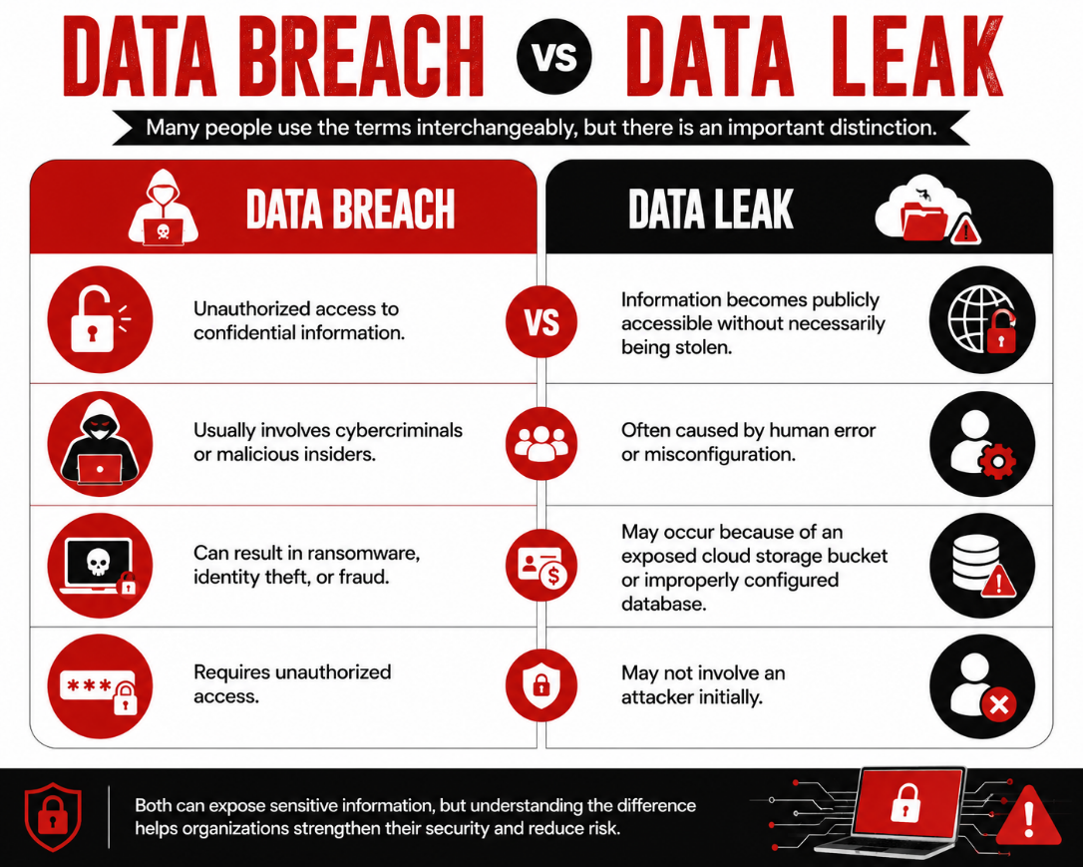
Data Breach vs Data Leak
Many people use the terms interchangeably, but there is an important distinction.
| Data Breach | Data Leak |
| Unauthorized access to confidential information. | Information becomes publicly accessible without necessarily being stolen. |
| Usually involves cybercriminals or malicious insiders. | Often caused by human error or misconfiguration. |
| Can result in ransomware, identity theft, or fraud. | May occur because of an exposed cloud storage bucket or improperly configured database. |
| Requires unauthorized access. | May not involve an attacker initially. |
For example, if hackers steal customer records from a financial institution, it is a data breach.
If an organization accidentally exposes a cloud database containing customer information because of incorrect security settings, it is a data leak.
However, data leaks frequently become full-scale data breaches once attackers discover and exploit the exposed information.
Data Breach vs Cyber Attack
Another common question is the difference between a data breach vs cyber attack.
Although related, they are not the same.
| Cyber Attack | Data Breach |
| Any malicious attempt to disrupt, damage, or gain unauthorized access to systems. | A specific outcome where sensitive data is accessed or stolen. |
| May include ransomware, DDoS, phishing, malware, or credential attacks. | Specifically involves unauthorized exposure of confidential information. |
| Not every cyber attack result in stolen data. | Every data breach involves unauthorized access to data. |
For instance:
- A Distributed Denial-of-Service (DDoS) attack may temporarily shut down a website without exposing customer information.
- A phishing campaign may become a data breach if attackers successfully steal employee credentials and access confidential databases.
In other words, a cyber attack is the method, while a data breach is often one of its outcomes.
Types of Data Breaches
Understanding the types of data breaches helps organizations identify potential risks and implement the right security controls. While attackers use different techniques, their objective remains the same: gaining unauthorized access to valuable information.
Below are the most common types of data breaches businesses face today.
| Type of Data Breach | Description |
| Malware and Viruses | Malicious software steals, modifies, or destroys sensitive data. |
| Phishing and Social Engineering | Attackers trick users into revealing credentials or confidential information. |
| Business Email Compromise (BEC) | Fraudulent emails impersonate executives or trusted partners to steal money or data. |
| Insider Threats | Employees or contractors intentionally or accidentally expose sensitive information. |
| Ransomware | Criminals encrypt systems and often steal data before demanding payment. |
| Access Control Breaches | Weak authentication or excessive permissions allow unauthorized access. |
| Supply Chain Attacks | Third-party vendors become the entry point into an organization. |
| Physical Security Breaches | Lost laptops, stolen servers, or unauthorized facility access expose sensitive information. |
| Human Error | Misconfigured databases, accidental emails, or improper file sharing expose confidential data. |
| Keyloggers | Malware secretly records keystrokes to capture usernames, passwords, and banking credentials. |
| Source Code Exposure | Hardcoded passwords, API keys, or credentials stored in repositories are compromised. |
Let’s explore these in more detail.
Malware and Virus Attacks
Malware remains one of the leading causes of modern data breaches. Cybercriminals typically deploy malicious software through phishing emails, infected downloads, compromised websites, or malicious USB devices.
Once installed, malware can silently steal login credentials, monitor user activity, transfer confidential files to external servers, install additional malicious programs, and create backdoors that allow attackers to regain access to the compromised system.
Because advanced malware is designed to evade detection, it can remain hidden within an organization’s network for weeks or even months before security teams discover its presence, giving attackers ample time to steal sensitive information and expand their access.
Phishing and Social Engineering
Phishing and social engineering remain among the most effective cyberattack techniques because they exploit human behavior rather than technical vulnerabilities. In these attacks, cybercriminals impersonate trusted entities such as banks, Microsoft 365, Google Workspace, delivery companies, HR departments, or company executives to deceive victims.
They often use convincing emails, text messages, or phone calls to trick individuals into resetting passwords, opening malicious attachments, clicking fake login pages, transferring money, or sharing confidential information.
With the rise of artificial intelligence, phishing campaigns have become even more sophisticated, enabling attackers to create highly personalized and realistic messages that are increasingly difficult for users to identify.
Business Email Compromise (BEC)
Business Email Compromise (BEC) is one of the most financially damaging forms of cybercrime today. In a BEC attack, cybercriminals compromise or spoof legitimate business email accounts to impersonate trusted executives, employees, or vendors.
Using these fraudulent emails, they trick recipients into approving fake invoices, changing supplier payment details, transferring company funds, sharing confidential documents, or disclosing sensitive payroll and employee information.
Because these emails closely resemble genuine business communications and often do not contain malicious attachments or links, they can bypass traditional security controls and are difficult for employees to identify as fraudulent.
Insider Threats
Not every breach originates from an external hacker.
Insider threats involve employees, contractors, or business partners who misuse their legitimate access to organizational systems.
Insider incidents generally fall into three categories:
| Insider Type | Example |
| Malicious Insider | Employee intentionally steals customer database before resigning. |
| Negligent Insider | Staff member accidentally shares confidential files publicly. |
| Compromised Insider | Employee account is hijacked by attackers. |
Organizations often underestimate insider risks because these users already possess authorized access.
Ransomware
Ransomware has evolved far beyond simply encrypting files. Modern ransomware attacks are highly sophisticated and often involve data theft before encryption begins. Attackers typically gain access to a network, escalate their privileges, move laterally across systems to identify valuable assets, and steal sensitive information before encrypting files.
They then demand a ransom for the decryption key while also threatening to publicly release the stolen data if the payment is not made. This tactic, known as double extortion, leaves organizations facing both operational disruption and the risk of sensitive information being exposed, increasing the financial, legal, and reputational impact of the attack.
Access Control Breaches
Access control breaches occur when attackers exploit weak authentication mechanisms or excessive user permissions to gain unauthorized access to an organization’s systems and sensitive data. Common security weaknesses include weak or reused passwords, the absence of multi-factor authentication (MFA), excessive administrative privileges, shared user accounts, and inactive accounts that have not been disabled.
Once cybercriminals obtain valid login credentials, they can often access systems as legitimate users, making their activities much harder to detect and increasing the risk of data theft or further compromise.
Supply Chain Attacks
Organizations increasingly depend on cloud providers, software vendors, consultants, and managed service providers. Unfortunately, attackers exploit these trusted relationships.
Instead of targeting the primary organization directly, they compromise a supplier and use that connection to infiltrate multiple customers simultaneously. Recent supply chain attacks have demonstrated how one vulnerable vendor can affect thousands of downstream organizations.
Physical Security Breaches
Despite the increasing reliance on digital technologies, physical security remains a critical aspect of protecting sensitive information. A physical security breach occurs when unauthorized individuals gain access to devices, storage media, or facilities containing confidential data. Common examples include stolen laptops, lost smartphones, unauthorized entry into server rooms, theft of backup drives, and the improper disposal of storage devices. If sensitive data stored on these devices is not encrypted, physical theft or loss can expose thousands or even millions of confidential records, leading to significant financial, legal, and reputational consequences for an organization.
Human Error
Human error remains one of the leading contributors to data breaches, often creating security gaps that cybercriminals can exploit. Simple mistakes such as sending confidential information to the wrong recipient, uploading sensitive files to public cloud storage, misconfiguring security settings, accidentally disabling security controls, or sharing passwords can expose critical business data.
Unlike sophisticated cyberattacks, these incidents are usually unintentional but can have equally serious consequences. In many cases, organizations only discover a breach after an employee inadvertently exposes sensitive information, highlighting the importance of regular cybersecurity awareness training and strong data handling policies.
What Causes a Data Breach?
One of the most frequently asked questions is what causes a data breach.
Although cyberattacks receive most media attention, the reality is that data breaches usually result from a combination of technical vulnerabilities, weak security practices, and human mistakes.
Below are the most common causes.
Weak or Stolen Credentials
Weak or stolen credentials remain one of the most common causes of data breaches. Using simple or reused passwords and failing to enable multi-factor authentication (MFA) makes it easier for cybercriminals to gain unauthorized access. Attackers often obtain credentials through phishing attacks, data leaks, credential stuffing, password spraying, keylogging malware, or dark web marketplaces. Once valid credentials are compromised, they can bypass traditional security defenses and access sensitive systems.
Unpatched Software Vulnerabilities
Unpatched software vulnerabilities are a common cause of data breaches. When organizations delay installing security updates, attackers can exploit known weaknesses in operating systems, applications, VPNs, or legacy software to gain unauthorized access. Many major breaches could have been prevented by applying available security patches promptly.
Social Engineering
Social engineering exploits human psychology rather than technical vulnerabilities to gain unauthorized access to sensitive information. Attackers use tactics such as fake invoices, CEO impersonation, technical support scams, phishing emails, and fraudulent software updates to trick employees into revealing credentials or confidential data. Even organizations with strong security controls can fall victim if employees unknowingly trust these deceptive communications.
Excessive User Permissions
Many organizations grant employees more access than they actually require. This violates the Principle of Least Privilege. If a compromised employee account has unrestricted access across multiple departments, attackers can move through the network much more easily.
Regular permission reviews significantly reduce this risk.
Third-Party Risks
Third-party vendors, suppliers, consultants, and cloud providers can introduce additional security risks if their systems are compromised. Since organizations often share sensitive information with these partners, it is essential to assess their security practices, compliance standards, and access controls. Weak vendor security has become one of the fastest-growing causes of enterprise data breaches.
How Data Breaches Happen
Many people assume cybercriminals simply “hack” a company in a single step.
In reality, most breaches follow a structured attack lifecycle.
Understanding how data breaches happen enables organizations to detect attacks earlier and reduce potential damage.
| Stage | Attacker Activity |
| Reconnaissance | Collect information about the target organization. |
| Initial Access | Gain entry through phishing, stolen credentials, malware, or vulnerabilities. |
| Privilege Escalation | Obtain higher-level administrative permissions. |
| Lateral Movement | Move between systems to locate valuable information. |
| Data Discovery | Identify sensitive files and databases. |
| Data Exfiltration | Transfer confidential information outside the network. |
| Monetization | Sell stolen data, launch ransomware, or commit fraud. |
Who Is Most at Risk of a Data Breach?
While every organization faces cyber risks, some industries are significantly more attractive to attackers because of the value of the information they store.
These agencies manage highly sensitive citizen information, national infrastructure, tax records, and law enforcement data, making them prime targets for cybercriminals and nation-state actors.
The Banking, Financial Services, and Insurance (BFSI) sector recorded 634 breach incidents, reflecting attackers’ continued interest in financial information that can be monetized quickly through fraud or sold on underground marketplaces.
The underground market for compromised enterprise access also reveals which industries attackers consider most valuable. Cyble identified 594 access sales targeting the retail sector, followed by 284 targeting BFSI organizations and 175 involving government agencies. These figures highlight how attackers increasingly profit by selling network access before ransomware groups or other threat actors launch follow-on attacks.
Although government, finance, and retail remain the most frequently targeted sectors, healthcare providers, educational institutions, manufacturing companies, and technology firms also face growing risks due to the large volumes of sensitive personal, operational, and intellectual property data they manage.
Common Data Breach Examples
Learning from real incidents is one of the best ways to understand how data breaches happen and why organizations must invest in proactive security measures. The following common data breach examples illustrate how attackers exploit technical vulnerabilities, third-party relationships, and human error to gain access to sensitive information.
Ticketmaster Data Breach (2024)
One of the largest publicly disclosed breaches in recent years affected Ticketmaster. Attackers reportedly stole data belonging to more than 560 million customers, including names, email addresses, phone numbers, order histories, and partial payment information.
The stolen database was later advertised for sale on cybercrime forums, highlighting how compromised customer information quickly enters the underground economy.
Key lesson: Organizations should continuously monitor for stolen data and secure cloud environments where customer information is stored.
AT&T Data Breach (2024)
AT&T disclosed that sensitive customer information, including Social Security numbers, account details, and passcodes, had been exposed after threat actors published previously stolen data online.
Although some of the compromised information dated back several years, the breach demonstrated that stolen data can remain valuable long after the initial compromise.
Key lesson: Organizations must maintain strong data retention policies and continuously monitor dark web marketplaces for leaked customer information.
Prudential Insurance Data Breach (2024)
Prudential experienced a breach that exposed personal information belonging to more than 36,000 individuals.
The compromised information included:
- Full names
- Addresses
- Driver’s license numbers
- Other personally identifiable information
Financial institutions remain highly attractive targets because attackers can monetize stolen identity information through fraud and identity theft.
Key lesson: Strong identity protection and continuous monitoring are critical in highly regulated industries.
Discord Data Exposure
Millions of publicly accessible Discord messages were reportedly collected and indexed by third parties, raising concerns about user privacy.
Although public messages differ from traditional confidential records, the incident demonstrated how publicly available information can still create significant privacy risks when aggregated at scale.
Key lesson: Organizations should understand that publicly shared information can still become part of a broader data exposure event.
Supply Chain Data Breaches
Modern organizations depend heavily on third-party vendors, making supply chain attacks increasingly common.
Instead of attacking a large enterprise directly, cybercriminals often compromise:
- Managed service providers
- Software vendors
- Cloud providers
- Payment processors
A single vulnerable supplier can provide attackers with access to hundreds or even thousands of downstream organizations.
Key lesson: Vendor risk management should be an essential part of every cybersecurity program.
Effects of a Data Breach
The effects of a data breach extend far beyond the immediate loss of confidential information. A successful breach can affect an organization’s finances, reputation, legal standing, and long-term business growth.
For individuals, the consequences often include identity theft, financial fraud, and privacy violations. For businesses, the impact can be much more severe.
Financial Losses
Recovering from a data breach is expensive.
Organizations typically incur costs related to:
- Incident investigation
- Digital forensics
- Legal services
- Regulatory compliance
- Customer notification
- Credit monitoring
- Public relations
- Infrastructure upgrades
Many organizations also experience lost revenue because customers lose confidence after a major breach.
Reputational Damage
Trust is difficult to earn and easy to lose.
Customers increasingly expect businesses to protect their personal information. A publicly disclosed breach can lead to:
- Customer churn
- Negative media coverage
- Reduced investor confidence
- Declining market value
- Difficulty acquiring new customers
Rebuilding trust often takes years.
Regulatory Penalties
Organizations that fail to protect sensitive information may face penalties under privacy and cybersecurity regulations.
Depending on the jurisdiction, businesses may be required to:
- Notify regulators
- Inform affected individuals
- Conduct forensic investigations
- Demonstrate corrective actions
Failure to comply with breach notification requirements can result in significant fines and legal consequences.
Operational Disruption
Many breaches interrupt normal business operations.
Systems may need to be:
- Shut down
- Isolated
- Rebuilt
- Restored from backups
If ransomware is involved, operations may remain unavailable for days or even weeks.
Identity Theft and Fraud
For individuals, stolen information frequently leads to:
- Identity theft
- Fraudulent bank transactions
- Credit card fraud
- Loan fraud
- Account takeovers
Criminals often combine stolen data from multiple breaches to create comprehensive victim profiles.
How to Respond to a Data Breach
Knowing how to respond to a data breach can significantly reduce financial losses and operational disruption.
The first few hours after discovering a breach are often the most critical.
Step 1: Contain the Incident
Immediately isolate affected systems to prevent attackers from moving further within the network.
This may involve:
- Disconnecting compromised servers
- Disabling affected accounts
- Blocking malicious IP addresses
- Revoking stolen credentials
Step 2: Assess the Scope
Determine:
- What information was accessed
- Which systems were affected
- How attackers entered the environment
- Whether the attack is still active
Digital forensic investigations are essential during this phase.
Step 3: Notify Stakeholders
Organizations should notify:
- Executive leadership
- Legal teams
- Security teams
- Regulators (where required)
- Customers
- Business partners
Clear communication helps reduce confusion and maintain trust.
Step 4: Eliminate the Threat
Once the attack vector has been identified, organizations should:
- Remove malware
- Patch exploited vulnerabilities
- Reset passwords
- Rotate encryption keys
- Strengthen authentication controls
Step 5: Monitor for Further Activity
Attackers sometimes leave hidden backdoors after a breach.
Organizations should continue monitoring for:
- Suspicious logins
- Privilege escalation
- Unexpected network traffic
- Credential misuse
Continuous monitoring helps detect follow-on attacks before they become another incident.
Data Breach Prevention
strategies dramatically reduce the likelihood and impact of an attack. While no organization can eliminate cyber risk entirely, strong data breach prevention
Implement Strong Identity Security
Identity remains the primary attack vector.
Organizations should enforce:
- Multi-factor authentication
- Strong password policies
- Password managers
- Role-based access controls
- Least privilege principles
Keep Systems Updated
Software vulnerabilities remain one of the easiest ways for attackers to compromise organizations.
Regularly update:
- Operating systems
- Applications
- Firewalls
- VPN appliances
- Endpoint security solutions
Prompt patching significantly reduces exploitable attack surfaces.
Encrypt Sensitive Information
Encryption ensures that even if attackers steal data, it remains unreadable without the appropriate decryption keys.
Businesses should encrypt:
- Customer databases
- Financial information
- Healthcare records
- Backup files
- Portable devices
Train Employees Regularly
Cybersecurity awareness remains one of the most effective security investments.
Training should cover:
- Phishing identification
- Password hygiene
- Safe internet practices
- Social engineering
- Incident reporting procedures
Employees are often the first line of defense.
Monitor Continuously
Organizations should continuously monitor:
- Network traffic
- Cloud environments
- User behavior
- Endpoint activity
- Dark web marketplaces
Threat intelligence platforms can identify compromised credentials and stolen corporate information before attackers launch larger campaigns.
Data Breach Best Practices
Following established data breach best practices helps organizations build long-term cyber resilience.
Some of the most effective practices include:
| Best Practice | Benefit |
| Adopt Zero Trust Architecture | Reduces unauthorized access. |
| Implement Multi-Factor Authentication | Protects against stolen credentials. |
| Perform Regular Security Audits | Identifies vulnerabilities before attackers do. |
| Conduct Penetration Testing | Tests real-world security posture. |
| Back Up Critical Data | Enables rapid recovery after ransomware attacks. |
| Monitor Third-Party Vendors | Reduces supply chain risks. |
| Encrypt Sensitive Information | Protects data even if systems are compromised. |
| Develop an Incident Response Plan | Improves recovery speed and coordination. |
| Use Threat Intelligence | Detects emerging threats before they become breaches. |
| Continuously Train Employees | Reduces phishing and social engineering success rates. |
Organizations that combine these practices with continuous security monitoring and proactive threat intelligence are significantly better prepared to defend against modern cyber threats.
Conclusion
Understanding what is a data breach is no longer optional in today’s digital economy. Cybercriminals continue to evolve their tactics, targeting organizations of every size through phishing, ransomware, stolen credentials, insider threats, and supply chain compromises.
The good news is that many breaches are preventable. By implementing strong identity security, continuously monitoring for threats, training employees, encrypting sensitive information, and adopting proactive data breach best practices, organizations can significantly reduce their exposure to cyber risk.
As the cyber threat landscape continues to evolve, businesses that invest in prevention, preparedness, and rapid incident response will be far better positioned to protect their data, maintain customer trust, and ensure long-term resilience.
FAQs About What is a Data Breach
What is the main cause of a data breach?
The main cause of data breaches is often human error or system vulnerabilities, such as weak passwords, unpatched software, or falling victim to phishing attacks, which allow unauthorized access to sensitive data.
How to solve a data breach?
Solving a data breach involves quickly identifying the source, containing the breach, securing affected systems, notifying impacted parties, and implementing stronger security measures such as data leak protection and monitoring tools to prevent future incidents.
Why does a Data Breach happen?
A data breach happens when unauthorized individuals exploit vulnerabilities in a system, use social engineering tactics like phishing, or leverage weak security practices to gain access to sensitive information.
How does a data breach occur?
A data breach occurs when unauthorized individuals gain access to sensitive information through hacking, phishing, malware, or exploiting system vulnerabilities. This compromises personal, financial, or organizational data.
What is the difference between a data breach and a cyber attack?
A cyber attack is any malicious attempt to disrupt, damage, or gain unauthorized access to computer systems or networks. A data breach, on the other hand, is the result of unauthorized access to sensitive or confidential information. While many cyber attacks lead to data breaches, not every cyber attack results in stolen data. For example, a Distributed Denial-of-Service (DDoS) attack disrupts services but may not expose confidential information.
What are the common causes of data breaches?
Common causes of data breaches include weak passwords, unpatched software, human error, phishing attacks, and insider threats. These factors leave systems vulnerable to unauthorized access.
What are the consequences of a data breach?
The data breach can lead to financial losses, reputational damage, regulatory fines, and loss of customer trust.
How can businesses prevent data breaches?
Businesses can reduce the risk of data breaches by implementing multi-factor authentication (MFA), enforcing strong password policies, encrypting sensitive data, regularly patching software vulnerabilities, conducting employee cybersecurity awareness training, monitoring networks for suspicious activity, and adopting a Zero Trust security model. Regular security assessments and incident response planning also play a crucial role in minimizing cyber risks.
What should you do if your data is involved in a data breach?
If your personal information is exposed in a data breach, immediately change your passwords, enable multi-factor authentication on affected accounts, monitor bank and credit card statements for suspicious activity, and watch for phishing emails or identity theft attempts. If financial information has been compromised, contact your bank or credit card provider immediately and consider placing a fraud alert or credit freeze with your credit bureau.
How can companies protect against data breaches?
To protect companies against data breaches, implement encryption, strong access controls, employee training, and regular security audits.
What do we understand by data breach Malaysia or data breach in Asian countries?
A data breach in Malaysia or Asian countries occurs when unauthorized access is gained to sensitive data, risking misuse of personal or business information.
What is the exact definition of a data breach?
A data breach is a security incident in which unauthorized individuals gain access to confidential, sensitive, or protected information. The exposed data may include personally identifiable information (PII), financial records, healthcare information, passwords, or intellectual property. Data breaches can result from cyberattacks, insider threats, human error, or system vulnerabilities and often lead to financial losses, legal consequences, and reputational damage.
What are some data breach examples?
Data breach examples include hacking, accidental data exposure, and phishing attacks that steal sensitive information.
what are data leaks?
Data leaks occur when sensitive information is unintentionally exposed or made accessible to unauthorized individuals, often due to security flaws or human error.
What are the most common causes of data breaches?
The most common causes of data breaches include phishing attacks, weak or stolen passwords, malware, ransomware, insider threats, unpatched software vulnerabilities, cloud misconfigurations, and human error. Attackers also exploit third-party vendors and compromised credentials purchased on underground marketplaces to gain unauthorized access to organizational networks.