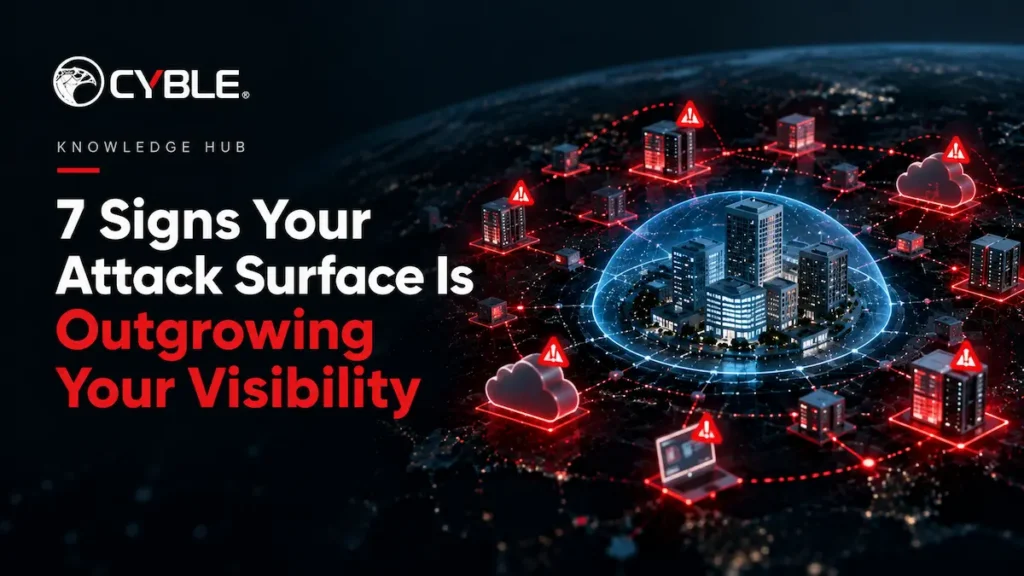
Here’s an uncomfortable truth most security leaders already suspect. Your organization is adding internet-facing assets faster than anyone is tracking them. A new cloud workload here, a marketing microsite there, a vendor portal someone spun up last quarter. Attack surface management exists because this growth doesn’t wait for your inventory spreadsheet to catch up.
And attackers aren’t waiting either. Cyble’s 2025 research across APAC and Europe found that attackers are treating externally exposed enterprise infrastructure as their main way in, with steady trading of initial access tied to exposed VPNs, cloud workloads, APIs and web apps.
So how do you know if your external attack surface has outgrown your team’s visibility? Here are seven signs worth taking seriously.
Why Attack Surface Management Matters More Every Quarter
Before the list, a quick reality check. The shift over the past year has moved away from malware-first breaches toward identity-based attacks like credential theft, MFA bypass, session hijacking and third-party access abuse. Attackers are logging in rather than breaking in.
That changes the game. Every exposed login page, forgotten test server and leaked password is a potential front door. If you can’t see those doors, you can’t lock them.
Sign 1: Your Asset Inventory Is Older Than Your Last Cloud Deployment
If your asset list lives in a spreadsheet or a CMDB that gets updated “when someone remembers,” it’s already out of date.
Cloud teams can launch new instances, storage buckets and APIs in minutes. Developers test things on public endpoints. Business units sign up for SaaS tools on a company card. This is shadow IT, and it’s rarely malicious. People are just trying to get work done.
The problem is that your security team can only protect what it knows about. For reference, CISA’s Binding Operational Directive 23-01 requires US federal agencies to run automated asset discovery every seven days. If government agencies need that cadence, a quarterly manual review isn’t going to cut it for a growing enterprise.
Quick check: Pick a random business unit and ask them what external tools and domains they use. Compare it to your inventory. The gap is usually eye-opening.
Sign 2: You Learn About Your Own Assets From Outsiders
This one stings. A security researcher emails you about an exposed server. A customer reports a phishing page that looks exactly like yours. A partner flags a login portal they didn’t know you had.
When outsiders are your asset discovery method, it means someone outside your walls has a clearer picture of your external attack surface than you do. And for every well-meaning researcher who reports it, there are others who won’t.
Quick check: Look at your last six months of inbound security reports. How many involved assets your team didn’t already know existed?
Sign 3: Old Subdomains Still Point Somewhere
Marketing campaigns end. Projects get cancelled. Cloud services get shut down. But the DNS records often stay behind.
A subdomain pointing to a cloud resource that no longer exists is a classic setup for subdomain takeover. An attacker claims that abandoned resource, and suddenly they’re hosting content on your trusted domain. That’s a perfect launchpad for phishing, session theft or malware delivery, all carrying your brand.
This is one of the clearest signs that growth outpaced visibility. Nobody decommissioned the record because nobody knew it was still there.
Quick check: Pull your full DNS zone and look for records pointing to cloud services, CDNs or third-party platforms. Verify each one still resolves to something you own.
Old subdomains can quietly put your brand at risk. Book a Cyble demo to find yours.
Sign 4: Your Credentials Show Up in Places You Never Checked
Here’s where the identity shift really matters. Exposed credentials from infostealer logs, old breaches and phishing kits end up on underground forums and marketplaces, often long before the victim notices anything wrong.
The scale is real. Cyble’s annual threat landscape report for 2025 counted 2,059 incidents focused on selling unauthorized access, including credentials, VPN entry points and admin footholds.
If your team isn’t doing dark web monitoring, you’re relying on luck. A valid employee password for a forgotten VPN gateway is basically an open door, and it doesn’t trigger any malware alerts.
Quick check: When did you last search for your corporate domain in leaked credential datasets? If the answer is “never” or “after an incident,” that’s the sign.
Sign 5: “Temporary” Cloud Exposures Become Permanent
Almost every cloud misconfiguration starts with good intentions. A storage bucket gets opened up to share files with a vendor. A dev environment gets exposed for a quick demo. A database port is opened to troubleshoot a connection issue.
Then the ticket closes, the person moves on, and the exposure stays.
Public code repositories are part of this too. API keys, tokens and connection strings get committed by accident all the time. Once they’re in a public repo, assume someone has already scraped them.
Quick check: Search your public code repositories for hardcoded secrets, and review cloud storage permissions for anything set to public access. Then ask who approved it and whether it’s still needed.
Sign 6: Vendors and Acquisitions Bring Assets Nobody Mapped
Growth doesn’t only come from inside. Every acquisition brings domains, servers, cloud accounts and legacy apps. Every new vendor with network access extends your perimeter.
Cyble’s research makes this point directly. Enterprises expanding across multiple markets often inherit fragmented infrastructure, which grows their external attack surface without a matching increase in security visibility.
Third-party risk isn’t just about questionnaires anymore. If a vendor’s exposed system connects to yours, their blind spot becomes yours.
Quick check: For your last acquisition, how long did it take to get a complete list of internet-facing assets? If it’s still in progress, that’s your answer.
Sign 7: You Patch by Scan Results, Not by Real Exposure
Most teams have more vulnerabilities than time. The usual response is to sort by CVSS score and work down the list. But a critical bug on an internal test box isn’t the same as a medium bug on an internet-facing login portal.
When your attack surface outgrows your visibility, you end up patching what your scanner sees rather than what attackers can actually reach. Worse, the assets you don’t know about never get scanned at all.
Good attack surface management flips this. It tells you which exposed systems are running vulnerable software, which of those are being actively discussed or exploited, and which ones to fix first.
Quick check: Compare your vulnerability scan scope to a fresh external discovery of your domains and IP ranges. Anything found externally but missing from your scans is unmonitored risk.
See which of your exposed assets are already on attackers’ radar. Book a Cyble demo Now.
How Attack Surface Management Closes the Visibility Gap
If three or more of these signs sound familiar, don’t panic. Almost every growing organization hits this point. What matters is how quickly you respond.
A practical first 30 days usually looks like this. Start with continuous discovery across domains, subdomains, IP ranges, cloud assets and code repositories. Assign an owner to every asset you find, because unowned assets are the ones that never get patched or shut down. Add dark web monitoring so you know when credentials or access tied to your organization show up for sale. Then prioritize fixes based on what’s exposed and what’s being targeted, not just on severity scores.
This is exactly where Cyble helps. Cyble’s attack surface management connects external asset exposure with live dark web monitoring and adversary tracking, so you can see which exposed assets are already in an attacker’s sights. It covers web and mobile apps, cloud systems, domains, email servers, IoT devices and public code repositories, all backed by Cyble’s AI-native platform and research from Cyble Research & Intelligence Labs.
The goal isn’t to stop your business from growing. It’s to make sure your visibility grows with it.
Frequently Asked Questions
What is attack surface management?
Attack surface management is the ongoing process of discovering, monitoring and reducing every internet-facing asset an organization owns, including domains, cloud resources, APIs, apps and exposed credentials, so security teams can fix weaknesses before attackers find them.
What is an external attack surface?
It’s everything related to your organization that can be reached from the internet. That includes websites, subdomains, VPNs, cloud storage, APIs, code repositories and third-party connections.
How often should asset discovery run?
Continuously, if possible. Cloud environments change daily, so periodic manual reviews miss new exposures. As a benchmark, CISA requires US federal agencies to run automated asset discovery at least every seven days.
How does dark web monitoring support attack surface management?
It shows you when your credentials, data or network access appear on underground forums. That gives you a chance to reset passwords, close access and investigate before attackers use what they bought.
Attackers are already mapping your attack surface. Book a Cyble demo and see it first.