If you are waiting for a dramatic hack to tell you something is wrong, you are looking in the wrong place. In most cases, credentials are already on the dark web weeks or months before anyone notices a breach. By the time IT teams see the damage, attackers have already logged in, moved data, or sold access to someone else. The warning signs are usually quiet, scattered across different systems, and easy to write off as “just one of those things.”
This is the exact gap that Cyble’s dark web monitoring and threat intelligence platform closes. Cyble tracks forums, marketplaces, and breach dumps around the clock so security teams can track credential leaks on the dark web before attackers get the chance to use them, not after.
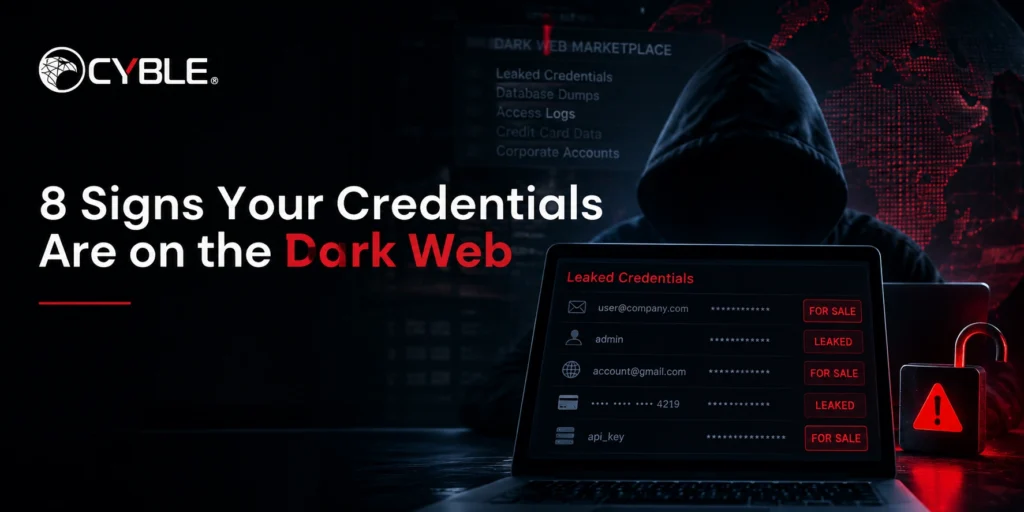
8 Signs Your Credentials Are Already on the Dark Web
Below are the eight signs that most often mean your organization’s credentials have already been exposed and are circulating where they should not be. Some of these you can catch by watching your own systems. Others require the kind of visibility that only a dedicated threat intelligence platform can give you.
1. A Sudden Spike in Failed Login Attempts
One or two failed logins a day is normal. People forget passwords. But a sudden jump in failed attempts, especially across multiple accounts at odd hours, usually means someone out there already has a list of usernames and is testing which ones still work. This is a classic sign of credential stuffing, where attackers take stolen username and password combinations from an old breach and try them against your login pages in bulk.
If your security logs show a pattern like this and it is not tied to any internal change, treat it as a strong signal that a batch of your credentials are already on the dark web and being tested in the wild.
2. Employees Getting Password Reset Emails They Never Requested
When someone did not request a reset but gets the email anyway, that is not a glitch. It usually means an attacker is trying to take over the account and is one step away from succeeding. This happens a lot after a data breach, because leaked email addresses get fed into automated tools that trigger reset requests across dozens of platforms at once.
A single employee reporting this might seem minor. Several employees reporting it in the same week is a pattern worth escalating immediately.
3. Phishing Emails That Know Too Much
Generic phishing is easy to spot. The kind of phishing that should worry you references real project names, actual vendor relationships, or a manager’s real schedule. That level of detail does not come from guessing. It comes from data that was already stolen, often through a previous credential leak that gave attackers access to internal emails or shared drives.
When phishing attempts start sounding informed rather than random, it is a strong indicator that stolen credentials or internal data have already made their way into the wrong hands.
4. Logins From Locations That Make No Sense
Most identity and access tools flag “impossible travel,” which is when the same account logs in from two far apart locations within a time window that makes physical travel impossible. One flagged login might be a VPN quirk. Repeated flags across different accounts, especially from regions your company has no business ties to, point to something bigger and are one of the clearest operational signs that credentials are already on the dark web and being actively used.
This is exactly what Cyble’s dark web monitoring is built to catch. Request a Demo to see how it works for your organization.
5. Customers Reporting Account Takeover or Fraud
If customers start contacting support about unauthorized purchases, changed account details, or logins they did not make, do not treat each case in isolation. Customer facing account takeover is often the first visible symptom of a much larger credential theft problem sitting upstream. Attackers rarely stop at one account once they have a working set of stolen logins.
Track these complaints together rather than ticket by ticket. A cluster of similar reports in a short window is rarely a coincidence.
6. Your Company Name Shows Up on Paste Sites or Breach Forums
Paste sites, forums, and dark web marketplaces are where stolen data actually gets traded. If your domain, employee email addresses, or internal system names start appearing in these places, that is about as direct a warning as you will get. Manually searching these sites is slow, risky, and often incomplete, since most of this activity happens in private channels that standard search engines never index.
This is exactly the gap Cyble’s dark web monitoring is built to close. It scans forums, marketplaces, and chatter that security teams cannot realistically track on their own, and flags mentions of your organization the moment they appear.
7. A Rise in Credential Stuffing Attacks on Login Portals
There is a difference between a random bot scanning your site and a targeted credential stuffing campaign. The second one uses real, previously leaked username and password pairs, tried against your systems specifically because attackers believe some of them will still work. If your web application firewall or login analytics show repeated, structured attempts using varied credential combinations, that is a strong operational signal, not background noise, and it almost always traces back to a batch of credentials already on the dark web.
8. Threat Intelligence Feeds Flag Your Domain
Sometimes the clearest sign is not something your team notices internally at all. It is an alert from a platform like Cyble showing your domain, executive email addresses, or employee credentials appearing in a fresh breach dump or dark web listing. This is the earliest possible warning, arriving before attackers even attempt to use what they have.
Organizations that rely only on internal logs and employee reports are always working a step behind. A dedicated monitoring solution catches exposure at the source, often before any of the other seven signs on this list ever show up.
Want to know what is already out there? Talk to Cyble’s team and find out if your organization’s data is already exposed.
What To Do If You Spot These Signs
Catching one or two of these red flags does not automatically mean a full-scale breach is underway, but it does mean it is time to act rather than wait. A few immediate steps matter more than anything else:
- Force a password reset for any account tied to the suspicious activity
- Turn on multi factor authentication everywhere it is not already enforced
- Review login and access logs for the affected accounts over the past 30 to 90 days
- Check whether the same credentials are reused across other internal systems
- Get visibility into whether your domain or employee data is already circulating on the dark web
That last point is where most internal teams struggle, simply because dark web spaces are not built to be searchable by regular tools. This is exactly why continuous dark web monitoring from a platform like Cyble has become a standard part of modern security programs rather than a nice to have.
Frequently Asked Questions
1. How do I know if my company’s credentials are on the dark web?
The most reliable way is through continuous dark web monitoring that scans forums, marketplaces, and breach dumps for your domain and employee data. Internal signs like login anomalies, unexpected password resets, and targeted phishing can also point to exposure, but they usually show up after the leak has already happened.
2. What should I do first if credentials are confirmed leaked?
Reset passwords immediately for every affected account, enable multi factor authentication, and check for credential reuse across other systems. Then investigate how far the exposure goes before deciding on next steps.
3. Can stolen credentials be removed from the dark web?
Once data is posted on dark web forums or marketplaces, it cannot be fully removed. The realistic goal is early detection so you can reset access and limit damage before attackers use what they have.
4. Is dark web monitoring worth it for smaller organizations?
Yes. Attackers do not only target large enterprises. Smaller companies are often easier targets because they have fewer resources dedicated to catching exposure early, which makes proactive monitoring even more valuable.
Conclusion
Credential exposure rarely announces itself. It shows up in small, disconnected signals that are easy to miss until they add up to something serious. Waiting for a major incident to confirm what is already happening puts your organization permanently on the back foot.
Cyble’s threat intelligence platform gives security teams real time visibility into dark web activity, leaked credentials, and exposure tied to their domain, long before attackers get the chance to act on it.
Don’t wait to find out the hard way. Request a free Cyble demo today and see exactly what is already exposed about your organization.