
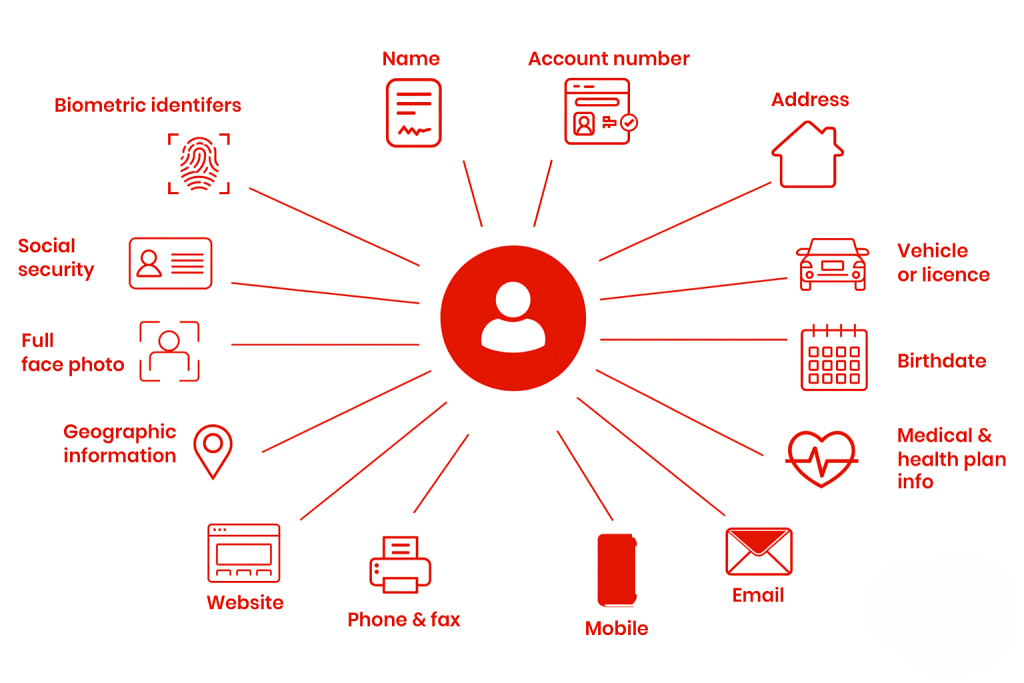
Consider a situation where someone knows your name, address, and date of birth. Sounds innocuous, right? Now imagine if your social security number or bank account information is included, and we have a legitimate identity theft case.
In today’s digital age, data is becoming one of our most valuable assets. However, not all data is created equally: some information is so personalized and sensitive that when it is discovered in the hands of the wrong person, the damages can be great. This is why it is now more important than ever to understand what PII is.
The definition of PII or personally identifiable information is any piece of data that can identify you as an individual. Think of sPII as your digital fingerprint, which is unique to you, is specifically personal, and is traceable back to you.
For example, your name, date of birth, email address, and even some biometric identifiers like fingerprints and facial recognition information is PII. Combined, these pieces of information would create your whole personal identity.
To break down the definition simply, PII is not just one piece of personally identifiable information; PII is the combination of all this information that makes you identifiable.
For this reason, organizations, especially those with government records or even financial records, are directed to take every precaution possible when it comes to handling personally identifiable information.
What Does PII Stand For?
It’s nice to answer a simple but frequent question: What is PII? It stands for Personally Identifiable Information.
This comes from a trusted institution, the U.S. Department of Labor (DOL). According to the DOL, personally identifiable information is any information that is about or can be connected with a person, such as your name, Social Security Number, or your biometric information when collected by itself or when linked with other identifying information, such as where you were born or your mother’s last name.
The important part is the connection. Alone, one piece of information may be non-threatening, but then once it is added to other information, it can be powerful and can become dangerous.
The Importance of PII Protection
Loss of control over personally identifiable information carries heavy consequences — identity theft, financial fraud, and reputational harm. Let’s consider a straightforward example. An organization uses a shared drive to keep employee data without encryption.
One misdirected email or involuntary access could potentially expose the personal information of hundreds of people. This is more than just a violation of privacy; it is a significant breach that can cost the organization and individuals a great deal of money.
Once this information has been disseminated, it can be used to open bank accounts, apply for loans, or commit crimes under someone else’s name. This is why every employee, especially those who have direct access to sensitive data, has a responsibility to treat PII protection as more than just a compliance issue — it is about trust and responsibility.
Privatizing Personal Information
The U.S. Department of Labor is setting a high standard in terms of PII and their guidelines remind employees and contractors that protecting data is not a matter of choice – it is a responsibility.
They are taking the following measures to ensure data security:
- Access Control: Only persons in the official capacity who are “need to know” can see or deal with sensitive records.
- Data Handling: Confidentiality must be maintained by contractors and no action or inaction on their part that can lead to unauthorized disclosure will be tolerated.
- Secure Transfer: Sensitive data can never leave the office without prior written consent and even in that case, it has to be processed following very tight security rules.
But it is not only about compliance. It is also about shifting to a more aware culture. Each action, no matter how trivial, such as clicking, file sharing, or device usage should be conducted and treated with care.
Even the smallest of errors such as not locking a laptop or password sharing can put the personally identifiable information at risk and cause a large data incident.
The Impact of Technology on PII Safety
As organizations become more robust and digital environments expand, manual monitoring is no longer sufficient. Cyber-attackers can use sophisticated means of exploiting even the weakest of links. This is where intelligent solutions come in.
Today, organizations are dependent upon advanced threat intelligence and monitoring systems capable of detecting the exposure of personally identifiable information through open and dark web monitoring.
For instance, Cyble has those capabilities in mind. This company assists organizations in determining whether their employees’ or customers’ PII meaning data has been breached and/or is being sold online. Cyble threat intelligence platforms monitor breaches and alert organizations in real time—helping organizations respond to the breach before the damage is done and extended.
The value of this approach derives from its predisposition to proactively determine exposure; rather than react after the fact as a breach has occurred; a primary goal of security demands the mindset of detection, early intervention and response.
Everyday Steps to Protect PII
You don’t have to be a cybersecurity expert to protect your data. Simple everyday actions can go a long way in keeping your personally identifiable information safe.
- Think Before You Share: Avoid oversharing personal details online, even on trusted social media platforms.
- Use Strong Passwords: Create complex passwords and enable multi-factor authentication wherever possible.
- Encrypt and Backup Data: Encryption ensures that even if data is stolen, it’s unreadable to unauthorized users.
- Stay Alert for Phishing: Cybercriminals often use fake emails or messages to trick people into revealing sensitive information.
Small habits like these help prevent massive problems. After all, protecting what constitutes PII starts with awareness and discipline.
Conclusion
Ultimately, protecting personally identifiable information is not just a technical puzzle — it’s a human one.
Every organization, whether a small start-up or a government agency, relies on people to use data in a proper manner. If an organization invests in employee training, creates capable awareness, and inspires responsible actions, they can reduce overall data risk by a meaningful amount.
As the saying goes, the security of a system is only as good as its weakest link. When everyone understands what is PII and the implications of it, the whole becomes greater than the sum of its parts and fortifies the entire system.