
Krybit ransomware is a financially motivated, Babuk-derived ransomware-as-a-service (RaaS) operation that emerged in April, this year, operating under an 80/20 affiliate revenue split, in exchange for access to cross-platform encryptor builders and technical support.
The Krybit ransomware group specializes in double-extortion operations, exfiltrating sensitive data before encrypting victim systems and pressuring payment through a dedicated Tor-based data leak site (DLS). Despite launching only in March 2026, Krybit has scaled quickly and became notable within weeks for a public, mutually destructive feud with a rival RaaS operator that exposed both groups’ internal infrastructure to researchers. Captured samples are flagged by antivirus engines as Babuk derivatives (ESET: Filecoder.Babyk.A; Microsoft: Babuk!ic; Combo Cleaner: Ransom.Babuk), placing Krybit among the large population of RaaS strains built on Babuk’s leaked 2021 source code rather than custom-engineered ransomware. No confirmed ties to an established ransomware gang or nation-state have been identified, and unlike more theatrical RaaS brands, Krybit’s operators have not published any explanation of the group’s name, branding, or manifesto.
Krybit ransomware at a glance
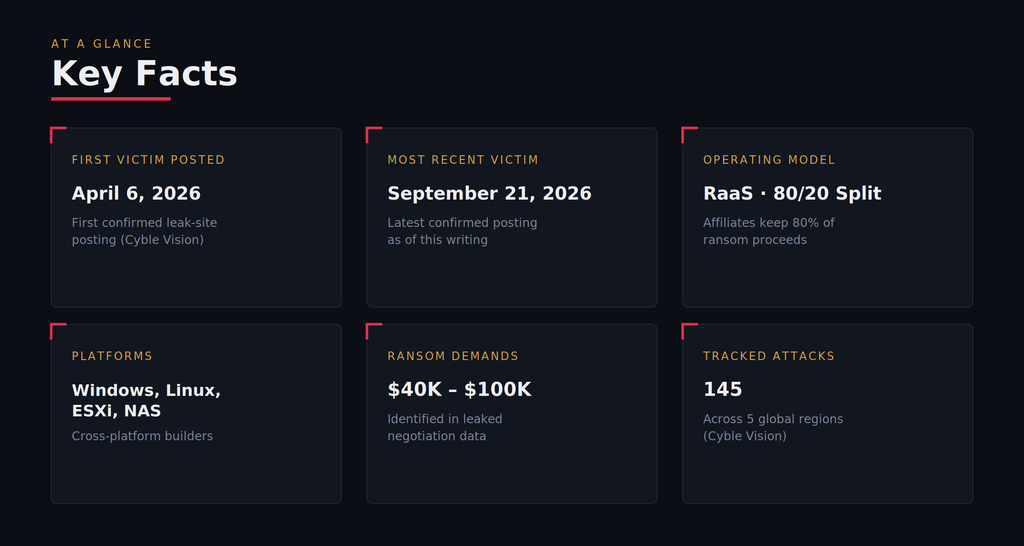
- First victim posted: April 6, 2026
- Most recent victim: September 21, 2026
- Operating model: Ransomware-as-a-Service (RaaS), 80/20 affiliate split
- Platforms: Windows, Linux, ESXi, NAS
- Ransom demands: $40,000–$100,000 per victim
- Tracked attacks: 145 across 5 global regions (Cyble Vision)
Origin, Targets, and Global Reach
Krybit was first observed in the wild in late March 2026. Per Cyble Vision tracking, the first Krybit victim was posted to the group’s data leak site on April 6, 2026, and the group has remained continuously active since, posting its most recent victim on September 21, 2026 — nearly six uninterrupted months of operation.
Krybit’s targeting pattern is broad and opportunistic rather than tied to a specific sector or region, consistent with an affiliate-driven RaaS model where each affiliate brings their own access and target selection.
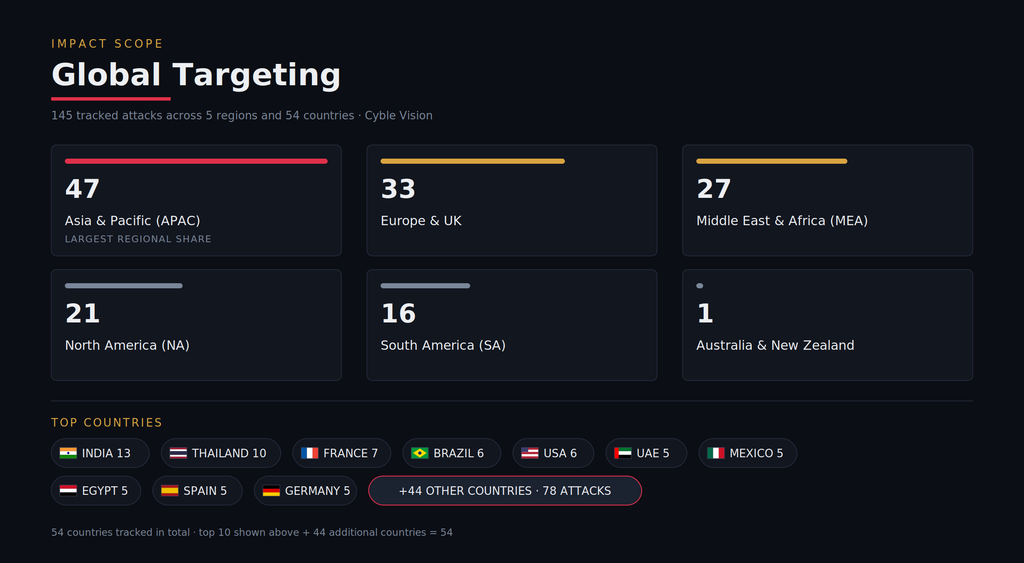
Regionally, Cyble Vision data shows Asia & Pacific as by far the most-targeted area (47 attacks), followed by Europe & UK (33), Middle East & Africa (27), North America (21), South America (16), and Australia & New Zealand (1) — 145 tracked attacks across all regions combined. At the country level, India leads as the single most-targeted nation (13 attacks), followed by Thailand (10), France (7), Brazil and the United States (6 each), and a five-way tie at 5 attacks apiece among the United Arab Emirates, Mexico, Egypt, Spain, and Germany. The remaining 78 attacks are spread across dozens of additional countries outside this top-10 tier, confirming the group’s genuinely global, opportunistic reach.
By industry, the top targets are:
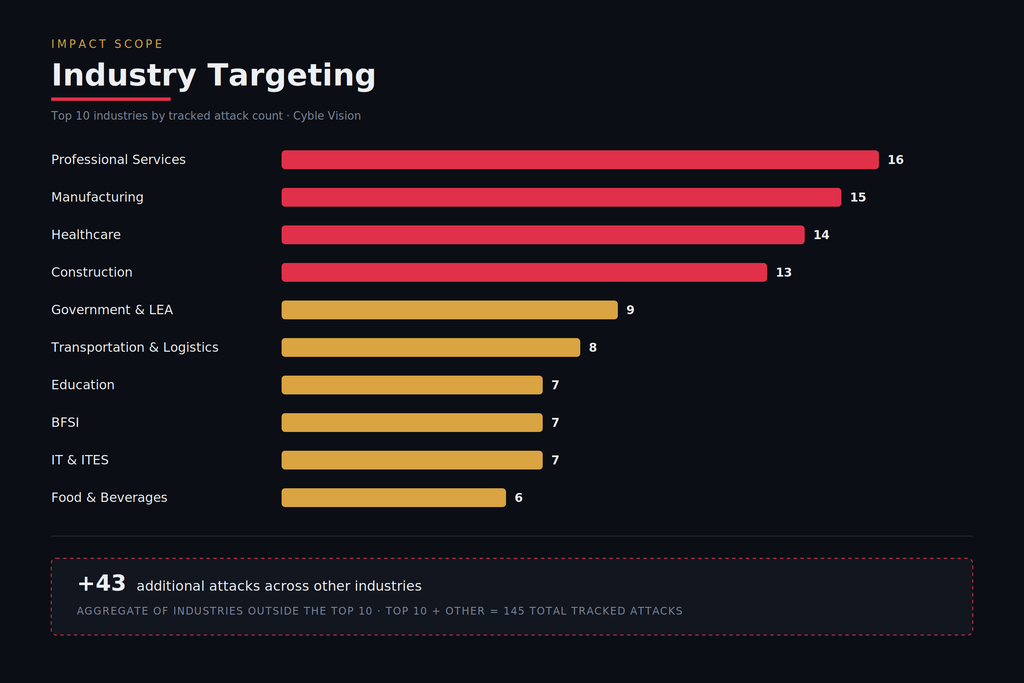
- Professional Services (16 attacks)
- Manufacturing (15 attacks)
- Healthcare (14 attacks)
- Construction (13 attacks)
- Government & Law Enforcement Agencies (9 attacks)
- Transportation & Logistics (8 attacks)
- Education (7 attacks)
- BFSI — Banking, Financial Services & Insurance (7 attacks)
- IT & ITES (7 attacks)
- Food & Beverages (6 attacks)
- Other industries (43 attacks)
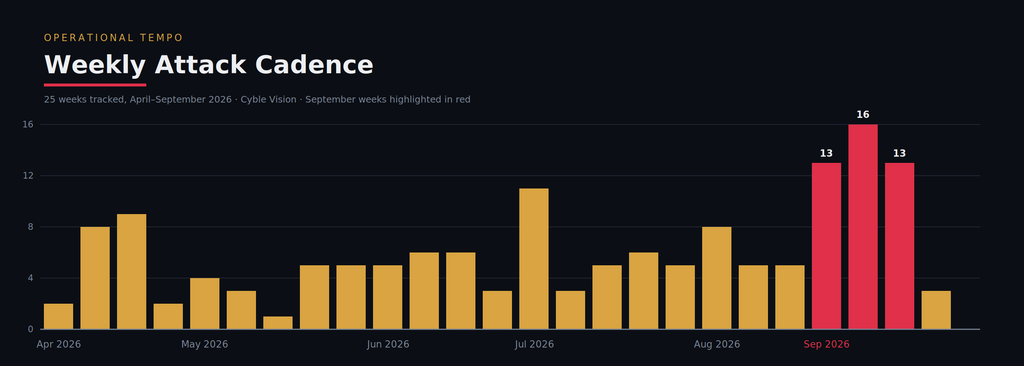
Krybit’s attack cadence has also accelerated sharply since launch. Weekly leak-site postings tracked by Cyble Vision across the 25 weeks from early April through late September 2026 sum to approximately 145 tracked postings — modest and sporadic through the spring and summer months (as low as a single victim in some weeks) before a marked surge beginning in September 2026, when weekly postings peaked at 16 victims in a single week, immediately preceded and followed by two more weeks at 13 each — the group’s three highest weekly totals on record, all landing within September alone. Krybit is not merely surviving but actively scaling its operation nearly six months after launch.
Operational Capabilities
The Krybit ransomware group runs a structured affiliate program built around cross-platform reach and a competitive revenue split. Key characteristics include:
- Cross-Platform Encryptor Builders – The group provides builders for Windows, Linux, VMware ESXi, and Network Attached Storage (NAS) devices, giving affiliates coverage across an organization’s server and storage estate rather than Windows endpoints alone.
- Affiliate-Favorable Revenue Split – Krybit offers affiliates 80% of ransom proceeds, retaining 20% itself, a standard but competitive incentive structure for RaaS platforms recruiting affiliate talent.
- Tor-Based Coordination – Affiliate and victim communications route through Tor-based infrastructure, with each operator and affiliate assigned an individual Tox messaging ID.
- Large-Scale Data Staging – Leaked panel data documented 10–250GB of exfiltrated data staged per victim prior to encryption.
- Ransom Demands – Demands identified in leaked negotiation data ranged from $40,000 to $100,000 per victim.
- Weak Internal Operational Security – A leaked affiliate panel showed credentials stored in plaintext (across both a password and plain_password field, with no hashing or salting) and five Bitcoin wallet addresses reused across multiple victims, an opsec failure that links Krybit’s cashout paths across its entire victim list for blockchain-tracing purposes.
Recent Activity
Krybit’s most consequential moment to date came from a conflict with a rival RaaS operation rather than from law enforcement or security researchers. In April 2026, rival group 0APT breached Krybit’s affiliate panel and published its contents, giving researchers an unfiltered look inside Krybit’s internal structure less than a month after launch. The leaked panel revealed 2 administrators, 5 affiliates, 20 victims in active negotiation, and the plaintext-credential and wallet-reuse failures described above.
0APT threatened to publicly dox Krybit’s operators (names, photos, and locations) unless a ransom was paid, and Krybit’s own site briefly went offline, replaced with a placeholder apologizing for the disruption. Krybit retaliated within one to two days: it compromised 0APT’s server, defaced 0APT’s leak site with the message “HACKED BY KRYBIT — Next time, don’t play with the big boys,” listed 0APT as a victim on its own DLS, and published 0APT’s full operational dataset. That counter-leak also proved that 0APT’s own widely publicized claim of 190+ victims (from its January 2026 launch) had been entirely fabricated, a discovery that damaged 0APT’s credibility far more than Krybit’s.
By late April 2026, Krybit’s DLS had resumed normal victim-posting operations, with no rebrand or takedown documented since. Cyble Vision tracking confirms the group’s first posted victim dates to April 6, 2026, and its posting activity has continued without interruption through the group’s most recent victim on September 21, 2026, including a cluster of eight new claims in a single day on July 1, 2026 (spanning the US, Taiwan, Vietnam, Mexico, Peru, Spain, and Italy), the Dominican Republic’s tourism authority on June 25, 2026, and a Thai metal-products manufacturer reported by CYFIRMA in early September 2026. Weekly posting volumes have trended sharply upward since, with September alone producing the group’s three highest weekly totals to date (16, and two weeks at 13) — a clear signal that Krybit remains fully operational and actively scaling.
Tactics, Techniques, and Procedures (TTPs)
Public technical analysis of Krybit remains more limited than for longer-running RaaS strains, and much of what is documented comes from tagged MITRE ATT&CK activity and malware behavior analysis rather than a full reverse-engineered execution chain.
No single initial access vector is consistently tied to Krybit, since affiliates supply their own access. Tracked activity points to Valid Accounts and Remote Desktop Protocol (RDP) as common entry points, consistent with other affiliate-model ransomware operations, though no specific phishing lure, exploited CVE, or exposed service has been publicly attributed to the group. Following access, Krybit uses script-based execution (the specific interpreter is unconfirmed) and establishes persistence via autostart execution and logon initialization scripts.
For defense evasion, researcher analysis describes obfuscation, process injection, and abuse of legitimate system processes, though no specific security-tool-disabling binary or EDR-killer has been isolated for this group. Reports assess that Krybit demonstrates credential access, system and network discovery, and data-staging capabilities consistent with typical pre-encryption reconnaissance, though specific tools have not been publicly identified. Victim communications and leak-site activity route through Tor hidden services, and exfiltration is tracked as occurring over the same command-and-control channel; no dedicated exfiltration tool (comparable to Rclone or WinSCP in other RaaS operations) has been named.
Prior to encryption, Krybit executes vssadmin.exe delete shadows /all /quiet to delete Volume Shadow Copies, disabling built-in Windows recovery. The final payload appends the .KRYBIT extension to encrypted files and drops a ransom note named RECOVER-README.txt, which directs victims to a Tor-based negotiation portal and claims exfiltration of employee data, credentials, financial records, and technical design files.
Conclusion
Krybit ransomware has gone from a March 2026 launch to 145 tracked attacks spanning five global regions in under six months — posting victims continuously from its first claim on April 6, 2026 through its most recent on September 21, 2026, and accelerating to its highest-ever weekly total (16 victims) in September — despite a major operational security failure in April 2026 that exposed its administrators, affiliates, plaintext credentials, and cashout wallets to a rival gang. Rather than collapsing under that exposure, Krybit counter-attacked its rival, restored its own credibility relative to 0APT, and resumed normal operations within weeks — a resilience that suggests a functional, capable RaaS operation rather than a fly-by-night one.
Its cross-platform reach across Windows, Linux, ESXi, and NAS, combined with broad, opportunistic, affiliate-driven targeting, makes Krybit a credible threat to organizations of any size, sector, or region. Its April exposure raises the group’s law-enforcement takedown risk and may eventually push it toward a rebrand, but organizations should not treat that as a reason to deprioritize defenses now.
Mitigations and Recommendations
- Enforce multi-factor authentication (MFA) on RDP, VPN, and remote administration interfaces.
- Eliminate unnecessary internet exposure of RDP and remote management ports; place any that must remain behind a VPN or jump host.
- Monitor for credential-stuffing and brute-force patterns against externally facing authentication portals.
- Maintain immutable or offline backups unreachable from the production network.
- Alert immediately on execution of vssadmin.exe delete shadows /all /quiet.
- Regularly test backup restoration procedures, including for ESXi and NAS environments given Krybit’s cross-platform builder support.
- Extend endpoint and monitoring coverage to Linux hosts, VMware ESXi hypervisors, and NAS devices, which are frequently under-monitored relative to Windows endpoints.
- Alert on process injection and unusual invocation of legitimate system utilities.
- Enable comprehensive process-creation and script-execution logging to compensate for the lack of publicly isolated Krybit-specific tooling.
- Ingest known Krybit .onion infrastructure into blocklists and Tor-traffic monitoring.
- Cross-reference any organization named on Krybit’s DLS against internal telemetry before treating the claim as confirmed.
- Track affiliate tradecraft migration in case Krybit rebrands or its affiliates move to other RaaS platforms following its April 2026 exposure.
MITRE ATT&CK Techniques Associated with Krybit
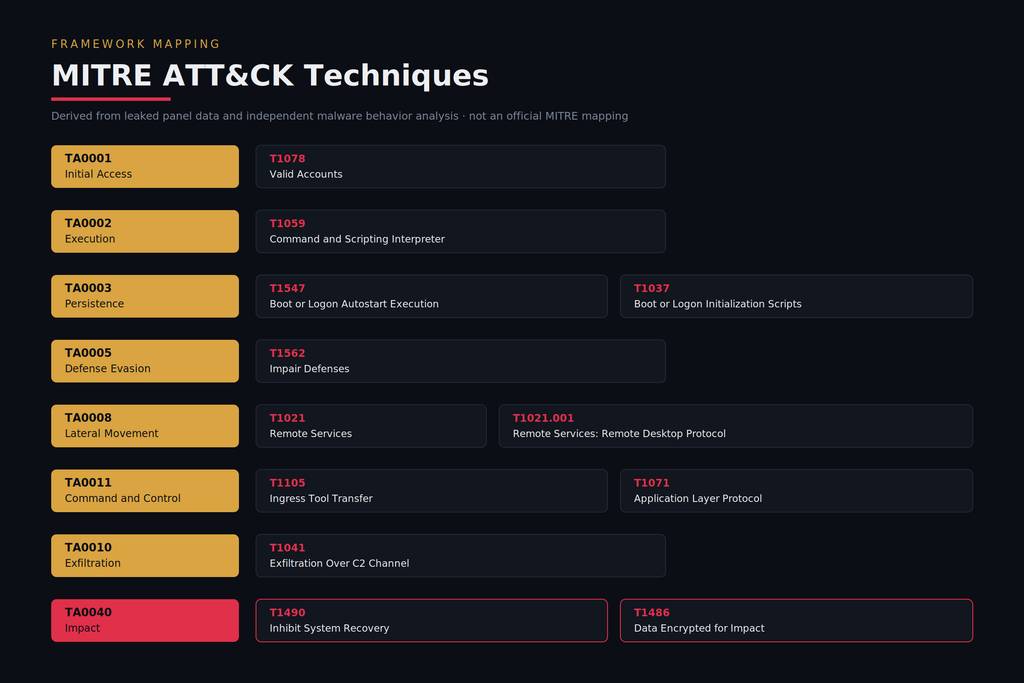
- Initial Access (TA0001) – Valid Accounts (T1078): Affiliates gain access using compromised or stolen credentials.
- Execution (TA0002) – Command and Scripting Interpreter (T1059): Uses script-based execution to run payloads and supporting tools.
- Persistence (TA0003) – Boot or Logon Autostart Execution (T1547): Establishes persistence through autostart mechanisms.
- Persistence (TA0003) – Boot or Logon Initialization Scripts (T1037): Uses logon initialization scripts to maintain access.
- Defense Evasion (TA0005) – Impair Defenses (T1562): Employs obfuscation, process injection, and abuse of legitimate system processes.
- Lateral Movement (TA0008) – Remote Services (T1021): Uses remote services, commonly RDP, to move across victim environments.
- Lateral Movement (TA0008) – Remote Services: Remote Desktop Protocol (T1021.001): RDP specifically tracked as a common access and movement vector.
- Command and Control (TA0011) – Ingress Tool Transfer (T1105): Transfers tools into victim environments over Tor-based infrastructure.
- Command and Control (TA0011) – Application Layer Protocol (T1071): Routes victim and affiliate communications through Tor hidden services.
- Exfiltration (TA0010) – Exfiltration Over C2 Channel (T1041): Stages and exfiltrates 10–250GB of data per victim over the same command-and-control channel.
- Impact (TA0040) – Inhibit System Recovery (T1490): Deletes Volume Shadow Copies via vssadmin.exe delete shadows /all /quiet prior to encryption.
- Impact (TA0040) – Data Encrypted for Impact (T1486): Encrypts victim files, appending the .KRYBIT extension.
Note: This mapping reflects TTPs and behaviors documented in open-source threat intelligence reporting, primarily derived from a leaked affiliate panel and independent malware behavior analysis; it is not an official MITRE-published mapping for this group.
Indicators of Compromise (IOCs)
File System
- Encrypted file extension: .KRYBIT
- Ransom note filename: RECOVER-README.txt
Data Leak Site (Tor)
- krybieodq754vlwufrsuxaswxb5zpxyibaawmed2jaduoz2e5m56hmid[.]onion
- krybitqsdzwmhnitvwuhvsntfgf2wrhxveyxroxpc44c6gkft2cqldyd[.]onion
- krybitx3fh5krdnhegyp2ob3lhizsaiadturtio3ginf7it5gsdgu2yd[.]onion
- krybitxdpxohsmjooeb3gbgpmdddreh6mnflzac6bnezz74b7yje67yd[.]onion
- krybivdln3oc3twbin4budgznzq7dmcolldnsx455lspxxe23b56y5qd[.]onion
Note: Financial (Bitcoin wallet) and Tox messenger identifiers were also recovered from the April 2026 panel leak, but we have refrained from disclosure.
Frequently Asked Questions
What is Krybit ransomware?
Krybit ransomware is a financially motivated, Babuk-derived ransomware-as-a-service (RaaS) operation first observed in the wild in late March 2026, with its first confirmed victim posted on April 6, 2026. It uses a double-extortion model, exfiltrating data before encryption, and negotiates through a Tor-based leak site.
Who is behind the Krybit ransomware group?
Krybit operates as an affiliate-driven RaaS platform offering an 80/20 revenue split in affiliates’ favor. A leaked affiliate panel from April 2026 identified 2 administrators and 5 affiliates operating under pseudonymous handles; no real-world identities have been publicly confirmed.
Is Krybit ransomware related to Babuk?
Yes. Captured Krybit samples are flagged by antivirus engines as Babuk derivatives (ESET: Filecoder.Babyk.A; Microsoft: Babuk!ic), placing it among the many RaaS strains built on Babuk’s leaked 2021 source code rather than custom-engineered ransomware.
What was the 0APT and Krybit ransomware feud?
In April 2026, rival RaaS group 0APT breached Krybit’s affiliate panel and threatened to dox its operators. Krybit retaliated within one to two days, compromising 0APT’s server, defacing its leak site, and revealing that 0APT’s own claimed 190+ victims had been entirely fabricated.
How does Krybit ransomware gain initial access?
No single vector is consistently tied to Krybit since affiliates supply their own access, but tracked activity points to Valid Accounts and Remote Desktop Protocol (RDP) as common entry points.
What encryption does Krybit ransomware use?
Krybit appends the .KRYBIT extension to encrypted files and drops a ransom note named RECOVER-README.txt directing victims to a Tor-based negotiation portal.
Which industries and countries does Krybit ransomware target?
Cyble Vision tracking shows Professional Services, Manufacturing, Healthcare, and Construction as the most-targeted industries, with India, Thailand, and France as the most-targeted countries — though the group’s 145 tracked attacks span every populated region.
How can organizations defend against Krybit ransomware?
Priority actions include enforcing MFA on RDP and VPN access, monitoring for vssadmin.exe shadow-copy deletion, extending monitoring to Linux, ESXi, and NAS environments, and maintaining offline backups. See Mitigations and Recommendations for the full list.
References
- Cyble Vision (internal threat intelligence platform), Krybit regional, country, and industry attack tracking and weekly activity data, accessed September 22, 2026
- Malpedia
- Halcyon
- Cyfirma
- SOCRadar
Media Disclaimer: This profile was compiled from publicly available open-source security reporting and dark web monitoring. It is provided for reference purposes only; readers bear full responsibility for their reliance on it.