Introduction
Cyber threats are evolving faster than ever. In 2025, organizations worldwide reported a sharp increase in automated attacks, AI-generated phishing campaigns, and zero-day exploits, pushing traditional defenses beyond their limits. Most organizations today have added AI to their security stack. Very few have built their security stack around AI.
That distinction, AI-native cybersecurity, is what separates reactive defense from autonomous protection.
Unlike legacy tools or add-on machine learning layers, an AI cybersecurity platform built natively on AI can ingest, analyze, and act on threat intelligence in real time. Powered by agentic AI, these systems don’t just detect threats; they investigate and respond autonomously.
This guide explains what AI-native cybersecurity means, how it differs from AI-assisted approaches, and how Cyble Vision and Blaze AI demonstrate this model in practice.
New to the concept? Start with our foundational guide → What Is AI in Cybersecurity
What Is AI-Native Cybersecurity?
AI-native cybersecurity refers to a security architecture where artificial intelligence is the core operating layer, not an added feature. In an AI-native security platform, every function, data ingestion, analysis, threat correlation, and response, is driven by AI models from the ground up.

To understand this shift, it helps to view cybersecurity evolution in three tiers. Traditional security relies on rules and signatures, making it effective only against known threats. AI-assisted security improves on this by adding machine learning layers to existing tools, enabling faster detection but still requiring human validation. AI-native cybersecurity, however, replaces this layered approach entirely; AI becomes the architecture itself, enabling autonomous decision-making.
This shift is necessary because threats have outpaced human response speeds. AI-generated attacks, autonomous botnets, and coordinated zero-day exploits operate in seconds. Only an AI-native system, capable of reasoning, learning, and acting independently, can match that velocity.
AI-Native vs AI-Assisted vs Traditional Security
The difference between these approaches is architectural—not incremental.
| Capability | Traditional Tools | AI-Assisted Security | AI-Native Security (Cyble) |
| Architecture | Rules + signatures | ML layer on existing stack | AI is the core engine |
| Threat detection | Known threats only | Pattern + anomaly matching | Predictive + autonomous |
| Response time | Hours to days | Minutes | Seconds — autonomous |
| New threats | Fails on zero-days | Limited adaptation | Continuous self-learning |
| Data scale | Low | High | 350B+ signals processed |
| Human dependency | Very high | Medium | Low — agentic option |
| Forecasting | None | Limited | Up to 6 months ahead |
| Dark web coverage | Minimal | Partial | Fully automated |
How AI Transforms the Cyber Threat Intelligence Lifecycle
AI-native platforms redefine every stage of the cyber threat intelligence lifecycle, enabling AI-powered threat intelligence at scale.
- Data collection: Modern platforms ingest massive volumes of data from the surface web, deep web, dark web, social media, and enterprise telemetry. Cyble processes over 350 billion threat signals, ensuring comprehensive visibility across the external threat landscape.
- Data processing and analysis: Using machine learning threat detection, AI-native systems identify patterns, anomalies, and correlations in real time. Cyble’s dual-brain architecture, combining neural memory for instant inference and vector memory for long-term threat actor tracking, enables both speed and context.
- Threat detection and response: Traditional systems alert analysts. AI-native platforms act. With agentic AI, threats are automatically investigated, correlated, and contained, compressing hours of manual work into minutes or seconds.
- Threat intelligence reporting: AI-native systems generate contextual reports tailored to different roles. CISOs receive strategic summaries, while analysts get actionable IOC feeds, all dynamically updated in real time.
- Feedback and continuous learning: Every interaction strengthens the system. AI-native platforms continuously learn from new threats, improving detection accuracy, and adapting to evolving attack techniques.
Cyble Blaze AI: The Agentic Engine Behind AI-Native Defense
Cyble’s AI-native platform is driven by Blaze AI, an agentic engine that autonomously detects, analyzes, and responds to cyber threats in real time.
Blaze AI operates as the intelligence layer that powers the entire platform. Unlike traditional systems that rely on predefined workflows, it independently investigates, correlates, and responds to threats without requiring human intervention at every step.
Its architecture is built on a dual-brain system. The neural layer processes real-time signals and identifies patterns instantly, while the vector memory layer retains long-term intelligence about threat actors, campaigns, and attack techniques. This allows Blaze AI to both react immediately and reason with historical context simultaneously.
The defining feature of agentic AI is autonomy. When a threat is detected, Blaze AI doesn’t just raise an alert, it takes action. It validates the threat, maps it to known attacker behavior, assesses severity, and initiates containment.
Blaze AI also introduces predictive defense. By analyzing dark web chatter, exploit development activity, and reconnaissance patterns, it can forecast threats up to six months in advance, transforming cybersecurity from reactive to proactive.
Cyble Vision: AI-Native Threat Intelligence for Enterprise
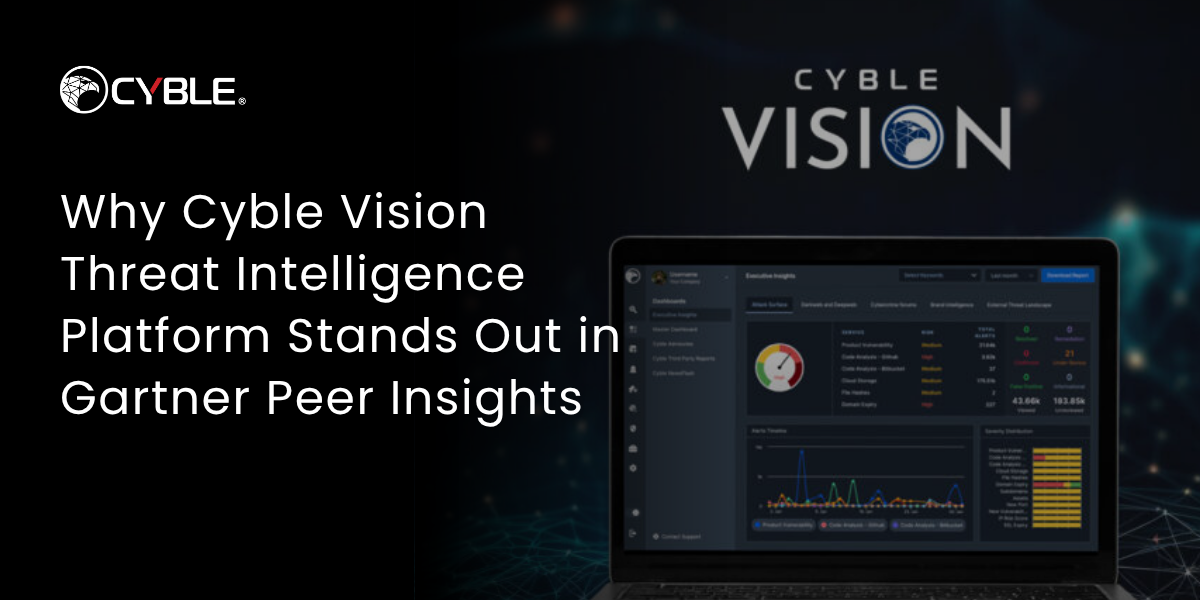
Cyble Vision is an AI-native threat intelligence platform that provides a unified view of an organization’s external threat landscape.
- Automated data collection: Cyble Vision ingests intelligence from 350B+ data points, spanning surface web, deep web, dark web, social media, and enterprise telemetry.
- Advanced data analysis: Powered by AI-native architecture and dual-brain processing, the platform detects patterns, anomalies, and emerging threats with high precision.
- Real-time threat detection: Continuous monitoring ensures threats are identified and addressed in real time, reducing exposure of windows significantly.
- Dark web intelligence: Cyble monitors over 500,000+ dark web sources, including underground forums, marketplaces, and messaging channels, delivering early warnings on data leaks and attack planning.
- Contextual intelligence: Threat insights are tailored by industry, geography, and organizational priorities, enabling more relevant decision-making.
- Industry recognition: Cyble has earned strong validation across industry platforms, including high ratings on Gartner Peer Insights and multiple G2 leadership badges, along with recognition as a CTI leader by Frost & Sullivan.
AI-Native Cybersecurity in Action: Use Cases by Role
- Enterprise SOC teams: SOC teams often spend the majority of their time on alert triage. AI-native platforms automate triage, correlation, and prioritization—ensuring only validated threats reach analysts. This reduces alert fatigue and significantly improves response times.
- Financial services CISOs: Financial institutions face constant threats such as credential theft and phishing. AI-native threat intelligence platforms monitor dark web activity continuously, enabling early detection of breaches and proactive defense strategies.
- Government & critical infrastructure: Nation-state attacks require deep intelligence and long-term visibility. AI-native systems provide continuous monitoring of APT groups and targeted campaigns, enabling intelligence-led defense for critical systems.
Advantages of Cyble’s AI-Native Platform
AI-native cybersecurity offers measurable improvements across all aspects of security operations.
- Enhanced Speed: Threat investigations are reduced from hours to minutes, with autonomous responses executed in seconds.
- Improved Accuracy: AI models achieve over 95% detection accuracy, minimizing false positives.
- Continuous Monitoring: 24/7 intelligence across 350B+ signals ensures constant vigilance.
- Predictive Capabilities: Forecast threats up to six months in advance.
- Scalability: Integrates with 70+ tools across existing security stacks.
- Industry Recognition: Validated by leading analyst platforms and customer reviews.
See Cyble’s AI-native platform to protect your organization.
Conclusion
AI in cybersecurity is no longer optional. But more importantly, the type of AI matters.
AI-native cybersecurity doesn’t just enhance existing systems; it transforms them. By combining agentic AI, massive-scale data processing, and predictive intelligence, platforms like Cyble enable organizations to move from reactive defense to autonomous protection.
Cyble stands at the forefront of this shift, delivering a platform built for the speed, scale, and complexity of modern threats.
Frequently Asked Questions (FAQs) for AI-Native Cybersecurity
What is AI-native cybersecurity?
AI-native cybersecurity is an architecture-first approach where artificial intelligence powers every layer of the security system, enabling autonomous detection, analysis, and response without relying on manual intervention.
How is AI-native different from AI-assisted security?
AI-assisted security adds machine learning to existing tools, while AI-native platforms are built entirely around AI, enabling faster, predictive, and autonomous operations.
What is agentic AI in cybersecurity?
Agentic AI refers to systems that can independently make decisions and take action. In cybersecurity, it enables autonomous threat detection and response, as seen in Cyble Blaze AI.
How does Cyble use AI in threat intelligence?
Cyble processes over 350 billion signals using AI-native architecture and Blaze AI to detect, analyze, and respond to threats in real time.
What is the difference between Cyble Vision and Blaze AI?
Cyble Vision is the threat intelligence platform, while Blaze AI is the agentic engine that powers autonomous detection and response within the platform.
Is AI-native cybersecurity suitable for small businesses?
Yes. AI-native platforms are scalable and can support organizations ranging from small businesses to large enterprises