Cybersecurity refers to the practice of defending digital systems, networks, and online data from security breaches and attacks. More generally, cybersecurity is the protection of information systems and the data that they store. The three basic goals of cybersecurity are confidentiality, integrity, and availability (CIA) of information. These protections are delivered through the implementation of technical controls and the establishment and maintenance of security policies and procedures.
A strong security plan covers all layers of a company’s IT infrastructure, from individual endpoints to cloud environments and the identities that can access them. With digital transformation picking up speed and AI changing the ways attacks and defenses work, cybersecurity has moved from a purely technical role to a business priority at the board level.

Why Is Cybersecurity Important in 2026?
The volume and complexity of cyberattacks are on the rise. By the end of 2025, Cyble had` confirmed more than 5,000 cyber incidents, comprising ransomware attacks, data breaches, sales of illicit access, and hacktivist activity.
Cybersecurity by the Numbers (2025–2026)
- Cyble observed 6,604 ransomware attacks in 2025.
- This includes 702 ransomware attacks and 54 major publicly reported data breaches and leaks.
- A total of 1,305 cyber incidents were reported in the Americas during Q1 2026.
- Five major ransomware groups account for 56% of all ransomware activity: Qilin, Akira, The Gentlemen, DragonForce, and INC Ransom.
- There were 20 underground marketplace listings advertising compromised corporate access in March 2026.
Today, the key verticals such as healthcare, banking, government, energy, and transportation have made internet-based systems an integral part of their daily operations. The situation is particularly alarming since often a single breach goes undetected for months and then it takes an equal number of months, along with millions of dollars in regulatory fines and reputation damage, to contain the same breach.
Hence, organizations, irrespective of size, have started treating cybersecurity as a continuous operational discipline rather than a project once undertaken.
See how much exposure your organization has right now.
Get a free attack surface assessment

What Are the Core Principles of Cybersecurity? (The CIA Triad)
The CIA triad is the basic model on which almost every cybersecurity control, policy, and technology decision is based. It represents Confidentiality, Integrity, and Availability—three principles that together define security in any system.
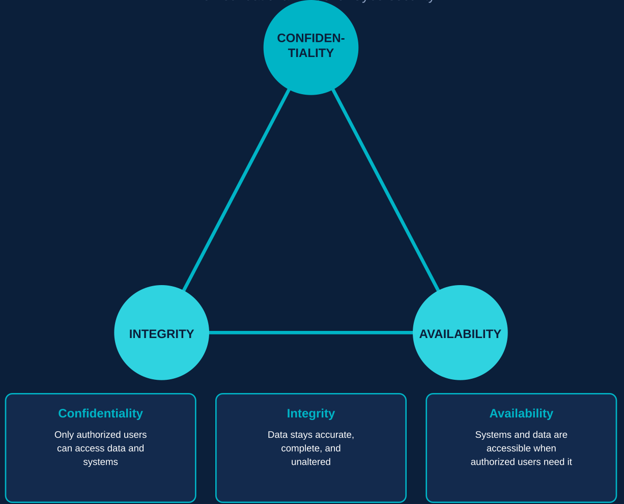
- Confidentiality: This ensures that the data and systems are accessible only to authorized users. This principle is enforced by controls such as encryption, access management, and the application of least-privilege permissions.
- Integrity: This ensures that data remains accurate, complete, and unaltered except for actions authorized by the organization. Hashing, digital signatures, and change-control processes maintain integrity.
- Availability: The system and data must be available to the authorized user when needed. Redundancy, failover systems, and DDoS protection are all elements that support availability.
Every implemented control by an organization, from firewall rule to backup policy, should map back to the protection of at least one leg of this triad.
What Are the Different Types of Cybersecurity?
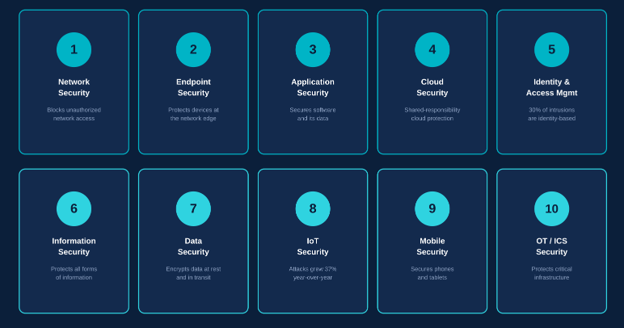
Cybersecurity is not one discipline, but a group of specialized domains working together to protect an organization’s entire digital footprint. The ten types that a modern security strategy should cover are listed below:
- Network Security: Network security stops unauthorized users from getting into network resources and quickly finds and stops ongoing cyberattacks and breaches while allowing safe access for authorized users. It is still the main thing in any cybersecurity program, using firewalls, intrusion detection/prevention systems, and network segmentation.
- Endpoint Security: Protecting Devices on the Perimeter Endpoint security includes desktops, servers, laptops, and mobile devices — the primary entry points attackers use to access a network. It secures these devices and their users against intrusions, thus strengthening the organization against enemies who use endpoints as a first step.
- Application Security (AppSec): Securing Software Application security protects software running on-premises and in the cloud. The main goal is to protect against unauthorized access to or misuse of applications and their data. It also covers design flaws and vulnerabilities that could be exploited by attackers to breach the wider network.
- Cloud Security: Protecting Cloud-Based Services and Resources Applications, data, storage, development tools, virtual servers — the infrastructure of an enterprise’s cloud service — are all protected under the concept of cloud security.
- Identity & Access Management (IAM) IAM decides the individuals and objects that can use an organization’s systems and data. The practice has become visible as its discipline because 30% of all intrusions are due to attacks based on identities.
- Information security protects all important information in an organization — digital files, data, paper documents, physical media, and verbal communication — from being accessed, disclosed, misused, or altered by unauthorized people.
- Data Security: Protection of Information at Rest and Transit. Data security is the protection of all forms of digital information. This can include encryption, tokenization, access controls, and even tools for data loss prevention (DLP).
- IoT Security: IoT security protects the growing universe of connected sensors, cameras, industrial devices, and smart equipment — most of which ship with weak default credentials and get infrequent patching.
- Mobile Security: Mobile security defends smartphones and tablets against malicious apps, unsecured Wi-Fi, device theft, and mobile-specific malware. As BYOD policies expand, mobile devices serve as an entry point into corporate networks and require the same rigor as traditional endpoints.
- Operational Technology (OT) / ICS Security: The security of OT and Industrial Control Systems (ICS) safeguards the tangible equipment, sensors, and control systems that are applied in the sectors of manufacturing, energy, water, and other critical infrastructures.
30% of intrusions start with stolen credentials. Cyble Vision flags exposed credentials before attackers use them.
What Are the Most Common Cybersecurity Threats in 2026?
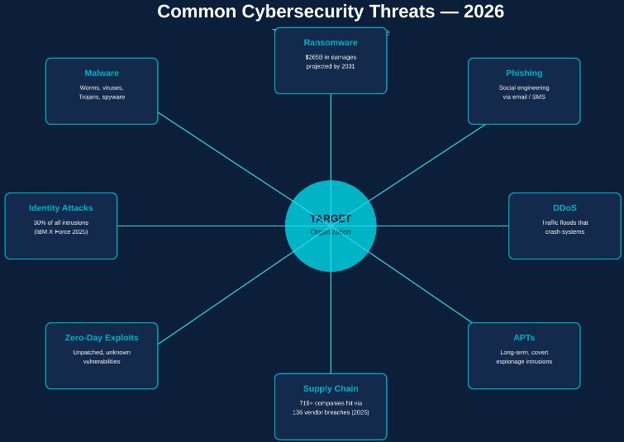
Keeping up to date with new cyber threats is a huge challenge, but knowing the most common types of attacks is the first step to defending against them.
- Ransomware: Ransomware is a type of malware that locks or encrypts the victim’s files or systems. The attacker then demands a ransom—often to be paid in a form of cryptocurrency—in exchange for restoring access to the data.
- Phishing & Social Engineering: Social engineering is the act of manipulating people into giving up confidential information. Phishing is the primary type of social engineering, using fraudulent emails or messages claiming to be from legitimate sources to trick individuals into providing personal information, such as login credentials or payment information.
- Distributed Denial-of-Service (DDoS): DDoS attacks involve a large number of systems flooding a target with traffic, connection requests, or packets, rendering legitimate access impossible and potentially crashing the targeted system
- Advanced Persistent Threats (APTs): APTs are long-term, focused breaches in which adversaries do not exfiltrate data right away; instead, they remain hidden within a network for an extended period, often to remove valuable information or to maintain access for future espionage.
- Supply Chain & Third-Party Attacks: Adversaries focus on breaching a trusted vendor or service provider to get into their customers’ networks.
- Zero-Day Exploits: The zero-day term means that the vulnerability is new and there is no patch available at the time of discovery.
Other common types of attacks include botnets, exploit kits, vishing, credential stuffing, SQL injection, and business email compromise (BEC).
How Is AI Changing Cybersecurity? Threats & Defenses
- Advanced Persistent Threats (APTs): APTs are long-term, focused breaches in which adversaries do not exfiltrate data right away; instead, they remain hidden within a network for an extended period, often to remove valuable information or to maintain access for future espionage.
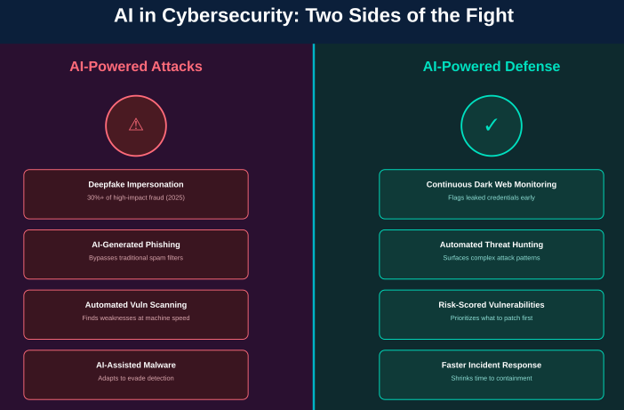
- AI-Powered Attacks: AI is being harnessed by cyber criminals to make attacks swifter, more persuasive, and harder to spot. Techniques include AI-generated phishing emails that bypass traditional spam filters, deepfake audio and video for corporate impersonation fraud, automated vulnerability scanning, and AI-assisted malware development.
- Cyble’s Executive Threat Monitoring Report found that deepfakes were involved in more than 30% of high-impact corporate impersonation attacks in 2025.
- AI-Powered Defense: On the defensive side, AI is automating labor-intensive functions that used to be manual and slow — dark web monitoring, threat hunting, and incident triage among them.
Monitor your vendors’ exposure alongside your own.
Check out Cyble’s Third-Party Risk Management
What Are the Key Cybersecurity Frameworks? (NIST, Zero Trust, ISO 27001, CIS)
Enterprises can take on existing frameworks and standards to give structure to their security policy, risk management process, and compliance activities rather than instituting a program from ground zero.
- NIST Cybersecurity Framework (CSF): The NIST Cybersecurity Framework, developed by the US National Institute of Standards and Technology, organizes security activities into core functions: Identify, Protect, Detect, Respond, and Recover.
- ISO/IEC 27001: ISO/IEC 27001 is an international standard for information security management systems (ISMS), providing a certifiable framework for managing information risk across people, processes, and technology.
- CIS Controls: The CIS Controls are a set of prioritized, actionable safeguards designed to protect organizations against the most common and damaging cyberattacks, offering a practical starting point for teams building out a security baseline.
- Zero Trust Security Model: Zero Trust operates on the principle of “never trust, always verify.” It assumes no entity — inside or outside the network — should be trusted by default; every access request is authenticated, authorized, and continuously validated.
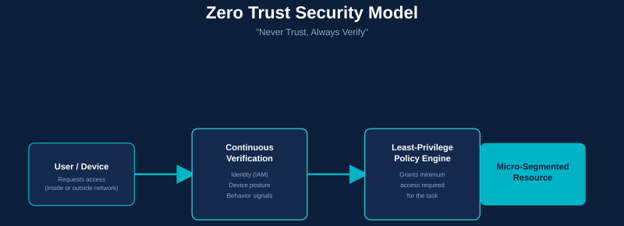
Any of these frameworks help an organization follow best practices as well as stay compliant with industry regulations, both of which improve security posture overall.
What Are Cybersecurity Best Practices for Organizations?
These ten steps below set out a basic practical baseline for implementation by any organization, regardless of size or industry:
- Implement Zero Trust architecture to continuously verify every user and device before granting access.
- Enable multi-factor authentication (MFA) across all accounts to reduce the risk of compromise even when passwords are leaked.
- Conduct regular employee security awareness training, since human error contributes to the large majority of breaches.
- Apply software patches and updates promptly to close known vulnerabilities before attackers can exploit them. Maintain encrypted, regularly tested backups so operations can recover without paying a ransom.
- Deploy endpoint detection and response (EDR) tools to detect and contain threats on devices in real time.
- Monitor the dark web for leaked credentials and mentions of your organization to catch exposure early.
- Conduct penetration testing and vulnerability assessments at least annually to discover and patch flaws before attackers do.
- Establish and regularly test an incident response plan (IRP) covering detection, containment, eradication, recovery, and post-incident analysis — including tabletop exercises and simulated attacks.
- Use a threat intelligence platform to shift from reactive to proactive defense, gaining visibility into threat actors, campaigns, and emerging vulnerabilities before they materialize.
Beyond these ten steps, a good program also depends on managing who has access to sensitive data, actively monitoring third-party users and applications, and treating cybersecurity as an organization-wide responsibility rather than an IT-only function.
Supply Chain & Third-Party Risk
Businesses are now trusting more of their applications and infrastructure to third-party cloud providers, software vendors, and outsourced services. As that trust grows, so do the attackers who seek to exploit it. With a vendor’s security compromised, a less-defended one could give the attackers an entry point to all organizations being served by that vendor. This was one of the factors that led to 2025 being a record year for third-party breach disclosures.
Vetting vendor security postures, third-party access management, and supply-chain compromise monitoring are no longer niche procurement activities but rather core functions of enterprise risk management.
Regulatory Compliance Organizations Must Navigate
Compliance requirements shape how organizations design their cybersecurity programs. Key regulations include:
- GDPR (EU): Governs data privacy and breach notification; penalties can reach €20 million or 4% of global annual turnover, whichever is higher.
- HIPAA (US): Protects healthcare data and patient privacy.
- CCPA (California): Establishes consumer data rights and disclosure obligations.
- DORA (EU): Sets operational resilience requirements for the financial sector.
- PCI DSS: Governs the security of payment card data.
- NIST CSF: A widely adopted compliance reference across US federal and private sector organizations.
Meeting these requirements is necessary but not sufficient on its own — compliance should function as a floor for a broader security strategy, not its ceiling, since cybersecurity threats evolve faster than regulations do.
Cyber Insurance
Cyber insurance provides financial protection in the event of an attack, including coverage for data breaches, ransomware, and business interruption. It does not replace the need for strong cybersecurity controls; insurers require evidence of MFA, EDR, and tested backups before issuing or renewing coverage.
Organizations should work closely with providers to understand exactly what is covered and ensure their security posture meets underwriting requirements; the global cyber insurance market is projected to keep growing sharply through the early 2030s as adoption expands beyond large enterprises.
Advantages and Disadvantages of Cybersecurity
Advantages
- Protection against data breaches: Prevents identity theft, financial loss, and reputational damage.
- Prevention of cyberattacks: Mitigate viruses, malware, ransomware, and phishing before they disrupt operations.
- Enhanced privacy protection: Protects personal details, browsing history, and communications.
- Business continuity: Prevents outages and data loss that would otherwise cause downtime.
- Regulatory compliance: Helps meet GDPR, HIPAA, and similar requirements, avoiding legal penalties.
Disadvantages
- High costs: Security software, hardware, and specialized personnel represent a real investment, particularly for smaller organizations.
- Management complexity: Large, intricate IT environments require continual policy updates and patch management.
- False sense of security: No system is foolproof, and overreliance on tools can lead organizations to neglect training and audits.
- System performance impact: Firewalls, encryption, and antivirus tools can consume resources and slow processing.
- Privacy trade-offs: Monitoring designed to catch threats can itself raise employee privacy concerns.
How Does Cyble Help Protect Against Cyber Threats?
Cyble is a cybersecurity company recognized in Gartner’s first-ever Magic Quadrant for Cyberthreat Intelligence Technologies (2026) as a Challenger. Cyble Vision, the company’s flagship threat intelligence platform, employs advanced monitoring capabilities to collect, analyze, and interpret threat data from across the open, deep, and dark web.
This proactive approach enables Cyble to identify potential threats, vulnerabilities, and breaches early, including monitoring dark-web forums, marketplaces, and threat-actor channels for early-warning intelligence.
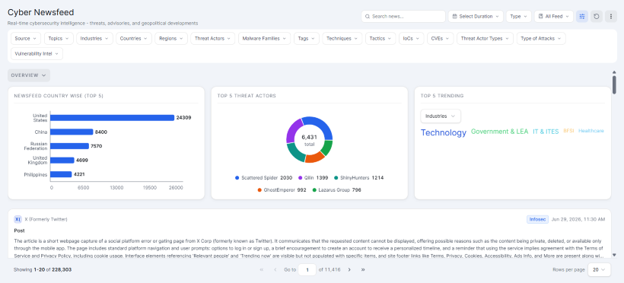
Beyond monitoring, Cyble’s cyber threat assessments evaluate an organization’s existing security infrastructure to pinpoint weaknesses and provide actionable recommendations that strengthen overall resilience.
Schedule a demo to experience Cyble Vision!
Conclusion
Cybersecurity is no longer just about preventing attacks—it is about building resilience against an increasingly complex threat landscape. As cyber threats continue to evolve, organizations need a layered security strategy that combines strong security controls, continuous monitoring, threat intelligence, and employee awareness. Those that take a proactive approach will be better equipped to reduce risk, respond faster to incidents, and protect their critical assets in 2026 and beyond
FAQs About Cybersecurity
What is cybersecurity in simple terms?
Cybersecurity is the practice of protecting computers, networks, applications, and data from unauthorized access, cyberattacks, and damage.
What are the main types of cybersecurity?
The main types are: Network Security, Endpoint Security, Application Security, Cloud Security, Identity & Access Management (IAM), Information Security, Data Security, IoT Security, Mobile Security, and Operational Technology (OT) Security. Each protects a different layer of an organization’s digital infrastructure.
What is the CIA triad in cybersecurity?
The CIA triad is the foundational model for cybersecurity: Confidentiality, Integrity, and Availability. Confidentiality ensures only authorized users can access data. Integrity means data remains accurate and unaltered. Availability ensures systems and data are accessible to authorized users when needed. Every cybersecurity control should support at least one of these three principles.
What is Zero Trust in cybersecurity?
Zero Trust is a framework built on the principle of “never trust, always verify.” Unlike perimeter-based security, it assumes no user or device — inside or outside the network — should be trusted by default; every access request is authenticated, authorized, and continuously validated.
How is AI being used in cyberattacks?
Cybercriminals use AI for more sophisticated, faster, and harder-to-detect attacks: AI-generated phishing emails that bypass spam filters, deepfakes used in corporate fraud (involved in over 30% of impersonation attacks in 2025, per Cyble), automated vulnerability scanning, and AI-assisted malware development.
What is the NIST Cybersecurity Framework?
The NIST Cybersecurity Framework (CSF) is a set of guidelines developed by the US National Institute of Standards and Technology. It organizes activities into core functions: Identify, Protect, Detect, Respond, and Recover. NIST CSF 2.0 (2024) added a sixth function, Govern. It’s widely adopted as a compliance reference in both public and private sectors.
What are the best cybersecurity practices for organizations?
Top practices include: implementing Zero Trust architecture, enabling multi-factor authentication, conducting regular security awareness training, patching promptly, maintaining encrypted backups, deploying EDR tools, monitoring the dark web for leaked credentials, conducting annual penetration testing, establishing an incident response plan, and using a threat intelligence platform for proactive awareness.
What is a cybersecurity threat intelligence platform?
A threat intelligence platform (TIP) collects, aggregates, and analyzes threat data from sources like dark web forums, malware feeds, and global sensor networks to help organizations identify, prioritize, and respond to threats before they materialize.
Why is cybersecurity critical?
Cybersecurity is essential as it protects all data types from damage and theft. It includes personally identifiable information (PII), sensitive data, personal details, protected health information (PHI), and industrial and government information systems.
What is the role of a CISO?
A Chief Information Security Officer (CISO) is a senior executive accountable for managing an organization’s information, cyber, and technology security. The primary duties of a CISO encompass creating, executing, and upholding security protocols to safeguard crucial data assets.
What are the 5 C’s of cyber security?
The 5 C’s of cybersecurity, includes, confidentiality, integrity, control, compliance and continuity. These five pillars help organization stay protected of cyber threats and expand their businesses.
What are the golden rules of cyber security?
There are various golden rules of cyber security, including making stronger passwords, two factor-authentication, backing up your data and more. By adhering to these rules, organization can better protect themselves from cyber threats.
What is C level in cyber security?
The C level in cyber security refers to the Chief-level executives responsible for overseeing and managing the organization’s cybersecurity strategy and operations. These executives hold various position in the cyber security field, including Chief Information Security Officer (CISO), Chief Security Officer (CSO), and Chief Technology Officer (CTO).