Open-source intelligence, OSINT, has sort of turned into one of the most useful assets for cybersecurity teams, threat intelligence analysts, investigators, and businesses. Rather than leaning on classified material, OSINT collects intelligence from publicly accessible places like websites, social media platforms, DNS records, search engines, breach databases, government archives, and even the dark web. If you analyze it in the right way, this kind of data can help organizations spot cyber threats, keep an eye on digital risks, and generally strengthen they security posture.
People seem to be wanting the best OSINT tools more and more, especially as cyberattacks keep getting more sophisticated. Global Market Insights says the global OSINT market was worth USD 12.7 billion in 2025 , and it should rise from USD 15.9 billion in 2026 to USD 133.6 billion by 2035, with a CAGR of 26.7%. That upward trend is pushed by more cyber threats, bigger digital footprints, tougher compliance requirements, plus those rapid technological changes that never really slow down.
AI is also reshaping the whole OSINT scene. Recent cybersecurity research found that 94% of professionals think AI will be the main catalyst of change in cybersecurity, and for organizations that are assessing the security of AI tools, that figure went from 37% in 2025 to 64% in 2026. so yeah, the momentum is real.
Whether you are doing threat hunting, penetration testing, digital investigations, or brand surveillance, picking the most suitable OSINT tools can improve the speed and also the accuracy of intelligence collection a lot.
Key Takeaways
- The global OSINT market is expected to reach USD 133.6 billion by 2035, growing at a 26.7% CAGR.
- Rising cyber threats, compliance requirements, and expanding digital footprints are driving OSINT adoption.
- AI is transforming intelligence gathering, with 94% of cybersecurity professionals identifying it as the biggest cybersecurity trend.
- The best OSINT tools help security teams discover exposed assets, monitor threat actors, investigate incidents, and strengthen cyber resilience.
- This guide compares the top 15 OSINT tools based on features, use cases, pricing, and ideal users.
What Are OSINT Tools?
OSINT tools are software applications designed to collect, analyze, and organize information from publicly available sources. These sources include websites, search engines, WHOIS databases, DNS records, social media platforms, public repositories, breach databases, and even historical web archives.
Unlike classified intelligence gathering methods, OSINT relies entirely on legally accessible information. Security professionals use these tools to identify exposed assets, investigate cybercriminals, uncover vulnerabilities, monitor threat actors, and analyze an organization’s external attack surface.
The best OSINT tools automate much of this work by aggregating data from multiple sources into a single interface, helping analysts save time while uncovering valuable intelligence.
Why Are OSINT Tools Important?
Organizations today generate massive digital footprints across websites, cloud platforms, social media, APIs, and connected devices. Attackers frequently exploit publicly exposed information before launching cyberattacks.
Using the best OSINT tools enables organizations to discover these exposures before adversaries do. Security teams can identify leaked credentials, exposed cloud storage, vulnerable internet-facing assets, phishing infrastructure, and malicious domains.
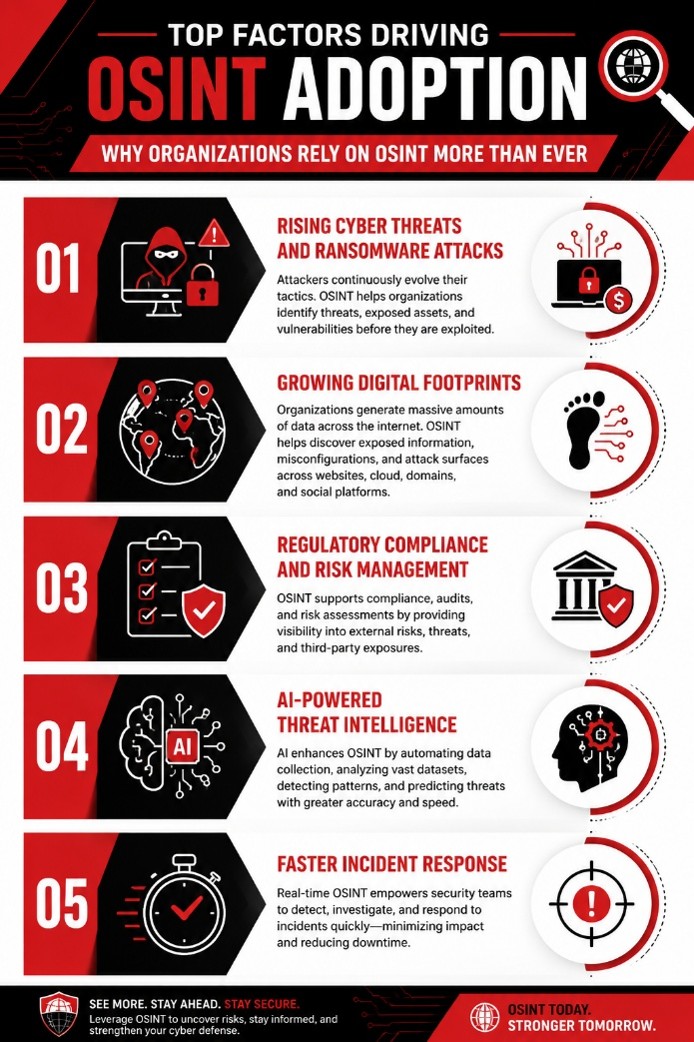
Some of the biggest factors driving OSINT adoption include:
- Rising cyber threats and ransomware attacks
- Growing digital footprints
- Regulatory compliance and risk management
- AI-powered threat intelligence
- Faster incident response
From Fortune 500 enterprises to government agencies, OSINT has become an essential component of modern cyber defense strategies.
Top 15 OSINT Tools Comparison
| Tool | Best For | Pricing | Skill Level |
| Cyble ODIN | Attack Surface Management | Enterprise | Intermediate |
| Maltego | Link Analysis | Free & Paid | Intermediate |
| Shodan | Internet Asset Discovery | Freemium | Beginner |
| TheHarvester | Email & Domain Recon | Free | Beginner |
| Recon-ng | Automated Reconnaissance | Free | Advanced |
| Censys | Internet-wide Asset Discovery | Freemium | Intermediate |
| SpiderFoot | Automated OSINT | Free & Paid | Intermediate |
| OSINT Framework | Finding OSINT Resources | Free | Beginner |
| Cyble Vision Indicator Search | IOC Intelligence | Enterprise | Intermediate |
| ExifTool / FOCA | Metadata Analysis | Free | Beginner |
| Google Dorking | Advanced Search | Free | Beginner |
| Social Searcher | Social Media Intelligence | Freemium | Beginner |
| DataSploit | Multi-source Intelligence | Free | Advanced |
| AmIBreached Search | Breach Monitoring | Enterprise | Beginner |
| Wayback Machine | Historical Website Analysis | Free | Beginner |
Top 15 Best OSINT Tools
1. Cyble ODIN
Cyble ODIN is an advanced internet asset search engine built for cybersecurity teams. It helps organizations discover exposed assets, vulnerable services, subdomains, IP addresses, and cloud resources before attackers exploit them.
Unlike traditional reconnaissance platforms, Cyble ODIN provides enriched intelligence that supports proactive threat hunting and external attack surface management.
Best for: Enterprise security teams and ASM.
2. Maltego
Maltego is among the best OSINT tools for relationship mapping and investigative analysis. It visually connects people, domains, organizations, email addresses, IPs, and social media accounts through interactive graphs.
Security analysts, investigators, and law enforcement agencies rely on Maltego to uncover hidden relationships across complex datasets.
Best for: Threat intelligence and digital investigations.
3. Shodan
Often called the “Google for Internet-connected devices,” Shodan indexes servers, webcams, routers, industrial control systems, and IoT devices connected to the internet.
Security professionals use Shodan to identify exposed services, open ports, outdated software, and vulnerable infrastructure before attackers can exploit them.
Its ease of use makes it one of the best OSINT tools for infrastructure discovery.
Best for: Internet-facing asset discovery.
4. TheHarvester
TheHarvester is a lightweight reconnaissance tool that collects publicly available information about domains, email addresses, hostnames, and subdomains.
It gathers data from multiple search engines and public sources, making it highly useful during penetration testing and external reconnaissance.
Best for: Initial reconnaissance.
5. Recon-ng
Recon-ng is a modular web reconnaissance framework that automates OSINT collection using multiple APIs and data sources.
With built-in modules, analysts can gather WHOIS information, DNS records, employee details, breach data, and social media intelligence from a single interface.
Its flexibility makes Recon-ng one of the best OSINT tools for experienced penetration testers.
Best for: Automated reconnaissance.
6. Censys
Censys continuously scans internet-facing assets and maintains a searchable database of hosts, certificates, ports, and services.
Security teams use it to discover exposed servers, validate SSL certificates, and monitor changes across internet infrastructure.
Best for: Internet asset visibility.
7. SpiderFoot
SpiderFoot automates intelligence gathering by collecting information from more than 200 public data sources.
It can investigate domains, IP addresses, email accounts, usernames, phone numbers, and network infrastructure while generating detailed reports.
SpiderFoot is now owned by Intel471, adding enterprise-grade capabilities while maintaining its popularity among security professionals.
Best for: Automated investigations.
8. OSINT Framework
The OSINT Framework isn’t a scanning tool itself. Instead, it serves as a directory that categorizes hundreds of open-source intelligence resources based on investigation type.
Whether you’re researching social media, domains, malware, public records, cryptocurrencies, or breach databases, the framework helps you quickly locate the right tool.
It remains one of the best OSINT tools for beginners starting their OSINT journey.
Best for: Finding specialized OSINT resources.
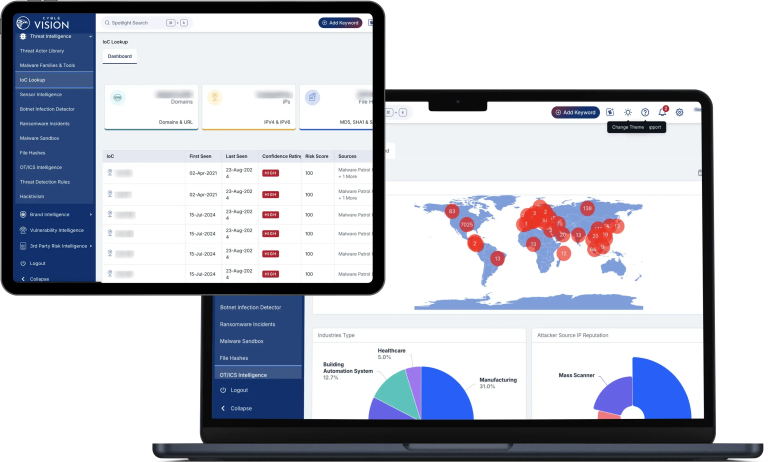
9. Cyble Vision Indicator Search
Cyble Vision Indicator Search is a browser-based OSINT tool designed to identify Indicators of Compromise (IoCs) directly from webpages. It automatically detects malicious IP addresses, domains, URLs, hashes, and other threat indicators, providing additional context to help analysts investigate incidents faster.
The tool also allows security teams to export intelligence in formats such as JSON, CSV, TXT, STIX 1.x, and STIX 2.1, making it easy to integrate with existing threat intelligence workflows and security platforms.
Best for: Threat intelligence analysts and Security Operations Centers (SOCs).
10. ExifTool and FOCA
Metadata often reveals more information than users realize. Documents, images, PDFs, and Office files can contain hidden details such as usernames, GPS coordinates, software versions, device information, and timestamps.
ExifTool and FOCA help investigators extract this metadata to identify potential security risks or gather investigative evidence. Security teams also use these tools to identify accidental data exposure before sensitive files become public.
Best for: Metadata analysis and digital forensics.
11. Google Dorking
Google Dorking is one of the simplest yet most effective OSINT techniques. Using advanced Google search operators, analysts can discover publicly indexed files, login portals, exposed documents, configuration files, and other sensitive information that organizations may have unintentionally exposed.
When used responsibly during security assessments, Google Dorking helps identify information leaks before attackers can exploit them.
Best for: Public information discovery and reconnaissance.
12. Social Searcher
Social media platforms contain enormous amounts of publicly available information. Social Searcher enables investigators to monitor conversations, hashtags, user profiles, brand mentions, and public posts across multiple social networks.
Organizations use the platform for brand monitoring, misinformation tracking, executive protection, and threat intelligence investigations.
Best for: Social media intelligence (SOCMINT).
13. DataSploit
DataSploit is an open-source intelligence framework that gathers information from multiple online sources through automation. It collects data related to domains, IP addresses, email accounts, usernames, social media profiles, and breach databases.
Its modular architecture allows analysts to automate repetitive reconnaissance tasks, making investigations significantly faster than manual research.
Best for: Automated OSINT investigations.
14. AmIBreached Search
Credential theft remains one of the biggest cybersecurity risks. AmIBreached Search helps organizations determine whether employee or customer credentials have appeared in publicly available breach datasets or dark web marketplaces.
Continuous monitoring enables security teams to respond quickly by resetting compromised credentials and reducing the risk of account takeover attacks.
Best for: Credential exposure monitoring.
15. Wayback Machine
The Wayback Machine archives historical versions of websites, allowing investigators to analyze how websites have changed over time.
Security professionals frequently use it to recover deleted content, review historical infrastructure, investigate phishing campaigns, or identify previously exposed sensitive information that may still be accessible through archived pages.
Best for: Historical website investigations.
How to Choose the Best OSINT Tool
Not every investigation requires the same OSINT platform. The best OSINT tools vary depending on your objectives, technical expertise, and security requirements.
| Requirement | Recommended Tool |
| Internet asset discovery | Shodan, Censys, Cyble ODIN |
| Threat intelligence | Cyble Vision Indicator Search, Maltego |
| Penetration testing | Recon-ng, TheHarvester |
| Metadata analysis | ExifTool, FOCA |
| Social media investigations | Social Searcher |
| Credential monitoring | AmIBreached Search |
| Historical research | Wayback Machine |
| Beginners | OSINT Framework |
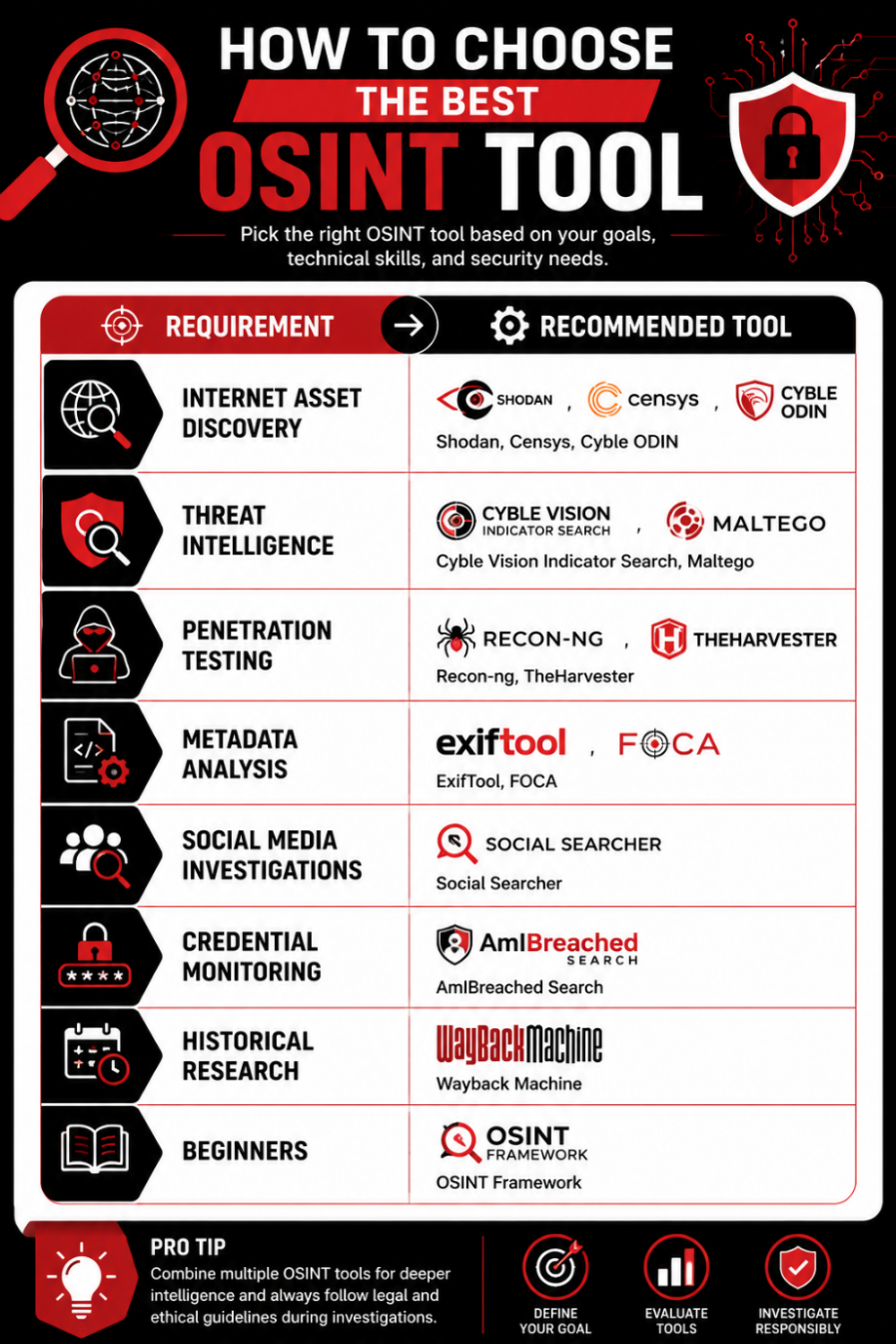
selecting an OSINT platform, consider factors such as automation capabilities, supported data sources, ease of use, reporting features, integration with security tools, and scalability. Enterprise organizations may also require API access, SIEM integration, and continuous monitoring features.
How AI is Transforming OSINT
Artificial intelligence is rapidly changing how intelligence gathering is performed. Traditional OSINT investigations often require analysts to manually correlate information from websites, DNS records, social media, breach databases, and public repositories. AI significantly reduces this effort by automating data collection, entity correlation, relationship mapping, and threat prioritization.
This transformation is already underway. Many of today’s best OSINT tools now include AI-powered capabilities that identify hidden relationships, detect anomalies, enrich threat intelligence, and prioritize high-risk findings. As organizations continue expanding their digital footprint, AI will play an increasingly important role in helping analysts process massive volumes of public data and uncover threats faster.
Conclusion
As cyber threats continue to evolve, investing in the best OSINT tools is no longer optional for security teams, investigators, or businesses seeking stronger cyber resilience.
Whether you need internet-wide asset discovery with Shodan, relationship mapping through Maltego, automated reconnaissance using Recon-ng, or enterprise-grade threat intelligence from Cyble ODIN and Cyble Vision, selecting the right OSINT solution depends on your specific use case and operational requirements.
With the OSINT market expected to surpass USD 133.6 billion by 2035, organizations that embrace AI-powered intelligence gathering and continuous monitoring will be better equipped to stay ahead of emerging cyber threats.
Frequently Asked Question (FAQs) about OSINT tools
What are OSINT tools?
OSINT tools are software applications designed to help professionals gather intelligence from publicly available data. They are used to collect information from sources like websites, social media, and public records, which is crucial for cybersecurity, threat assessment, and investigations.
How do OSINT tools help with cybersecurity?
OSINT tools assist cybersecurity teams by identifying publicly available information that could expose vulnerabilities. By scanning for exposed data, unpatched systems, or metadata leaks, OSINT tools help security teams assess risks and strengthen their defense against potential threats.
What is the OSINT framework?
The OSINT framework is a structured approach for organizing and utilizing free OSINT tools. It provides a categorized list of tools that can help professionals gather intelligence efficiently, making it easier to focus on the right resources for specific security and intelligence tasks.
What is the difference between OSINT and threat intelligence?
OSINT refers to collecting intelligence from publicly available sources, while threat intelligence involves analyzing information from multiple sources, including OSINT, commercial feeds, malware analysis, and internal telemetry, to identify and mitigate cyber threats.
Why is balancing OSINT with OPSEC important?
Balancing OSINT with OPSEC (Operational Security) is crucial to avoid inadvertently exposing sensitive organizational data. While OSINT tools help gather intelligence, OPSEC ensures that organizations protect their own information from being exploited by malicious actors.
What are OSINT virtual tools?
OSINT virtual tools are online platforms that help gather and analyze publicly available data from the internet for intelligence purposes, such as cybersecurity and investigations.
What are the three types of OSINT?
Human OSINT, Technical OSINT, and Geospatial OSINT.Which are the best OSINT tools?
Some of the best OSINT tools include Cyble ODIN, Maltego, Shodan, Censys, SpiderFoot, Recon-ng, TheHarvester, OSINT Framework, DataSploit, and Wayback Machine.
Are OSINT tools legal?
Yes. OSINT tools are legal when they collect information from publicly accessible sources and are used in compliance with applicable laws, privacy regulations, and platform terms of service.
Who uses OSINT tools?
OSINT tools are widely used by cybersecurity professionals, SOC analysts, penetration testers, threat intelligence teams, law enforcement agencies, journalists, fraud investigators, and businesses for security and research purposes.
How is AI improving OSINT?
AI automates data collection, entity resolution, relationship mapping, anomaly detection, and threat prioritization. This enables analysts to process larger datasets more efficiently and uncover actionable intelligence faster.
What factors should I consider when choosing an OSINT tool?
When selecting an OSINT tool, evaluate its supported data sources, automation capabilities, ease of use, reporting features, AI capabilities, integrations, scalability, and whether it meets your investigation or cybersecurity requirements.